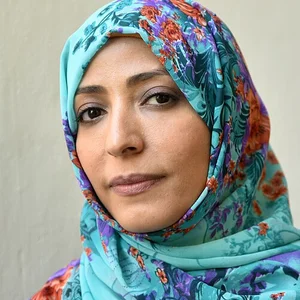

Yemeni journalist, human rights activist, and politician, a leading figure of the 2011 uprising against Saleh's regime. In 2011, she became the first Arab woman and the youngest laureate at the time to receive the Nobel Peace Prize.
Tawakkol Karman(1979 — ?)
Tawakkol Karman
Yémen
6 min read
Frequently asked questions
Key Facts
- Born on February 7, 1979, in Mekhlaf, in the Taiz Governorate of Yemen.
- Founded the organization “Women Journalists Without Chains” in 2005 to defend freedom of the press.
- Became a major figure of the Yemeni uprising in 2011, nicknamed the “Mother of the Revolution.”
- Received the Nobel Peace Prize in 2011, shared with Ellen Johnson Sirleaf and Leymah Gbowee, the first Arab woman to be so honored.
- A member of the Islamist Al-Islah party, she advocates for non-violence and women's participation in political life.
Works & Achievements
A press freedom and human rights organization that marked the beginning of her public activism.
Weekly peaceful demonstrations in Sanaa demanding freedoms, reforms, and an end to corruption.
A leading figure of the 2011 revolution, nicknamed “the mother of the revolution” for her role in the protests against Saleh.
The first Arab woman and, at the time, the youngest laureate in the prize's history, honored for her nonviolent struggle.
A landmark speech in which she defended democracy, women's rights, and nonviolence in the name of the Arab Spring.
A humanitarian and educational foundation supporting freedom, human rights, and aid to victims of the war in Yemen.
She joined the independent body tasked with arbitrating the social network's moderation decisions, extending her fight for freedom of expression.
Anecdotes
Around 2004, during a human rights conference, Tawakkol Karman publicly removed her niqab, keeping only a colorful headscarf, declaring that covering women's faces was a matter of custom and not of Islam. She then called on Yemenis to do the same so that women could fully take part in public life, which caused an uproar in a deeply conservative society.
On the night of 22 to 23 January 2011, in the midst of the uprising, she was arrested in Sanaa by regime forces. The news triggered such a wave of anger and protests that she was released in less than 36 hours: far from silencing her, her arrest set the Yemeni protest movement ablaze.
Protesters nicknamed her “the mother of the revolution” and “the iron woman.” In October 2011, at only 32 years old, she became the first Arab woman to receive the Nobel Peace Prize and, at the time, the youngest laureate in the history of the prize (a record broken in 2014 by Malala Yousafzai).
When a journalist called her in the middle of the night to tell her she had won the Nobel Prize, she was in a simple canvas tent on “Change Square,” among the protesters she had stood beside for months. She did not leave the camp even then.
The 2011 Nobel Peace Prize was awarded to her at the same time as to two Liberians, President Ellen Johnson Sirleaf and activist Leymah Gbowee: it was the first time the prize honored three women in this way for their commitment to women's rights and peace.
Primary Sources
The prize is awarded to Ellen Johnson Sirleaf, Leymah Gbowee and Tawakkol Karman for their non-violent struggle for the safety of women and for women's right to full participation in peace-building work.
I dedicate this prize to my mother, to the Yemeni woman, to all the dignified and proud women of Yemen and of the whole world, and to all those who fight for their rights and their freedom.
A solution to women's problems can only be found in a free and democratic society where human energy is set free, that of women as well as that of men, together.
Key Places
Port city in the southwest of the country where Tawakkol Karman was born in 1979.
City where she lives, works as a journalist, and wages her activist and political struggle.
Esplanade near Sanaa University, the epicenter of the 2011 uprising, which she led from her tent.
Hub of protesting youth from which the first major demonstrations she supported set out.
Place where she was awarded the Nobel Peace Prize on December 10, 2011.
Typical Objects

After removing her niqab around 2004, she adopted a brightly colored headscarf, which became the symbol of her choice to be visible and active in public life.

On “Change Square,” she lived for weeks in a canvas tent among the protesters, making the encampment the heart of the uprising.

To rally the crowds and set the rhythm of the demonstrations, she used a megaphone, which became one of her trademarks as a leader.

A journalist by training, she documented the abuses of those in power; her press card is a reminder that her struggle was born from defending the freedom to inform.

Facebook, Twitter, and text messages helped her organize protests, bypass censorship, and alert media around the world.

Held up by the protesters she led, they demanded Saleh's resignation, democracy, and women's rights.

Received in Oslo in December 2011, it gave international recognition to her nonviolent struggle and that of the women of the Arab Spring.
School Curriculum
Vocabulary & Tags
Key Vocabulary
Tags
Daily Life
Morning
During the uprising, Tawakkol Karman rises early, performs the dawn prayer and takes care of her three children before heading to **Change Square**. The morning is devoted to coordinating the protesters and checking on the night's news.
Afternoon
In the afternoon, she takes up her work as a journalist again: she gathers testimonies, drafts statements and gives interviews to international media to make the Yemeni situation known.
Evening
In the evening, she gives speeches, leads meetings with other activists and posts on social media. She often spends the night in a tent, on the square, among the protesters.
Food
Her diet remains that of Yemeni cuisine: flatbread, fava beans (*foul*), rice, the national dish *salta* and sweet tea. At the camp, meals are frugal and shared among the protesters.
Clothing
She wears a long *abaya* and a brightly colored hijab, ever since she gave up the niqab around **2004** to be fully visible in public spaces.
Housing
She ordinarily lives in a house in **Sanaa** with her family, but during the **2011** uprising she spent long weeks in a canvas tent, in the middle of the encampment on Change Square.
Historical Timeline
Period Vocabulary
Liens externes & ressources
Références
Œuvres
Fondation de « Femmes journalistes sans chaînes »
2005
Organisation des sit-in de la place de la Liberté
2007–2011
Direction du soulèvement yéménite
2011
Prix Nobel de la paix
2011
Conférence Nobel d'Oslo
10 décembre 2011
Fondation Tawakkol Karman
2013
Conseil de surveillance de Meta (Facebook)
2020