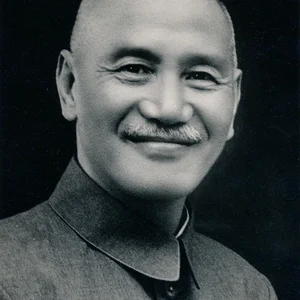

Chinese military leader and statesman, head of the Kuomintang (Nationalist Party) after the death of Sun Yat-sen. Defeated by Mao Zedong's communists in 1949, he withdrew to the island of Taiwan, where he led the Republic of China until his death.
Chiang Kai-shek(1887 — 1975)
Chiang Kai-shek
Taïwan, dynastie Qing
6 min read
Frequently asked questions
Key Facts
- 1925: takes the lead of the Kuomintang after the death of Sun Yat-sen
- 1926-1928: leads the Northern Expedition, which reunifies much of China
- 1937-1945: directs the Chinese resistance against the Japanese invasion during the Second Sino-Japanese War
- 1949: defeated by Mao's communists, he takes refuge in Taiwan
- 1949-1975: presides over the Republic of China in Taiwan until his death
Works & Achievements
By training the corps of Nationalist officers, Chiang Kai-shek built the military instrument that secured his power and enabled him to reunify China.
Military campaign against the warlords that led to the nominal reunification of China under the Nationalist government in Nanjing.
Chiang Kai-shek set up a centralized regime that attempted to modernize China, despite corruption and internal divisions.
He led the Chinese resistance against Japan, tying down a significant portion of the Japanese army on the Asian theater.
Recognition of China as a major Allied power; securing the promise that territories conquered by Japan would be returned.
A work setting out his nationalist and anti-imperialist vision for China's future, widely circulated as a propaganda text.
After his defeat, he transformed Taiwan into an anti-Communist stronghold backed by the United States, laying the foundations for the island's future economic rise.
Anecdotes
In December 1936, during the *Xi'an Incident*, **Chiang Kai-shek** was kidnapped by his own generals, who demanded that he end the civil war against the Communists in order to fight Japan. Held prisoner for nearly two weeks, he eventually agreed to a united front with his Maoist enemies.
His second wife, **Soong May-ling** (Madame Chiang Kai-shek), perfectly fluent in English and educated in the United States, played a major diplomatic role: in **1943**, she became the first Chinese person and one of the few women ever to address both houses of the American Congress, seeking support for China.
Converted to Methodist Christianity in **1930**, partly under the influence of his Soong in-laws, **Chiang Kai-shek** read the Bible every day and kept a personal diary throughout his life — a precious document studied by historians today.
After his defeat in **1949**, he had a large part of the imperial treasures of the Forbidden City transferred to Taiwan. These works of art now form the heart of the collections at the National Palace Museum in Taipei.
In **1943**, **Chiang Kai-shek** took part in the Cairo Conference alongside **Roosevelt** and **Churchill**, a sign that China was recognized as one of the great Allied powers of the Second World War, despite its real military weakness.
Primary Sources
The Three Great Allies are fighting this war to restrain and punish the aggression of Japan... It is their purpose that Japan shall be stripped of all the territories she has stolen from the Chinese, such as Manchuria, Formosa, and the Pescadores, shall be restored to the Republic of China.
Without the Kuomintang, there would be no China. The destiny of the nation and that of the party are inseparable.
I must purify and discipline myself each day, for the shame of the nation rests upon my shoulders.
We shall reconquer the mainland. The Republic of China will never die so long as a single one of its faithful remains.
Key Places
Birthplace of Chiang Kai-shek, where he returned several times and kept the family home. A place of memory recalling his modest origins as salt merchants.
Capital of the Nationalist government from 1928 onward, the center of Chiang Kai-shek's power before the war and the scene of the Japanese massacre of 1937.
School founded in 1924 of which Chiang Kai-shek was the first commandant; it trained the corps of Nationalist officers and established his military authority.
Site of the December 1936 incident in which Chiang Kai-shek was kidnapped by his own generals and forced to accept a united front with the Communists against Japan.
Provisional capital of the Nationalist government during the Sino-Japanese War, after the evacuation of Nanjing and the loss of the major coastal cities.
Seat of the Republic of China after the retreat of 1949; Chiang Kai-shek led the island from there until his death in 1975. The memorial dedicated to him still draws visitors today.
Typical Objects

Chiang Kai-shek almost always appeared in a plain uniform, without ostentatious decorations, asserting his identity as a military leader. This disciplined image was at the heart of his propaganda.

A symbol of command and military honor, the ceremonial sword accompanied the Nationalist officers trained on the model of the Whampoa Military Academy, which Chiang Kai-shek headed.

The Kuomintang's “Blue Sky, White Sun, and a Wholly Red Earth” flag became the national emblem. Kept in Taiwan after 1949, it symbolizes the claimed continuity of the Republic of China.

Chiang Kai-shek kept a daily diary for more than half a century, in which he recorded political reflections, prayers, and self-criticisms. These notebooks are now a leading historical source.

Having converted to Protestantism in 1930, Chiang Kai-shek read the Bible daily, a practice that nurtured his image as a rigorous man and brought him closer to his American allies.

During the retreat to Taiwan, thousands of imperial artworks were evacuated from the mainland. Today they make up the collections of the National Palace Museum in Taipei.
School Curriculum
Vocabulary & Tags
Key Vocabulary
Daily Life
Morning
Chiang Kai-shek rose early, often before dawn, faithful to an almost military discipline. He began with meditation, prayer, and Bible reading, then recorded his thoughts in his private diary before receiving his first reports.
Afternoon
His afternoons were devoted to affairs of state and the army: meetings with officers and ministers, study of military maps, and strategic decisions. In wartime, he frequently inspected the troops and the front lines.
Evening
In the evening, he often continued his reading and the writing of his diary, and dined with his wife Soong May-ling, who served as an adviser and interpreter. He went to bed early, avoiding alcohol and excess.
Food
Of humble origins, he enjoyed simple, frugal Chinese cuisine, preferring rice, vegetables, and tea to feasts. He avoided alcohol and tobacco, out of concern for discipline and health.
Clothing
He most often wore a plain military uniform and cap, the image of the disciplined leader. In civilian or diplomatic settings, he might don the traditional long Chinese robe or a Western suit.
Housing
He lived in official residences in Nanjing, then in Chongqing during the war, and finally in guarded estates in Taiwan. He also maintained an attachment to the family home in his native village of Xikou.
Historical Timeline
Period Vocabulary
Liens externes & ressources
Références
Œuvres
Direction de l'Académie militaire de Whampoa
1924
Expédition du Nord
1926-1928
Mise en place du gouvernement nationaliste de Nankin
1928
Front uni et résistance à l'invasion japonaise
1937-1945
Participation à la conférence du Caire
1943
China's Destiny (La Destinée de la Chine)
1943
Fondation de la République de Chine à Taïwan
1949-1975