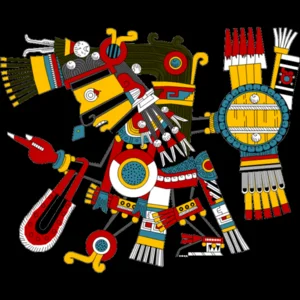

Tezcatlipoca, "Smoking Mirror," is one of the major deities of the Aztec pantheon. God of the night, the starry sky, sorcery, and fate, he is the eternal rival of Quetzalcóatl. His emblematic attribute is an obsidian mirror in which he reads the thoughts of men.
Tezcatlipoca
Tezcatlipoca
8 min read
Frequently asked questions
Key Facts
- Tezcatlipoca means "Smoking Mirror" in Nahuatl, a reference to his obsidian divination mirror
- He is one of the four sons of Ometecuhtli, the supreme god of duality in Aztec cosmogony
- His rival Quetzalcóatl is said to have driven him out of the paradise of Tamoanchan, triggering the fall of humanity across several cosmic cycles
- He is associated with the constellation Ursa Major and the North Star, symbols of eternal night
- During the Toxcatl festival, a young man would represent him for a year before being sacrificed in his honor
Works & Achievements
Together with Quetzalcóatl, Tezcatlipoca is co-creator of the universe, the earth, and humankind. He rules over the first sun before being overthrown, setting in motion the cycle of destructions and re-creations that defines the Aztec cosmos.
A major religious ceremony in which a young man would spend a full year living as the embodiment of Tezcatlipoca before being sacrificed. Anthropologists regard this rite as one of the most elaborate in the pre-Columbian world.
A ritual chant sung during ceremonies in his honor, recorded by Sahagún. The hymn invokes him as "lord of the night" and "he whose slaves we all are," reflecting the profound dread he inspired.
A pre-Columbian pictographic manuscript containing the richest representations of Tezcatlipoca: his divine attributes, his ritual calendar, his conflicts with other gods, and his animal manifestations.
A central mythological narrative in which Tezcatlipoca ensnares Quetzalcóatl using his mirror and pulque, bringing about the downfall of the ideal city. Recorded in the *Anales de Cuauhtitlan* and Sahagún's Florentine Codex.
Anecdotes
Each year, during the Toxcatl festival (fifth month of the Aztec calendar), a young man of perfect beauty was chosen to embody Tezcatlipoca for twelve full months. He was given four wives, music, feasts, and all divine honors. At the end of the year, he himself climbed the steps of the temple, solemnly breaking his reed flutes, before being sacrificed — a sign that even perfection is fleeting.
According to myth, Tezcatlipoca used his obsidian mirror to set a trap for his rival Quetzalcóatl. He showed him his own aged and disfigured face reflected in the mirror, then pushed him to drink pulque (maguey liquor). Drunk and ashamed, Quetzalcóatl committed unforgivable wrongs and was forced to flee the city of Tollan, leaving the field clear for his enemy.
During the creation of the world, Tezcatlipoca served as bait to lure the earth monster Cipactli, a primordial crocodilian creature floating in the primordial waters. He plunged his foot into the water to attract it, and Cipactli bit it clean off with a snap of its jaws. This is why Tezcatlipoca is often depicted with a leg ending in a smoking mirror or a serpent in place of his foot.
Tezcatlipoca was nicknamed Titlacauan, 'We are his slaves,' because the Aztecs believed he could read the thoughts of every human being through his obsidian mirror. No one could hide their sins or secret desires from him. Priests considered him omniscient, capable of simultaneously seeing the past, present, and future of every mortal.
Tezcatlipoca and Quetzalcóatl, originally allied as co-creators, became cosmic rivals who fought over power across successive suns. According to the myth of the Five Suns, Tezcatlipoca was the first sun (Nahui Ocelotl, the Jaguar Sun), before being overthrown. Each destruction of a sun brought about the annihilation of humanity, until the current sun was created through the collective self-sacrifice of the gods.
Primary Sources
This pre-Columbian pictographic manuscript, made on animal skin, abundantly depicts Tezcatlipoca with his smoking mirror, his black skin, and his serpent foot. It stands as one of the richest iconographic sources on the deities of the Mesoamerican pantheon.
Titlacauan, Tezcatlipoca, Yaotle — he is everywhere and nowhere, in the sky, on earth and beneath the earth. He bestows wealth, valor, honors and dignity, and takes them back whenever he pleases. He is shadow, he is night.
And thus was the first sun: its calendrical sign was Four-Jaguar. This sun was called the Sun of the Jaguar. Tezcatlipoca dwelt within it. The sky moved, there was no sun. This sun lasted six hundred and sixteen years.
And Tezcatlipoca said to Quetzalcóatl: Come and behold your body in the mirror. Quetzalcóatl looked and was seized with dread. He said: If my vassals were to see me like this, they would flee.
O master, O night, O wind — thus did the elders call you. You are everywhere, you mock us. We, your servants, are your playthings, your small creatures.
Key Places
Capital of the Aztec Empire and the main center of Tezcatlipoca's cult. His temple stood within the sacred precinct of the Templo Mayor, the stage for the great ceremonies of Toxcatl.
The mythic Toltec city where Tezcatlipoca is said to have defeated Quetzalcóatl through trickery, bringing about the fall of that legendary city. The archaeological site of Tula is identified with this Tollan of the ancient narratives.
The primordial Aztec paradise where the gods gathered to deliberate over the creation of humanity. Tezcatlipoca played a central role in the divine councils that decided the fate of humankind.
The great twin temple of Tenochtitlan where sacrifices were performed during the Toxcatl festival. Archaeological excavations conducted since 1978 have uncovered concrete evidence of the rituals dedicated to Tezcatlipoca.
A major cultural center of the Aztec Triple Alliance, where hymns and myths related to Tezcatlipoca were taught in the *calmecac* (priestly schools) and passed down from generation to generation.
Typical Objects

Tezcatlipoca's emblematic attribute: a mirror of polished obsidian stone in which he reads the thoughts, sins, and fate of every human being. His very name means 'Smoking Mirror'.

Having lost a foot during the creation of the world — torn off by the monster Cipactli — Tezcatlipoca is depicted with one foot replaced by a smoking mirror or a serpent's head, a symbol of his founding mutilation.

A sacred animal associated with the night and martial power, the jaguar is Tezcatlipoca's animal alter ego (nahualli). Priests wore jaguar skins during the Toxcatl ceremonies.

Tezcatlipoca is depicted with his body painted black (the color of night and sorcery), streaked with yellow bands. This paint distinguished his priests and the young men who embodied him during the sacred year.

The ixiptla played the flute throughout the year to announce his divine presence in the streets of Tenochtitlan. The solemn breaking of these flutes as he climbed the temple steps signaled the imminence of the sacrifice.

A ritual weapon used during sacrifices offered to Tezcatlipoca, the obsidian knife also symbolized the god's sharp and absolute power over human destinies.

Tezcatlipoca rules the night sky and the stars. His ritual shield bore stellar motifs, recalling his sovereignty over the night and his role as guardian of the dark cosmos.
School Curriculum
Vocabulary & Tags
Key Vocabulary
Tags
Daily Life
Morning
At sunrise, the priests of Tezcatlipoca performed purification rites: ritual baths, offerings of copal (sacred resin incense), and prayers directed toward the east. The ixiptla, the living incarnation of the god, was bathed, adorned with divine ornaments, and fed by devoted servants at dawn, treated as a deity in flesh and blood.
Afternoon
In the calmecac (priestly schools), afternoons were devoted to teaching sacred hymns, calendars, and myths related to Tezcatlipoca. The ixiptla walked through the streets of Tenochtitlan playing the flute, acclaimed by the population as the visible manifestation of the god of night.
Evening
Night was the absolute domain of Tezcatlipoca: priests kept vigil, burned copal, and chanted hymns to honor him in the darkness. It was believed that he roamed the shadows in the form of a jaguar or a headless giant (the Yohualtepochtli), testing the courage of travelers lost in the night.
Food
The ixiptla received the finest dishes of Aztec cuisine: stuffed tamales, xocolatl (spiced chocolate beaten with vanilla), turkey and game meats, rare vegetables and fruits. These food offerings symbolized the abundance that Tezcatlipoca could bestow or withdraw at his will.
Clothing
Depictions of Tezcatlipoca show him dressed in warrior and divine attire: loincloths adorned with black feathers, golden sandals, an elaborate headdress, and jewelry of gold and obsidian. The ixiptla wore these same ornaments throughout the year, a visible testament to divine magnificence in the city's streets.
Housing
Tezcatlipoca was venerated in a dedicated temple within the sacred precinct of Tenochtitlan, adorned with sculptures of jaguars and skulls. The ixiptla lived in a sumptuous palace with four wives chosen from among the most distinguished young women of the empire, until the hour of sacrifice.
Historical Timeline
Period Vocabulary
Liens externes & ressources
Références
Œuvres
Création du monde (cosmogonie des Cinq Soleils)
Temps mythique
Fête de Toxcatl — rite de l'ixiptla
Annuel, Ve mois du calendrier aztèque (xiuhpohualli)
Hymne à Tezcatlipoca (Tezcatlipoca icuic)
Avant 1519, compilé vers 1547
Représentations dans le Codex Borgia
Avant 1519
Mythe de la chute de Quetzalcóatl à Tollan
Tradition orale, compilée au XVIe siècle