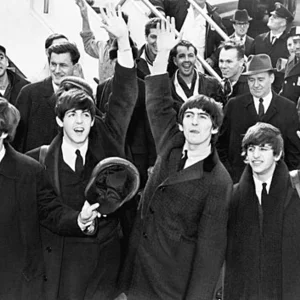

Paul McCartney is a British songwriter, singer and bassist, co-founder of the Beatles. With John Lennon, he formed one of the most influential songwriting duos of the 20th century, before pursuing a solo career and going on with the band Wings.
The Beatles (Paul McCartney)
Sir James Paul McCartney
4 min read
Frequently asked questions
Famous Quotes
« And in the end, the love you take is equal to the love you make.»
Key Facts
- 1942: born in Liverpool on 18 June
- 1960: co-founded the Beatles with John Lennon, George Harrison and Ringo Starr
- 1963-1970: the Beatles' era of worldwide fame (Beatlemania)
- 1970: the Beatles split up and he began his solo career, then founded the band Wings
- 1997: knighted by Queen Elizabeth II (Sir Paul McCartney)
Works & Achievements
The Beatles' first album, recorded in a single day, which launched their success in the United Kingdom.
A ballad written by McCartney, one of the most covered songs in the history of music.
A revolutionary concept album, considered a major milestone in the history of pop.
The Beatles' penultimate album, famous for its cover and its closing medley.
A song and album marking the end of the Beatles' shared career.
A hit album by his band Wings, which confirmed his career after the Beatles.
A single written by McCartney to comfort John Lennon's son, which became a worldwide anthem.
Anecdotes
Paul McCartney is said to have composed the melody of "Yesterday" in a dream: when he woke up in 1964, he rushed to the piano to play it, convinced he had heard it somewhere else. For weeks, he kept asking people around him to make sure he wasn't plagiarizing anyone. The song is today one of the most covered in history.
Left-handed, McCartney plays the bass upside down: he had a Höfner "violin" guitar modified so he could play it with his left hand. This instrument became so iconic of the Beatles that it is nicknamed the "Beatle bass."
In 1965, the Beatles, including McCartney, were made Members of the Order of the British Empire (MBE) by Queen Elizabeth II, which shocked some former servicemen who returned their own medals in protest.
A persistent rumor born in 1969, dubbed "Paul is dead," claimed that McCartney had died and been replaced by a look-alike. Fans saw hidden "clues" on album covers, such as the fact that he walks barefoot on the cover of Abbey Road.
In 1976, during a tour with his band Wings, McCartney long refused to play the Beatles' songs again, wanting to prove that he could succeed in a new career without leaning on his glorious past.
Primary Sources
“I've taken drugs. But I don't think it's the answer to everything.”
“We're going to stay together as long as it's fun for us.”
“It's a great honour. I'm thrilled, and I regard it as a tribute to everyone I've worked with.”
Key Places
Birthplace of Paul McCartney, an industrial port where the Beatles formed.
Studios where the Beatles recorded most of their albums and carried out their sonic experiments.
Underground club where the Beatles performed hundreds of times in the early 1960s.
City where the Beatles honed their stage act during long club residencies in 1960-1962.
Places of remembrance linked to the Beatles; Liverpool's museums preserve objects and memorabilia of the group.
Typical Objects

Violin-shaped bass guitar, modified for a left-handed player, which became McCartney's signature instrument. It is nicknamed the "Beatle bass".

The medium on which the Beatles' albums were released, listened to all over the world. The sleeve became an artistic object in its own right.

Bass used by McCartney from 1965 onward, with a more powerful sound, for the Beatles' studio-era albums.

Honorary distinction awarded to the Beatles by the Queen in 1965, a sign of their official recognition.

A recording device that allows several sounds to be layered, used at Abbey Road Studios for groundbreaking sonic experiments.
School Curriculum
Vocabulary & Tags
Key Vocabulary
Tags
Daily Life
Morning
At the height of Beatlemania, mornings were often disrupted by fans gathered outside his London home. McCartney sometimes got up late after nights spent in the studio or in concert.
Afternoon
Afternoons were devoted to rehearsals, photo shoots, interviews, or songwriting, often in collaboration with John Lennon. Touring periods involved a great deal of travel.
Evening
Evenings were spent performing in concert before screaming crowds, or later, after touring stopped in 1966, in long nighttime recording sessions at Abbey Road Studios.
Food
A Briton of the 1960s, McCartney ate the typical food of the era; he would later become, alongside his wife Linda, a well-known advocate of vegetarianism.
Clothing
At first, the Beatles wore matching suits and the “mop-top” haircuts imposed by their manager. From 1967 onward, they adopted colorful, psychedelic outfits.
Housing
Born into a modest Liverpool background, McCartney settled in London during the Beatles years, then acquired several properties and a farm in Scotland where he took refuge after the band broke up.