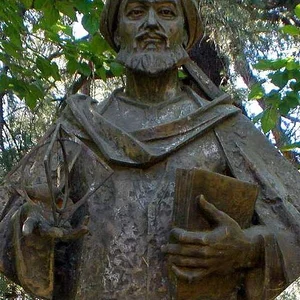
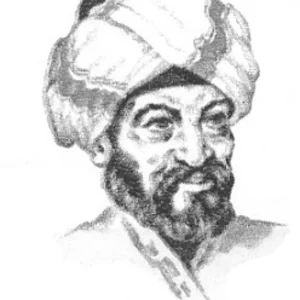
A 14th-century Byzantine astronomer and mathematician, a scholar and ecclesiastical dignitary in Constantinople. He is the author of a vast treatise on astronomy that synthesizes the Greek, Persian, and Latin traditions.
Theodore Meliteniotes
Theodore Meliteniotes
5 min read
Frequently asked questions
Key Facts
- Lived in the 14th century (died around 1393) in the Byzantine Empire.
- Around 1352 he wrote the Astronomy in three books (Tribiblos / Astronomike Tribiblos), a vast astronomical compilation.
- His work synthesizes the Greek (Ptolemy), Persian, and Latin astronomical traditions.
- Held important positions in the Church and in teaching at Constantinople (director of the patriarchal school).
- A figure of the Byzantine scientific renaissance of the Palaiologos era.
Works & Achievements
A vast astronomical treatise in three books synthesizing Greek (Ptolemaic), Persian, and Latin methods; his major work and one of the high points of late Byzantine astronomy.
A long allegorical and didactic poem on virtue, illustrating the author's dual scientific and spiritual learning.
Studies analyzing and comparing the planetary tables that came from the East, contributing to their reception in the Greek world.
A major institutional achievement: by directing patriarchal teaching, he trained a generation of scholars and passed on ancient knowledge in a declining Byzantium.
Anecdotes
Theodore Meliteniotes ran the patriarchal school of Constantinople, one of the last great institutions of learning in the dying Byzantine Empire. While holding high ecclesiastical office, he taught astronomy, proving that in the 14th century science and Church could live under the same roof.
His major work, the *Astronomical Tribiblos* (the “book in three books”), is a monument: in it he compares and combines the Greek methods inherited from **Ptolemy**, the Persian astronomical tables brought from the East, and Latin elements coming from the West. It was a true encyclopedia of the heavens for its time.
While the Byzantine Empire was losing its provinces one after another to the Ottomans, Constantinople was paradoxically experiencing an intense “Palaiologan Renaissance.” Meliteniotes was one of those scholars who, amid the political decline, sought to preserve and pass on all of ancient knowledge.
Meliteniotes took an interest in the Persian astronomical tables, transmitted to Byzantium by scholars such as **Gregory Chioniades**, who had travelled as far as Tabriz. In this way he helped circulate calculations of the planets' positions between the Muslim East and the Greek world.
Primary Sources
Here the author announces his intention to gather into three books the science of the stars according to the Greeks, the Persians, and the Latins, so that nothing useful to the calculation of celestial motions might be lost.
A long didactic poem in verse, in which the narrator wanders through an allegorical garden evoking the virtues, bearing witness to the author's twofold scientific and religious learning.
Key Places
Capital of the Byzantine Empire and intellectual center where Meliteniotes lived, taught, and held his ecclesiastical offices. The heart of the Palaiologan renaissance.
Institution of higher learning attached to the patriarchate, of which Meliteniotes was the director. Theology, rhetoric, and the sciences were taught there.
The great church of Constantinople, center of Byzantine religious life, in whose orbit ecclesiastical dignitaries such as Meliteniotes moved.
Ilkhanid capital from which, via traveling scholars, came the Persian astronomical tables that Meliteniotes studied and compared with the Greek tables.
Liens externes & ressources
Références
Œuvres
Tribiblos astronomique (Astronomikè Tribiblos)
vers 1352
Sur la Chasteté / la Tempérance (Eis tèn Sôphrosynèn)
XIVe siècle
Commentaires sur les tables astronomiques persanes
XIVe siècle
Direction de l'école patriarcale
vers 1360-1393