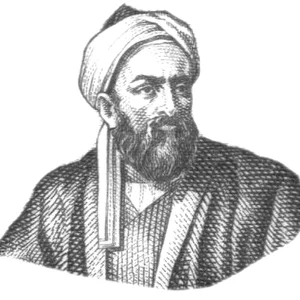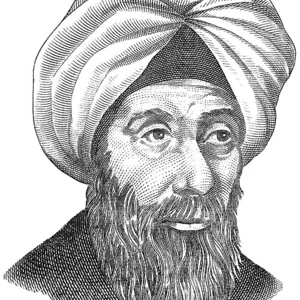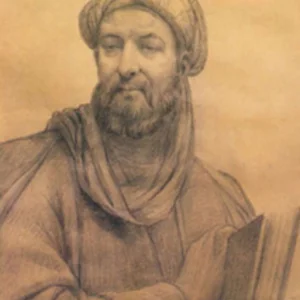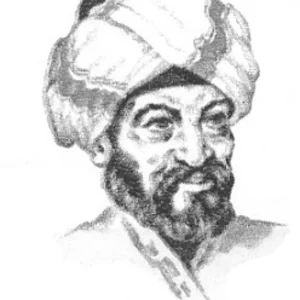

Al-Kindi is regarded as the first great philosopher to write in Arabic. A polymath of the 9th century, he worked at the House of Wisdom in Baghdad and played a major role in transmitting Greek thought to the Islamic world.
Frequently asked questions
Key Facts
- Born around 801 in Kufa and died around 873 in Baghdad
- Active at the House of Wisdom (Bayt al-Hikma) under the caliphs al-Ma'mun and al-Mu'tasim
- Supervised and corrected translations of Greek works (Aristotle, the Neoplatonists) into Arabic
- Author of more than 250 treatises spanning philosophy, mathematics, medicine, and music
- Pioneer of cryptanalysis with his frequency analysis method for deciphering messages
Works & Achievements
His major philosophical work, dedicated to the caliph al-Mu'tasim, which seeks to reconcile Greek philosophy with Islamic thought.
The oldest known treatise on cryptanalysis, which describes frequency analysis of letters, the foundation of modern decoding.
A treatise on vision and light that influenced medieval optics in Europe after its translation into Latin.
Among the first writings on music theory in Arabic, in which he studies notes, rhythms, and harmony.
A work that helped spread the Indian numeral system (the “Arabic numerals”) throughout the Islamic world.
Writings in which Al-Kindi attempts to apply mathematics to the dosage of medicines, a pioneering approach in pharmacology.
He supervised and corrected translations of Greek works, contributing to the introduction of Aristotle and Neoplatonism into Arabic thought.
Anecdotes
Al-Kindi worked at the "House of Wisdom
(Bayt al-Hikma) in Baghdad
where he supervised the translation of Greek works into Arabic. He was nicknamed
the philosopher of the Arabs" because he was the first Arabic-speaking thinker to embrace the legacy of Aristotle and Plato.
Al-Kindi wrote a treatise on cryptanalysis in which he describes the method of "frequency analysis
: counting how many times each letter appears in an encrypted message in order to decipher it. It is the oldest known text on this technique
the ancestor of modern decoding.
A universal mind, Al-Kindi wrote on subjects as varied as music, medicine, astronomy, optics and perfumes. He is credited with more than 260 treatises, although many have now been lost.
Under the caliph al-Mutawakkil, Al-Kindi fell out of favor: his library was confiscated and he is said to have been beaten. His rivals, jealous of his learning, helped push him out of the court.
Al-Kindi was one of the first to apply mathematics to medicine, seeking to quantify the effect of medicines. He also tried to measure the strength of remedies according to degrees, a pioneering approach for his time.
Primary Sources
We should not be ashamed to acknowledge truth and to assimilate it from whatever source it comes to us, even if it is brought to us by earlier generations and foreign peoples.
One way to decipher an encrypted message, if we know its language, is to find a different plaintext of the same language, long enough, and to count how many times each letter appears in it.
Al-Kindi was the most distinguished man of his time, unique in his knowledge of all the ancient sciences. He was called the philosopher of the Arabs.
Vision occurs through the rays that issue from the eye in straight lines and fall upon the object seen.
Key Places
City in Iraq where Al-Kindi was born around 801. His father was the governor there.
Major intellectual center where Al-Kindi received part of his early education before moving to Baghdad.
Abbasid capital where Al-Kindi worked at the House of Wisdom and spent most of his career. He died there around 870.
A scholarly institution where Greek, Persian, and Indian texts were translated and studied. Al-Kindi played a central role there in transmitting Greek knowledge.
Capital founded in 836 where Al-Kindi stayed as tutor to the son of Caliph al-Mu'tasim.
Typical Objects

Astronomical instrument used to measure the position of celestial bodies and determine the time. Al-Kindi wrote about its use and about astronomy.

A cut reed dipped in ink, the scholar's writing tool. Al-Kindi wrote hundreds of treatises in his own hand.

The medium for works translated from Greek and for original treatises. Paper, imported from China, was spreading throughout the Islamic world at the time.

A model of the sky made of rings representing the celestial circles, used to study the movements of the planets and stars.

A plucked string instrument on which Al-Kindi developed musical theory. He was one of the first to write about Arabic music theory.

A device used to distill substances, employed in alchemy and for making perfumes and remedies, subjects on which Al-Kindi wrote.
School Curriculum
Vocabulary & Tags
Key Vocabulary
Tags
Daily Life
Morning
Al-Kindi began his day with the dawn prayer, then made his way to the House of Wisdom. The morning was devoted to reading Greek manuscripts and supervising the translators who rendered the works of **Aristotle** and **Plato** into Arabic.
Afternoon
In the afternoon, he wrote his own treatises with the reed pen, addressing sometimes philosophy, sometimes astronomy or medicine. He also received students and discussed the scientific problems of the day with fellow scholars.
Evening
In the evening, he sometimes observed the sky for his astronomical studies or continued his experiments on optics and sound. As a courtier, he could be invited to the caliph's gatherings (*majlis*), where science and poetry were debated.
Food
The diet of a well-off scholar in **Baghdad** included bread, rice, vegetables, dates and fruit, as well as mutton or poultry. Spiced dishes and drinks sweetened with honey or fruit syrups were much enjoyed.
Clothing
Al-Kindi wore the garments of scholars and notables: a long tunic (*qamis*), a loose-fitting robe (*jubba*) and a turban (*imama*) wound around the head. Linen or cotton fabrics suited the hot climate of Iraq.
Housing
He lived in an urban dwelling in **Baghdad**, arranged around an inner courtyard to provide shelter from the heat. His house held a rich library, which was confiscated when he fell out of favor under **al-Mutawakkil**.
Historical Timeline
Period Vocabulary
Liens externes & ressources
Références
Œuvres
Fi al-Falsafa al-Ula (Sur la philosophie première)
vers 830-840
Risala fi Istikhraj al-Mu'amma (Sur le déchiffrement des messages chiffrés)
IXe siècle
De aspectibus (Traité d'optique)
IXe siècle
Risala fi al-Musiqa (Traités sur la musique)
IXe siècle
Sur l'usage des chiffres indiens
IXe siècle
Traités de médecine et de pharmacologie
IXe siècle
Traduction et commentaire de la Théologie d'Aristote
IXe siècle