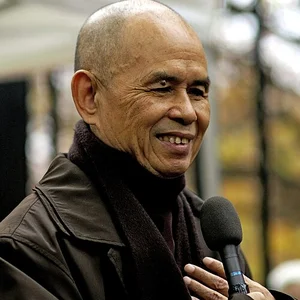

Vietnamese Zen Buddhist monk, poet, and peace activist. A major figure in spreading mindfulness to the West, he founded the Plum Village community in France and popularized “engaged Buddhism.”
Thich Nhat Hanh(1926 — 2022)
Thích Nhất Hạnh
France, Vietnam
6 min read
Frequently asked questions
Famous Quotes
« There is no way to happiness; happiness is the way.»
Key Facts
- Born in 1926 in Huế, in central Vietnam, and ordained as a Buddhist monk at the age of 16
- During the Vietnam War, he developed “engaged Buddhism” and campaigned for peace; Martin Luther King Jr. nominated him for the Nobel Peace Prize in 1967
- Forced into exile from 1966 onward, he settled in France and founded Plum Village in the Dordogne in 1982
- The leading force behind spreading mindfulness meditation throughout the West through numerous books
- Died in 2022 at the Tu Hieu Temple in Huế, where he had returned in 2018
Works & Achievements
A small handbook that became a worldwide classic, presenting mindfulness as a practice that can be applied to the simplest everyday gestures.
A community of lay and monastic practitioners founded on the idea of “interbeing”: everything is connected and depends on everything else.
A book in which he sets out “engaged Buddhism” and pleads for a peace that takes the side of no armed camp.
The creation in the Dordogne of the largest Buddhist monastery in the West, which welcomes thousands of retreatants every year.
A widely read collection that offers walking meditation and conscious breathing as paths to inner and social peace.
A deeply moving poem written after the tragedy of the boat people, expressing compassion for the victim as much as for the executioner.
Through his books and retreats, he popularized a practice now adopted in education, healthcare, and business.
Anecdotes
In 1966, the pastor Martin Luther King met Thích Nhất Hạnh and described him as “an apostle of peace and nonviolence.” The following year, King nominated him for the Nobel Peace Prize, a rare gesture since nominations are normally kept secret.
Having become a monk at sixteen, the young Nguyễn Xuân Bảo learned that the Zen path is not found in texts alone: his master first asked him to sweep the courtyard and wash the bowls while putting all his attention into it. This idea of the everyday gesture performed in full mindfulness would become the heart of his teaching.
During the Vietnam War, he refused to take sides and organized relief for villagers bombed on both sides. This refusal led to his exile from his country in 1966: he would not be able to return until nearly forty years later.
In 1982, he founded Plum Village in the countryside of the Dordogne, where he had 1,250 plum trees planted — a number that recalls the number of the Buddha's disciples. The sale of the plums was used to help the starving children of Vietnam.
Struck by a severe stroke in 2014, he lost the ability to speak but continued to teach through his simple presence. In 2018, he chose to return to die at the Từ Hiếu Temple in Huế, the very place where he had entered as a novice.
Primary Sources
While you are washing the dishes, you should only be washing the dishes, which means you should be fully aware of the fact that you are washing the dishes.
Peace is found in every step. Let us walk hand in hand. With each step a fresh wind blows. With each step a flower blooms.
Do not say that I will depart tomorrow, for even today I am still arriving. I am the child in Uganda, all skin and bones, and I am the arms merchant, selling deadly weapons to Uganda.
I do not personally know of anyone more worthy of the Nobel Peace Prize than this gentle Buddhist monk from Vietnam.
Key Places
Former imperial capital of Vietnam, the city of his birth and his death. A center of Vietnamese Buddhist culture.
The Zen monastery where he entered as a novice at sixteen and where he chose to spend his final years before dying.
The meditation center he founded in 1982 in southwestern France, which became a leading global hub of mindfulness.
He studied here in the early 1960s, before teaching Buddhism at Columbia University in New York.
The city where he founded the School of Youth for Social Service and the Order of Interbeing during the war.
He led the Buddhist peace delegation during the 1968-1973 talks here and lived part of his exile in the city.
Typical Objects
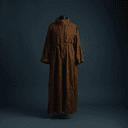
A long earth-colored tunic worn by the monks and nuns of Plum Village. Its plainness recalls the renunciation of possessions and the equality of the community.
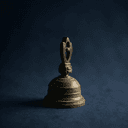
A small bell that one is invited to sound to remind everyone to stop and breathe. Its chime gives structure to the days of a retreat.
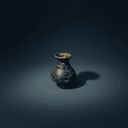
With a brush he traced short phrases such as “Breathe, you are alive” or “This page is a cloud.” These calligraphies have become a celebrated part of his teaching.
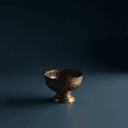
A simple bowl in which the monk receives his food, a symbol of humility and of trusting dependence on the community.
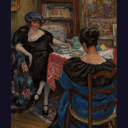
Drinking a cup of tea in mindfulness is one of his best-known examples: holding the cup, feeling its warmth, being fully present in the moment.
📷 Domaine public · Wikimedia Commons ↗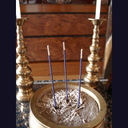
Lit during ceremonies and meditations, its fragrant smoke marks the opening of a sacred time and a moment of contemplation.
📷 CC BY-SA 3.0 · Wikimedia Commons ↗School Curriculum
Vocabulary & Tags
Key Vocabulary
Daily Life
Morning
The day begins before dawn with seated meditation, followed by a silent walking meditation in nature. Every action, even washing one's face or making the bed, is performed slowly and mindfully.
Afternoon
The afternoon combines manual work — gardening, cooking, maintenance — with teachings of the Dharma given to the community. The steady sound of the bell invites everyone to stop and take three breaths.
Evening
The evening is devoted to meditation, chanting, or sharing in small circles called “Dharma families.” Noble silence then settles in until the following morning.
Food
Strictly vegan out of respect for all life, he ate simple meals of rice, vegetables, and tofu, taken in silence and mindfulness. The first practice was to look at one's plate while recognizing the sun, the rain, and the work of others.
Clothing
He wore the brown robe of Vietnamese monks and, for ceremonies, a saffron-yellow stole. Shaved head, simple sandals, without any superfluous belongings.
Housing
He lived in a modest hermitage within monasteries, first at Plum Village in the Dordogne and later at the Từ Hiếu Temple in Huế. A bare place, open onto the garden and conducive to silence.
Historical Timeline
Period Vocabulary
Liens externes & ressources
Références
Œuvres
Le Miracle de la pleine conscience
1975
Fondation de l'Ordre de l'Interêtre (Tiếp Hiện)
1966
Vietnam : Lotus in a Sea of Fire
1967
Fondation du Village des Pruniers
1982
La paix est en chaque pas (Peace Is Every Step)
1991
Le poème « Appelez-moi par mes vrais noms »
1978
Diffusion de la pleine conscience (mindfulness) en Occident
années 1970-2020