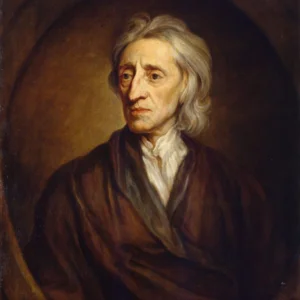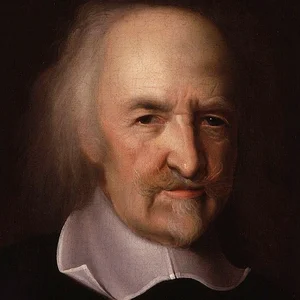

A 17th-century English philosopher, Thomas Hobbes is the author of Leviathan (1651), a founding work of modern political philosophy. He develops a social contract theory justifying the absolute authority of the state to guarantee peace and security.
Thomas Hobbes(1588 — 1679)
Thomas Hobbes
royaume d'Angleterre
8 min read
Frequently asked questions
Famous Quotes
« The life of man in a state of nature is solitary, poor, nasty, brutish, and short.»
« Covenants, without the sword, are but words.»
Key Facts
- 1651: Publication of Leviathan, a major treatise in political philosophy
- 1642–1651: Writing of Leviathan during the English Civil War
- Development of a social contract theory grounded in reason and self-interest
- Philosophical justification for the absolute power of the sovereign to maintain social order
- 1588–1679: An exceptionally long life for the era (91 years), allowing him to publish several foundational works
Works & Achievements
A major work of political philosophy in which Hobbes develops his theory of the social contract and argues for the absolute authority of the state as a necessary escape from the chaotic state of nature. It is a foundational text of modern political philosophy.
A political philosophy treatise written in Latin that sets out the principles of civil government, prefiguring the ideas later developed in Leviathan. It represents the first systematic formulation of his political theory.
A work of natural philosophy and logic in which Hobbes develops his materialist conception of the universe and lays the foundations of his scientific and philosophical thought.
A philosophical treatise in which Hobbes analyses human nature, the passions, and the motivations of men, forming a key element of his theoretical construction of the social contract.
One of his earliest political texts, written during the English Civil War, setting out the fundamental principles of his philosophical and political system.
A scientific work in which Hobbes critiques experiments on the vacuum and defends a materialist conception of physics against the new theories of his era.
Anecdotes
Thomas Hobbes lived through the English Civil War (1642–1651), a period of intense political upheaval. Fearing for his safety, he fled England in 1640 and took refuge in France, where he reflected on the conditions necessary for peace and social order. This traumatic experience profoundly shaped his political philosophy, particularly his conviction that strong authority is essential to prevent chaos.
Hobbes was a man of many talents: mathematician, translator, and courtier. He served as tutor to the future Charles II of England during the king's exile in France, which gave him access to high-level intellectual and political circles. This proximity to power allowed him to refine his theories on the state and sovereignty.
At the age of 90, Hobbes wrote his autobiography in Latin verse, demonstrating his intellectual commitment right to the end of his life. He continued to publish political and philosophical works despite his advanced age, remaining a respected intellectual figure in England until his death in 1679.
Hobbes translated Homer's Iliad and Odyssey, completing this monumental work after the age of 87 when he was already very old. His verse translation was well received by his contemporaries and shows that his genius extended far beyond political philosophy to encompass ancient literature.
Primary Sources
During the time men live without a common power to keep them all in awe, they are in that condition called war; and such a war as is of every man against every man.
Philosophy is the knowledge acquired by reasoning, from the generation or construction of things.
The state of nature, that is to say, the condition of men without a common power to restrain them, is a state of war of all against all.
The history of the causes of the English Civil War, and of the troubles that followed, until the Restoration of His Majesty Charles the Second.
I rejoice at having the opportunity to discuss with a man whose judgment in matters of philosophy is so widely recognized.
Key Places
Birthplace of Thomas Hobbes on 5 April 1588. This small town in Shropshire, England, marks the origins of the great political philosopher.
Hobbes studied at Magdalen Hall from 1603. The university shaped his thinking and gave him a solid grounding in classical and humanist culture.
The heart of English intellectual and political life, where Hobbes spent much of his career. It was in London that he wrote his major works and took part in the philosophical debates of the 17th century.
Hobbes went into exile in France between 1640 and 1651, a period during which he moved in Parisian intellectual circles and wrote Leviathan, his masterpiece of political philosophy.
The estate where Hobbes worked as tutor and secretary to the Cavendish family. This aristocratic setting provided him with protection and resources to pursue his philosophical research.
Another major residence of the Cavendish family where Hobbes stayed regularly. It was in this prestigious setting that he developed and refined his political and philosophical thought.
Typical Objects

A major work published in 1651, this political philosophy treatise sets out Hobbes's theory of the social contract. It is the symbol of his foundational contribution to modern political thought and to the justification of state authority.

Essential tools of the 17th-century writer, these allowed Hobbes to compose his philosophical works. These instruments represent the intellectual labor and scholarly writing of the early modern period.

Leather-bound volumes were a hallmark of any 17th-century intellectual's library. Hobbes, a dedicated scholar and avid reader, owned an extensive collection that reflected the humanist culture of his era.

These symbols of royal power embody the central concept of Hobbes's thought: the absolute authority of the sovereign, necessary to maintain social order and prevent the state of nature.

Representing the conflict and violence of the state of nature as described by Hobbes — the war of all against all — the sword symbolizes the necessity of the Leviathan to establish peace and security.

A characteristic object of study in the 17th century, it represents the interest of modern thinkers in geography and the wider world. Hobbes, within his context, reflected on the political organization of human societies.

An object symbolizing Hobbes's social contract theory, in which individuals surrender their natural freedom to a sovereign in exchange for security and social peace.

Optical instruments of the 17th century representing the careful observation and rational analysis that characterize both Hobbes's philosophical method and modern scientific thinking.
School Curriculum
Vocabulary & Tags
Key Vocabulary
Tags
Mouvement
Daily Life
Morning
Thomas Hobbes rose early, around 6–7 in the morning, in his bedroom warmed by a fireplace. After dressing with the help of his valet, he had a light breakfast of bread, butter, and ale (a common healthy drink of the era), before devoting himself to his studies and the writing of his philosophical works.
Afternoon
The afternoon was generally spent corresponding with other thinkers, reading in his personal library, or taking walks for physical exercise, which Hobbes considered essential to good health. He occasionally received visitors from his scholarly circle to discuss philosophical and political questions.
Evening
In the evening, Hobbes dined modestly around 5–6 o'clock with his family or close companions, then retired to his study to continue his intellectual work. Before bed, he took time for reading and reflection, retiring relatively early to preserve his health.
Food
Hobbes's diet, typical of the English gentry, included white bread, game, poultry, fish (particularly on religious days), and seasonal fruits and vegetables. He regularly drank ale, wine, and cider, beverages preferred over water, which was considered impure at the time.
Clothing
Hobbes wore the typical dress of the 17th-century gentry: an outfit consisting of knee breeches, a fitted doublet, and a long periwig in keeping with fashion. From middle age onward, he added a cape or wool coat for outings, along with silk stockings and buckled shoes.
Housing
Hobbes lived in various prestigious residences, most notably with the Earl of Devonshire, with whom he had a close relationship, before settling in London. His homes featured several rooms, a well-stocked library, and fireplaces, reflecting the high social standing of a scholar and man of letters of the English gentry.
Historical Timeline
Period Vocabulary
Visual Style
Un style gravure du XVIIe siècle aux influences baroques, caractérisé par un clair-obscur dramatique et des contrastes tranchés. L'imagerie combine l'austérité de la pensée hobbesienne avec la solennité du pouvoir d'État, évoquant la domination du Léviathan à travers une esthétique gravée et texturée, typique des estampes hollandaises.
Sound Ambience
Une ambiance sonore sombre et contemplative évoquant le cabinet d'étude d'un philosophe du XVIIe siècle, mêlant les sons du travail intellectuel (plume, pages) aux bruits d'une Angleterre puritaine et austère, reflétant la rigueur philosophique et la réflexion sur l'ordre politique.
Liens externes & ressources
Références
Œuvres
Léviathan
1651
De Cive (Du Citoyen)
1642
De Corpore (Du Corps)
1655
De Homine (De l'Homme)
1658
Élémentes de la Loi naturelle et politique
1640
Dialogus Physicus
1661