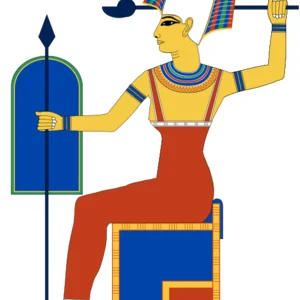

Toci, whose name means “Our Grandmother” in Nahuatl, is a mother goddess in Aztec mythology. Associated with the earth, healing, and midwives, she was venerated as the “heart of the Earth” and ranks among the major deities of the Mexica pantheon.
Toci
Toci
6 min read
Frequently asked questions
Key Facts
- Goddess of the Aztec religion, venerated before the Spanish conquest of 1521
- Her name means “Our Grandmother” (Toci) in the Nahuatl language
- Identified with the “heart of the Earth” and associated with the mother goddesses Tlazolteotl and Teteoinnan
- Patroness of midwives, healers, and childbirth
- Honored during the festival of Ochpaniztli, a time of cleansing and harvest in the Mexica calendar
Works & Achievements
Great festival of the harvest and the sweeping, of which Toci was the central deity, marking the purification of the earth before the harvests.
Toci protected the ticitl (midwives and physicians), invoked during childbirth and healing.
As goddess of the steam bath, she presided over rites of healing and purification through heat and water.
Toci was identified with the universal mother of the pantheon, source of divine and human life.
Toci was frequently associated with Tlazolteotl, goddess of fertility, of excess, and of the purification of sins.
She embodied the living center of the earth, nourisher of all creatures and receptacle of the dead.
Anecdotes
Toci bore the nickname "Our Grandmother
(which is what Toci means in Nahuatl)
but she was also called Teteoinnan
the Mother of the gods." For the Aztecs, she embodied the Earth itself, both a source of life and a tomb to which the dead returned.
Each year, during the festival of Ochpaniztli (the "sweeping
)
the Aztecs cleaned houses and temples to honor Toci. A woman was chosen to impersonate the goddess during the ceremonies
then sacrificed: her skin was worn by a priest
symbolizing the renewal of the earth before the harvests.
Toci was the protector of midwives (the ticitl) and healers. Women who helped with childbirth invoked her, for birth was compared to a battle: the mother was seen as a "warrior" capturing a new being.
Toci was also the patroness of the temazcal, the Aztec steam bath. Her image was often carved above the entrance of these sweat lodges, for heat and water served to heal the sick and purify the body, domains placed under her protection.
Soldiers and physicians saw Toci as a dual figure: a goddess of healing but also tied to war. She was nicknamed "Heart of the Earth
(Tlalli iyollo)
for she beat at the center of the world and nourished all living beings.
Primary Sources
She was called Teteoinnan, that is to say, the mother of the gods; she was also called Toci, our grandmother, and the heart of the earth.
In this month they celebrated the festival of the mother of the gods named Toci; the roads and the houses were swept in her honor.
Depiction of Toci-Teteoinnan during the festival of Ochpaniztli, clad in the skin of a sacrificial victim and holding a ritual broom.
This goddess, called the grandmother, was held to be the mother of all and was invoked by physicians and midwives.
Key Places
Capital of the Aztec empire where the great religious festivals took place, including Ochpaniztli dedicated to Toci.
Great double temple of Tenochtitlan, a ceremonial center where the Mexica deities were honored and the rites of the mother goddess were celebrated.
Twin city of Tenochtitlan, famous for its huge market, where medicinal herbs and objects linked to Toci's healing cults were sold.
Mythical representation of the underground, nourishing world of the earth, of which Toci was the beating “heart” that made plants grow.
Great Mesoamerican religious center where many deities were venerated, including the earth and fertility goddesses close to Toci.
Typical Objects

Broom of plant fibers used to clean houses and temples during the festival of Ochpaniztli. It symbolized the purification of the earth before the harvests.

Toci, as a mother goddess, is often depicted with a spinner's spindle stuck into her headdress. Spinning symbolized women's work and the creative power of the earth.

Small stove of stone and earth where people took curative and purifying steam baths. Toci was its patron, her image often guarding the entrance.

Head ornament of bark paper (amatl) and raw cotton worn by depictions of Toci. It marked her status as a mother goddess linked to the earth.

In her warrior aspect, Toci-Tlazolteotl is portrayed holding a shield (chimalli) and a broom brandished like a weapon, uniting war and purification.

Images of Toci show a mouth surrounded by black rubber (ulli) and a painted face, distinctive signs of the goddesses of the earth and fertility.
School Curriculum
Vocabulary & Tags
Key Vocabulary
Tags
Daily Life
Morning
As an earth goddess, Toci was imagined awakening with the first rays of sun on the maize fields. The midwives and healers who served her began the day with prayers and by gathering medicinal herbs at the market of Tlatelolco.
Afternoon
Her priestesses and devotees swept temples and houses, a ritual gesture placed under her protection. The afternoon was also the time for tending to the sick in the temazcal, the steam bath of which Toci was the patroness.
Evening
In the evening, fires were lit and copal (incense) was burned in honor of the Mother of the gods. The songs and dances of festivals such as Ochpaniztli carried on by the light of the braziers.
Food
Offerings to Toci included the fruits of the earth she made grow: maize, beans, squash, amaranth and chili peppers. She was also presented with pulque, a fermented agave drink, and maize cakes.
Clothing
Depictions of Toci show her dressed in a huipil (tunic) and a white cotton skirt, crowned with bark paper and raw cotton, her face painted black around the mouth and adorned with feathers.
Housing
Her mythical domain was the whole earth, but her cult centered on the temples of Tenochtitlan and the humble temazcal steam baths. She was said to dwell at the “heart of the earth,” beneath the nourishing soil.
Historical Timeline
Period Vocabulary
Liens externes & ressources
Références
Œuvres
Fête d'Ochpaniztli
calendrier rituel aztèque (XVe-XVIe siècle)
Patronage des sages-femmes et des guérisseuses
époque mexica
Protection du temazcal
époque mexica
Identification à Teteoinnan, la Mère des dieux
mythologie aztèque
Lien avec Tlazolteotl
mythologie aztèque
Figure du « Cœur de la Terre » (Tlalli iyollo)
mythologie aztèque