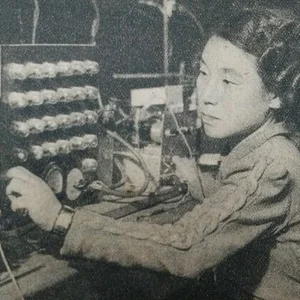

Toshiko Yuasa (1909-1980) was the first female Japanese physicist. A specialist in radioactivity and nuclear physics, she spent the bulk of her career in France, at the CNRS, following in the footsteps of the Joliot-Curies' work.
Toshiko Yuasa(1909 — 1980)
Toshiko Yuasa
Japon, empire du Japon
6 min read
Frequently asked questions
Key Facts
- Born in 1909 in Tokyo, she was the first Japanese woman to become a physicist.
- Arrived in Paris in 1940 to study radioactivity in the laboratory of Frédéric Joliot-Curie.
- In 1944, during the liberation of Paris, she left the city by bicycle, taking her spectrometer with her.
- Joined the CNRS in 1949, where she continued her research on beta decay.
- Died in 1980 in Paris, after a scientific career conducted mostly in France.
Works & Achievements
Doctoral work defended in France, studying the shape of the continuous energy spectrum of beta rays, building on the research of the Joliot-Curies.
Design and fabrication of her own measuring instrument, which she saved during her flight from Berlin and which symbolizes her experimental ingenuity.
In-depth experimental studies on the shape of beta spectra and the physics of radioactive nuclei, carried out as a permanent researcher at the CNRS.
Notes and articles published in French and international journals, contributing to the understanding of beta radioactivity.
Texts in which Yuasa recounts her life as a scientist in Paris, introducing French culture to the Japanese public.
Anecdotes
In 1940, in the middle of the World War, Toshiko Yuasa crossed Eurasia alone by train on the Trans-Siberian Railway to reach Paris and join the laboratories of Frédéric and Irène Joliot-Curie. This journey of several weeks, from Japan to occupied France, reflects her determination to study radioactivity alongside the world's leading specialists.
At the end of the war, in 1945, Yuasa fled the bombing of Berlin, carrying with her own hands the beta-ray spectrometer she had built herself. According to the famous account, she transported her precious instrument by bicycle and on foot amid the chaos, refusing to abandon the tool of all her research.
Toshiko Yuasa was Japan's first woman physicist. During her studies at Tokyo's Bunrika University, she was the only female student in an entirely male class, at a time when science was almost exclusively reserved for men.
In 1944, at the Liberation of Paris, Yuasa had to leave France: as a national of an enemy country (Japan was allied with Germany), she was no longer allowed to continue her work. Rather than give up research, she left to carry on her experiments in Germany, in Berlin.
Today, a Franco-Japanese particle physics laboratory, the “Toshiko Yuasa Laboratory” (TYL), bears her name. It symbolizes the scientific bridge between France and Japan that she embodied all her life, having split her career between the two countries.
Primary Sources
Note presenting her experimental measurements of the shape of the continuous spectrum of beta rays emitted by radioactive elements, carried out in the laboratory of Frédéric Joliot-Curie.
Work devoted to the study of the continuous spectrum of beta rays, defended in France during the war in the wake of the Joliot-Curies' research on radioactivity.
Accounts and correspondence in which Yuasa describes her life as a researcher in Paris, her attachment to France, and the material conditions of research in the postwar period.
Key Places
Toshiko Yuasa's birthplace, where she grew up and pursued her higher studies in physics at Bunrika University.
Frédéric Joliot-Curie's laboratory, where Yuasa carried out her first French research on radioactivity starting in 1940.
The city where Yuasa continued her experiments after having to leave France in 1944, and which she fled in 1945 with her spectrometer.
The Centre National de la Recherche Scientifique, where Yuasa spent the bulk of her career from 1949 onward, rising to the rank of research director.
The city where Toshiko Yuasa spent most of her life as a researcher and where she died in 1980.
Typical Objects

Instrument used to measure the energy of the electrons (beta rays) emitted during the decay of radioactive nuclei. Yuasa built one with her own hands and saved it during her escape from Berlin.

Device that detects the particles and radiation emitted by radioactive substances by producing a click with each impact. A basic tool of the nuclear physicist.

Small sample of a radioactive element serving as raw material for experiments on beta decay. Handled with care in the laboratory.

Notebook in which the researcher recorded her measurements, calculations, and experimental observations each day. The indispensable written memory of research.

White work garment that protects the researcher and marks their belonging to the world of science. Yuasa's everyday attire in the laboratory.

A simple and widespread means of transport in wartime Europe. Yuasa is said to have used it to carry her spectrometer during her escape from Berlin in 1945.
School Curriculum
Vocabulary & Tags
Key Vocabulary
Daily Life
Morning
Toshiko Yuasa would head to her Parisian laboratory early, where she prepared her radioactive sources and checked the calibration of her measuring instruments. The morning was often devoted to launching the lengthy beta-ray detection experiments.
Afternoon
The afternoon was spent patiently recording data from the counters, performing calculations, and discussing results with her colleagues at the CNRS. Research demanded precision, patience, and long hours bent over the instruments.
Evening
In the evening, she read scientific papers, wrote up her publications, or penned letters and essays intended for Japan. In this way, she maintained a link between her two countries.
Food
Living in France, Yuasa adopted a simple diet that blended everyday French cooking with Japanese dishes she prepared herself. During and after the war, rationing meant frugal meals.
Clothing
In the laboratory, she wore the white coat of the researchers. In town, she dressed plainly, in Western style, in keeping with the understated elegance of the Parisian women of her time.
Housing
She lived in a modest Parisian apartment, close to her place of work. Her home reflected an austere life, almost entirely devoted to science.
Historical Timeline
Period Vocabulary
Liens externes & ressources
Références
Œuvres
Thèse de doctorat sur le spectre des rayons bêta
1943
Construction d'un spectromètre à rayons bêta
années 1940
Recherches sur la désintégration bêta au CNRS
années 1950-1970
Publications scientifiques en physique nucléaire
années 1940-1970
Écrits et essais sur la France (en japonais)
années 1950-1970