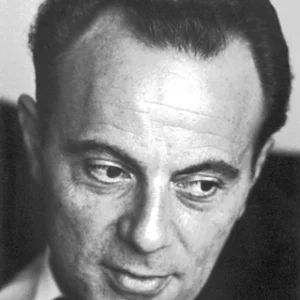

François Jacob (1920-2013) was a French biologist and geneticist. Together with Jacques Monod, he uncovered the mechanism of gene regulation, which earned him the Nobel Prize in Physiology or Medicine in 1965.
François Jacob(1920 — 2013)
François Jacob
France
6 min read
Frequently asked questions
Famous Quotes
« The dream of every cell is to become two cells.»
Key Facts
- Born on 17 June 1920 in Nancy, died on 19 April 2013 in Paris
- Joined the Free French Forces during the Second World War, wounded in 1944
- In 1961, proposed with Jacques Monod the concept of the operon and the model of gene regulation
- Nobel Prize in Physiology or Medicine 1965 with Jacques Monod and André Lwoff
- Elected to the Académie française in 1996
Works & Achievements
A fundamental discovery explaining how genes are regulated; it paved the way for all of modern molecular biology.
A central concept showing how the information in DNA is carried out to build proteins.
An award shared with Monod and Lwoff for their discoveries concerning the genetic control of enzyme and virus synthesis.
A major essay retracing the history of ideas about heredity, hailed as a work of philosophy of science.
A reflection on evolution and the diversity of life, in which he develops his famous idea of nature's “tinkering.”
An autobiography acclaimed for its literary qualities, blending wartime memories with his scientific journey.
A rare literary honor for a scientist, recognizing his talent as a writer.
Anecdotes
Before becoming a great scientist, François Jacob wanted to be a surgeon. But in 1940, at age 20, he left France to join the Free French Forces in London. Severely wounded in 1944 during the Battle of Normandy, he would never be able to operate: his trembling hands eventually steered him toward research.
Jacob was made a Companion of the Liberation and received the Croix de guerre. Hit by shell fragments in Tunisia and then in Normandy, he bore physical after-effects for the rest of his life. He used to say that it was while convalescing that he discovered his scientific calling.
With Jacques Monod and André Lwoff, Jacob worked at the Pasteur Institute in a buzzing atmosphere nicknamed “the attic.” It was there, through endless discussions, that they invented the concepts of the “operon” and “messenger RNA,” revolutionizing our understanding of how genes work.
In 1965, at just 45 years old, Jacob received the Nobel Prize in Medicine, shared with Monod and Lwoff. When asked how his ideas came about, he replied that science often resembled “tinkering”: nature, like evolution, makes new things out of old ones.
François Jacob was also a celebrated writer. His autobiography “The Statue Within” (1987) is regarded as a literary masterpiece, and he was elected to the Académie française in 1996, a rare honor for a scientist.
Primary Sources
The synthesis of enzymes in bacteria follows a double genetic control by the structural genes and the regulatory genes. We propose the concept of an operon to describe a group of genes whose expression is coordinated by an operator.
In the laboratory, when morning came, the wait was always the same: what would the experiment say? Science is a permanent struggle against the illusions one builds for oneself.
Natural selection does not work like an engineer, but like a tinkerer who does not yet know what he is going to produce, yet salvages whatever comes to hand.
The study of bacteria and their viruses has allowed us to tackle one of the most fundamental problems in biology: how genetic information is expressed and regulated within the cell.
Key Places
City in Lorraine where François Jacob was born in 1920. He spent part of his childhood there before pursuing his studies in Paris.
A leading center of biological research where Jacob carried out most of his work from 1950 onward, in the famous “attic” of Lwoff and Monod.
City where the young Jacob joined the Free French Forces in 1940 to fight alongside Free France.
Site of the 1944 landings where Jacob was severely wounded, which would prevent him from becoming a surgeon.
Prestigious institution where Jacob was appointed professor of cell genetics in 1977.
City where François Jacob lived, taught, and died in 2013, after an exceptional scientific and literary career.
Typical Objects

An essential instrument for observing bacteria and their cultures. Jacob used it daily in his work on Escherichia coli.

A small circular dish made of glass or plastic, used to grow colonies of bacteria on an agar medium. A basic tool of microbiology at the Pasteur Institute.

A precision instrument for drawing up and transferring small volumes of liquids or bacterial cultures. An essential gesture in genetics experiments.

A model bacterium used by Jacob and Monod to study gene regulation. The “workhorse” of molecular biology.

A notebook in which the researcher carefully records protocols, results, and hypotheses. The written memory of every experiment.

A conceptual diagram describing how a group of genes is switched on or off together. A major discovery that earned Jacob and Monod the Nobel Prize.
School Curriculum
Vocabulary & Tags
Key Vocabulary
Daily Life
Morning
Jacob would arrive early at the Pasteur Institute, eager to discover the results of the bacterial cultures left out the day before. The morning often began with examining the Petri dishes and planning the day's experiments.
Afternoon
The afternoon was devoted to painstaking work: seeding bacteria, measuring enzyme production, and recording every result in the laboratory notebook. Lively discussions with Monod and Lwoff punctuated the day.
Evening
In the evening, Jacob enjoyed reading and reflecting on the great questions of biology. It was also the time when, later in his life, he wrote his books blending science and philosophy.
Food
Like most Parisians of his time, he enjoyed simple, convivial French cuisine. Meals were an opportunity to carry on scientific debates around the table.
Clothing
In the laboratory, he wore the researcher's white coat. In town, he favored the understated, elegant attire typical of twentieth-century Parisian intellectuals.
Housing
Jacob lived in Paris, close to his places of work. His daily life was divided between his apartment, the Pasteur Institute, and, later, the Collège de France.
Historical Timeline
Period Vocabulary
Liens externes & ressources
Références
Œuvres
Modèle de l'opéron (avec Jacques Monod)
1961
Hypothèse de l'ARN messager
1961
Prix Nobel de physiologie ou médecine
1965
La Logique du vivant. Une histoire de l'hérédité
1970
Le Jeu des possibles
1981
La Statue intérieure
1987
Élection à l'Académie française
1996