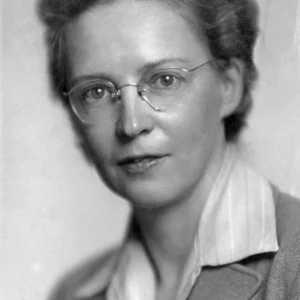

Kathleen Booth (1922-2022) was a British computer scientist and mathematician, a pioneer of the early days of computing. She is credited with inventing assembly language and designing the first computers at Birkbeck College in London, alongside Andrew Booth.
Kathleen Booth(1922 — 2022)
Kathleen Booth
Royaume-Uni
6 min read
Frequently asked questions
Key Facts
- Born on 9 July 1922 in Stourbridge, England
- From the late 1940s, took part in designing the first computers (ARC, SEC, APE(X)C) at Birkbeck College in London
- Created one of the first assembly languages around 1947-1950, making it easier to program machines
- Co-wrote 'Automatic Digital Calculators' in 1953, one of the first books describing the principles of programming
- Died on 29 September 2022 in Canada, at the age of 100
Works & Achievements
Designing one of the first ways to write programs using code-words translated into machine language. A key step toward more accessible programming.
One of the first calculators built at Birkbeck, running on relays; Kathleen wrote its coding.
An electronic calculator developed at Birkbeck College as part of their research into stored-program machines.
A general-purpose computer whose design served as the basis for several British commercial machines.
A reference work presenting the logic and programming of the first digital calculators.
A pioneering textbook for learning programming, among the very first of its kind in the world.
Pioneering work aimed at simulating neural networks for pattern and character recognition, at the dawn of artificial intelligence.
Anecdotes
In the late 1940s, Kathleen Booth devised one of the very first ways to write programs using word-codes rather than long strings of binary digits: it was the ancestor of assembly language. Thanks to her, giving instructions to a machine became a little more human.
In 1947, still a young researcher, she crossed the Atlantic with Andrew Booth to meet the famous mathematician John von Neumann at Princeton. The ideas they brought back from this trip shaped the design of their first computers, built in London.
With Andrew Booth, she did not merely conceive machines: they built them partly with their own hands, soldering relays and winding wires. The ARC, their first calculator, filled an entire room and ran on hundreds of clicking electromechanical relays.
As early as 1958, she published a book, *Programming for an Automatic Digital Calculator*, one of the first manuals teaching how to program a computer — at a time when almost no one in the world knew how to do it.
Kathleen Booth also took an early interest in ideas now called “artificial intelligence,” seeking to simulate neural networks to recognize shapes and characters. She died in 2022, at the age of 100.
Primary Sources
Report written after their visit to the Institute for Advanced Study in Princeton, setting out the design principles of a universal electronic computer and the organization of its memory.
Document describing how to code instructions for the Automatic Relay Calculator (ARC), one of the first computers built at Birkbeck College.
Co-authored book presenting the workings, logic, and programming of the first automatic digital computers.
Pioneering manual explaining step by step how to write programs for a computer, intended for the very first programmers.
Key Places
Town in the West Midlands where Kathleen Britten was born in 1922.
University of London institution where she earned her bachelor's degree in mathematics in 1944.
Place where she designed, programmed and built the first computers (ARC, SEC, APE(X)C) with Andrew Booth.
American research center where she met John von Neumann in 1947, an inspiration for their machines.
Canadian university where the couple continued their careers after emigrating to Canada in 1962.
Typical Objects

Cylinder coated with magnetic material used to store data and programs, developed by Andrew Booth and programmed by Kathleen. It is one of the ancestors of computer memory.

Long ribbon dotted with small holes that encoded the instructions and numbers for the machine. It was both the keyboard and the external memory of the time.

Small switches controlled by electricity that clicked away to carry out the ARC's calculations. Hundreds of them formed the “brain” of the machine.

Grid-ruled sheets on which programmers wrote by hand, box by box, each instruction intended for the machine. This is where programs were born before being punched.

Essential tool for assembling by hand the circuits, relays and wires of the earliest computers. Kathleen and Andrew Booth built part of their machines themselves.

Sliding instrument used to quickly perform multiplications and divisions before the arrival of electronic calculators. A daily companion of the scientists of this generation.
School Curriculum
Vocabulary & Tags
Key Vocabulary
Tags
Daily Life
Morning
Early in the morning, Kathleen heads to the Birkbeck laboratory where the machines under construction await her. She checks the relays and wires, then bends over the coding sheets to prepare the day's programs.
Afternoon
The afternoon is devoted to calculations, to trials on the ARC or the APE(X)C, and to hunting down errors: a miscoded instruction or a faulty relay can bring everything to a halt. She discusses improvements to be made with Andrew Booth.
Evening
In the evening, she writes reports and articles, refines her ideas on assembly language, or drafts the chapters of her future textbooks. Pioneering work leaves little respite.
Food
In post-war England, food is still shaped by rationing: bread, potatoes, vegetables, a little meat, and tea. Meals are simple and waste nothing.
Clothing
She wears the plain, practical outfits of a 1940s-50s academic: a skirt or dress, a blouse, a wool cardigan, all suited to laboratory work.
Housing
The couple first lives in London, close to their research sites, in the modest housing typical of the post-war period, before later settling in Canada.
Historical Timeline
Period Vocabulary
Liens externes & ressources
Références
Œuvres
Langage d'assemblage et assembleur
vers 1947-1950
ARC — Automatic Relay Calculator
1948
SEC — Simple Electronic Computer
vers 1950
APE(X)C — All Purpose Electronic Computer
vers 1951-1952
Automatic Digital Calculators (avec A. D. Booth)
1953
Programming for an Automatic Digital Calculator
1958
Recherches sur les réseaux de neurones
1958