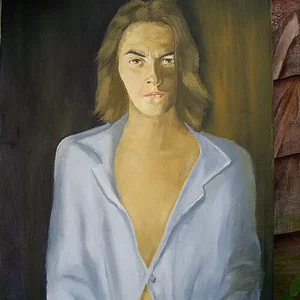

Tracey Emin is a British contemporary artist and a leading figure of the Young British Artists. Her deeply autobiographical work explores intimacy, sexuality and personal suffering through installation, neon, drawing and embroidery.
Tracey Emin(1963 — ?)
Tracey Emin
Royaume-Uni
6 min read
Frequently asked questions
Key Facts
- Born on 3 July 1963 in Croydon (London)
- Her installation *My Bed*, shown at the Turner Prize in 1999, becomes an iconic work of contemporary art
- In 1995 she creates *Everyone I Have Ever Slept With 1963–1995*, a tent sewn with names
- Represents the United Kingdom at the Venice Biennale in 2007
- Appointed Professor of Drawing at the Royal Academy of Arts in 2011
Works & Achievements
Embroidered tent listing everyone she had ever shared a bed with; an iconic YBA work, destroyed in a fire in 2004.
Autobiographical film about her teenage years in Margate, blending pain and liberation through dance.
An installation of her own unmade bed, one of the most talked-about works of contemporary art; nominated for the 1999 Turner Prize.
A beach hut in which she poses naked, evoking memory and abandonment.
A provocative photographic self-portrait questioning money, the body and success.
A 20-metre neon work installed in London's St Pancras station, a monumental message of love.
A monumental bronze sculpture installed in Oslo outside the Munch Museum, a tribute to motherhood and resilience.
Anecdotes
In 1999, Tracey Emin exhibited "My Bed" at the Tate Gallery as part of the Turner Prize: her own unmade bed, surrounded by empty alcohol bottles, tissues and underwear. The work caused an enormous scandal, with some visitors even trying to "clean" it, but it became one of the most famous installations in British contemporary art.
In 1997, during a live televised debate on Channel 4 about the Turner Prize, a drunk Emin walked off the set, declaring that she would rather go home to see her friends and her mother. This chaotic episode made her instantly famous with the British public.
Her embroidered tent "Everyone I Have Ever Slept With 1963–1995" listed the names of everyone she had ever shared a bed with, including her grandmother and her twin brothers: it was therefore not only about lovers. The work, bought by Charles Saatchi, was destroyed in a warehouse fire in 2004.
Originally from Margate, a deprived seaside resort in Kent, Emin turned her difficult childhood into artistic material. In 2017, she gave a neon work "I Want My Time With You" installed in St Pancras station in London, a giant love message welcoming Eurostar travellers.
In 2011, Tracey Emin was appointed Professor of Drawing at the Royal Academy of Arts: she became one of the first two women to hold this position since the institution's founding in 1768, two and a half centuries earlier.
Primary Sources
I woke up and saw the bed, and I thought: if I take it out of here and put it in a white gallery, it will be the most devastating thing I have ever made.
Everyone I Have Ever Slept With, 1963–1995.
Margate. That is where I come from. Everything I am began there, on that wind-battered coast.
I never thought I would survive. Now every day is a gift, and I want to draw, draw, draw.
Key Places
Town where Tracey Emin was born in 1963 along with her twin brother Paul.
Seaside resort where Emin spent a difficult childhood; a major source of inspiration and the site of her TKE Studios project.
School where she earned her painting degree in 1988.
Site of the 1999 Turner Prize nomination where “My Bed” was exhibited and caused a scandal.
Institution where she became Professor of Drawing in 2011 and exhibits regularly.
Site where Emin represented the United Kingdom at the British Pavilion in 2007.
Typical Objects

Emin writes handwritten phrases in colored neon letters, turning intimate words into glowing sculptures. It has become her visual signature.

The autobiographical bed of “My Bed,” surrounded by personal objects, turns the most intimate aspects of everyday life into an exhibited work of art.

Emin pieces together fabrics and embroiders words and slogans, repurposing a traditionally feminine domestic craft into political and intimate art.

Her quick, nervous drawings, often of female bodies, explore sexuality and vulnerability with great economy of means.

The support for the famous work that listed, in appliqué, the names of everyone she had ever slept with, playing on intimacy and misunderstanding.

Emin films autobiographical confessions and performances, such as “Why I Never Became a Dancer.”
School Curriculum
Vocabulary & Tags
Key Vocabulary
Daily Life
Morning
Emin has often described mornings spent drawing as soon as she wakes, sometimes right in bed, capturing the raw emotional state of the day. Quick ink drawing is for her an almost therapeutic daily ritual.
Afternoon
Her afternoons are split between the studio, embroidering her appliqués, and overseeing large projects such as her neons or bronzes. She also works with assistants and craftspeople to produce her large-scale pieces.
Evening
In the 1990s, her London nights within the YBA scene were famous for their buzz and excess. Later on, she chose a quieter life centred on her work and her move to Margate.
Food
Emin has spoken openly about her difficult relationship with alcohol, long present in her life and her art. After her cancer and her surgery in 2020, she profoundly changed her lifestyle.
Clothing
Her style blends elegance with unapologetic eccentricity, from dressy gowns to casual, ink-stained studio outfits. She often appears in the press with a bold, personal look.
Housing
For a long time she lived and worked in vast studios in east London, in Spitalfields. Since the 2020s, she has largely returned to settle in Margate, the town of her childhood, where she has created a complex of studios.
Historical Timeline
Period Vocabulary
Liens externes & ressources
Références
Œuvres
Everyone I Have Ever Slept With 1963–1995
1995
The Last Thing I Said to You Is Don't Leave Me Here
2000
I've Got It All
2000
I Want My Time With You
2018