 flip
flipIseult's Blancmange for the Wounded Knight
Iseult's Blancmange for the Wounded Knight
Why this dish? Iseult is not only a lover: she is a healer, daughter of a queen skilled in remedies, who saves Tristan when he is poisoned by the Morholt's lance. Blancmange, a white and sweet dish made from almond milk, was THE dish given to the sick and weak. Here it is as Iseult's care for the languishing knight.
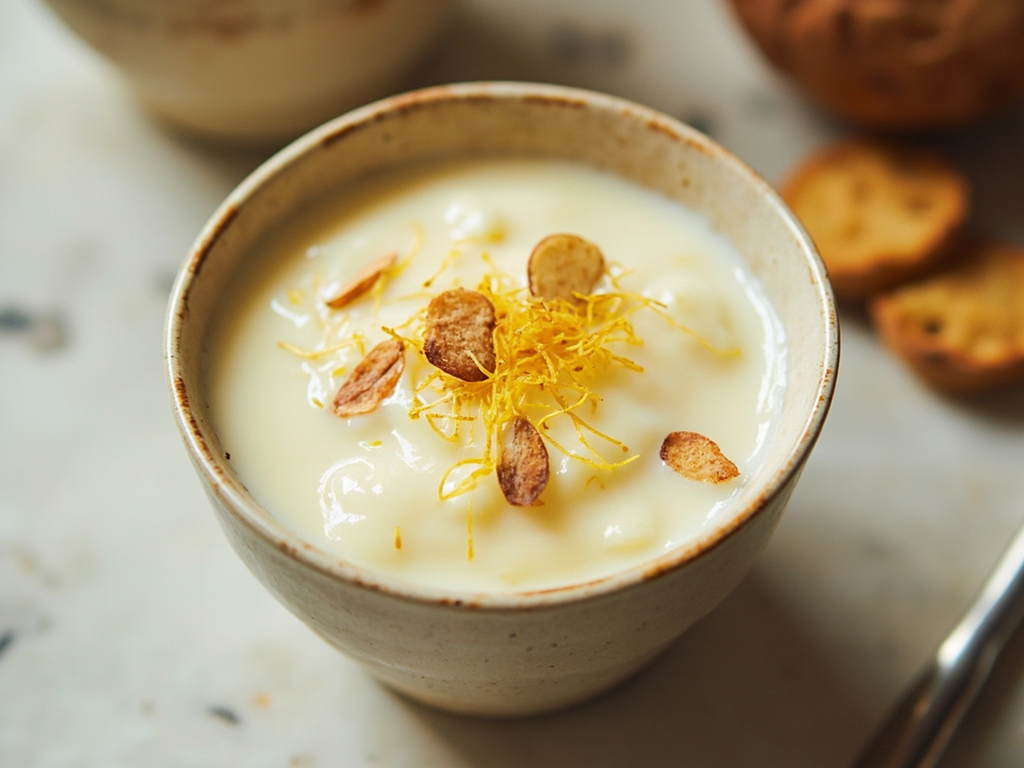
A velvety white and nourishing pottage of almond milk and rice, enriched with fine slivers of chicken breast, perfumed with a hint of ginger and saffron. Mild, comforting, easy to swallow: the medieval dish for rebuilding bodies.
When the Morholt's venom consumed me and no physician could cure me, it was Iseult's white hands that called me back to life. She had me brought this pale broth of ground almonds and shredded chicken, barely touched with saffron, gentle as a balm. 'Eat,' she said, 'and regain your strength, knight.' I confide in you: there are remedies that heal the body, and only one that wounds the soul forever — but this one, drink it without fear.
- •Ground almonds — a good handful (almond milk (base))
- •Capon or chicken breast — one, shredded (strength)
- •Rice — a little (mild thickener)
- •Honey or sugar — to taste (sweetness)
- •Saffron, ginger — a pinch (flavor and color)
Iseult's Blancmange for the Wounded Knight
A velvety white and nourishing pottage of almond milk and rice, enriched with fine slivers of chicken breast, perfumed with a hint of ginger and saffron. Mild, comforting, easy to swallow: the medieval dish for rebuilding bodies.
Why this dish? Iseult is not only a lover: she is a healer, daughter of a queen skilled in remedies, who saves Tristan when he is poisoned by the Morholt's lance. Blancmange, a white and sweet dish made from almond milk, was THE dish given to the sick and weak. Here it is as Iseult's care for the languishing knight.
When the Morholt's venom consumed me and no physician could cure me, it was Iseult's white hands that called me back to life. She had me brought this pale broth of ground almonds and shredded chicken, barely touched with saffron, gentle as a balm. 'Eat,' she said, 'and regain your strength, knight.' I confide in you: there are remedies that heal the body, and only one that wounds the soul forever — but this one, drink it without fear.
Ingredients (period version)
- Ground almonds — a good handful (almond milk (base))
- Capon or chicken breast — one, shredded (strength)
- Rice — a little (mild thickener)
- Honey or sugar — to taste (sweetness)
- Saffron, ginger — a pinch (flavor and color)
Ingredients
- Unsweetened almond milk — 500 ml (base)
- Cooked chicken breast — 1, finely shredded (mild protein)
- Short-grain rice — 60 g (or 2 tbsp rice flour) (thickener)
- Honey — 1 to 2 tbsp (sweetness)
- Saffron — 1 pinch (optional, for color) (flavor/color)
- Ground ginger — 1 pinch (mild warmth)
- Toasted slivered almonds — 1 tbsp (finish)
Method
- Cook the rice in the almond milk over low heat until very tender (about 20 min), stirring.
- Add the finely shredded chicken, honey, ginger, and saffron; let meld for a few minutes.
- Blend for a smooth velouté, or leave a little texture for a more rustic version.
- Adjust sweetness; the dish should be comforting, neither too sweet nor too salty.
- Serve warm in a bowl, sprinkled with toasted slivered almonds.
How it was made : Blancmange appears in almost all medieval cookbooks and was explicitly recommended for the sick and convalescent for its mildness and digestibility. Almond milk, which keeps better than animal milk and respects the Church's lean days, made it an ideal dish. Sugar, still medicinal and rare in the 12th century, was often replaced by honey.
The contemporary twist : Pure sweet version (without poultry): a saffron-scented rice pudding with almond milk, served in a verrine with caramelized almonds — blancmange becomes a dessert again, as it later did.
Sources : Le Viandier de Taillevent (14th c.) · Le Ménagier de Paris (c. 1393) · Forme of Cury (England, c. 1390)
Tristan and Iseult · Charactorium