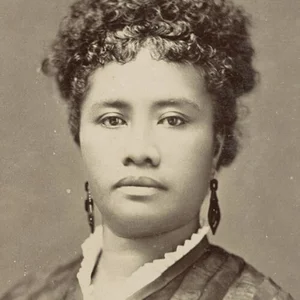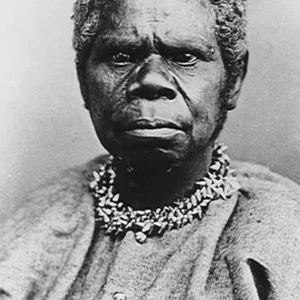

Truganini (c. 1812–1876) was an Aboriginal woman from Tasmania who witnessed the near-extermination of her people during the Black War. She was deported to Flinders Island along with the last surviving Tasmanian Aboriginals. Long referred to as 'the last Tasmanian', she became a global symbol of colonial genocide.
Truganini(1812 — 1876)
Truganini
Australie
9 min read
Frequently asked questions
Key Facts
- Born around 1812 into the Search Bay tribe of south-eastern Tasmania
- The Black War (1824–1831) wiped out nearly the entire Tasmanian Aboriginal population
- Deported in 1834 to Flinders Island (Wybalenna settlement) along with the last Aboriginal survivors
- Died on 8 May 1876 in Hobart, regarded at the time as the last full-blooded Tasmanian Aboriginal
- Her body was exhumed and put on display at the Hobart Museum; her ashes were not returned until 1976, one hundred years after her death
Works & Achievements
Truganini was the indispensable guide, interpreter, and diplomat for Robinson during five expeditions across Tasmania. Her knowledge of languages and clans made it possible to locate and contact the last surviving groups, making her a central — and tragically ambiguous — figure in this chapter of colonial history.
At Wybalenna and Oyster Cove, Truganini was one of the last custodians of the languages, songs, techniques, and stories of the Palawa people. She passed on what she could to the few remaining survivors and to the observers who listened to her, becoming an irreplaceable source for 19th-century ethnography.
Truganini's entire life was an act of resistance against erasure: physical resistance during the conflicts of the 1820s, cultural resistance at Wybalenna, and symbolic resistance in refusing to be reduced to the passive role of 'last survivor' that others sought to impose on her.
After her death, Truganini became an international figure in the condemnation of genocidal colonialism, cited by civil rights movements, Indigenous organizations, and international bodies as a paradigmatic example of the destruction wrought by European colonial expansion.
The scandal of her skeleton being put on public display — finally withdrawn from the museum in 1947 after decades of protest — fueled a worldwide movement for the repatriation of Indigenous human remains held in European and Australian museums, ultimately leading to her cremation in 1976.
Anecdotes
Truganini grew up on Bruny Island, where her family was devastated by colonial violence: her mother was stabbed by sailors, her uncle shot dead, and her fiancé Paraweena drowned before her eyes by sealers who had abducted her. Even before the Black War, she had already lost nearly everyone she loved to British colonisation.
Between 1829 and 1834, Truganini accompanied George Augustus Robinson on his 'Friendly Mission', travelling hundreds of kilometres on foot and by canoe across Tasmania to persuade the last Aboriginal groups to surrender peacefully. Without her, Robinson could never have made that contact: she served as interpreter, guide, and mediator — but also as a symbolic hostage for the colonists' supposed 'good faith'.
Transferred to Wybalenna on Flinders Island in 1834, Truganini watched the community rapidly decline: of the 135 Aboriginal people deported there, more than half died within a decade from disease, malnutrition, and despair. The living conditions at Wybalenna, presented as 'protection', more closely resembled a detention camp overseen by missionaries.
Before her death in 1876, Truganini pleaded with authorities not to dissect her body or put it on display. Her fears were well founded: two years after her death, her skeleton was exhumed and exhibited at the Tasmanian Museum and Art Gallery for thousands of visitors to see, until 1947. It was not until 1976 — a full century after her passing — that her remains were finally cremated and her ashes scattered in the D'Entrecasteaux Channel, in accordance with her wishes.
The designation of Truganini as 'the last Tasmanian Aboriginal' was challenged as early as the nineteenth century. Hundreds of people of Tasmanian Aboriginal descent — particularly the communities of the Bass Strait islands — had never ceased to exist. This colonial fiction was designed to symbolically erase any future territorial or cultural claims by Australia's Aboriginal peoples.
Primary Sources
Truganini… she is a most determined and resolute woman, and has rendered me more essential service than any other native. Without her assistance I should not have been able to accomplish what I have done.
Trucanini, or Lallah Rookh as she was sometimes called, was the last of her race to survive in the island. She died May 8, 1876, in Hobart Town, aged about 73 years. She was a woman of considerable intelligence and great personal courage.
We are dying. No more of us will be left. We were promised to be taken care of… We have been good and obedient. Why are we made to suffer?
The last of the Tasmanian aborigines died yesterday. Truganini, whose age was estimated at about seventy, breathed her last at five o'clock in the morning. She was the sole survivor of a race that once inhabited this island.
Key Places
Truganini's birthplace and ancestral territory of the Nuenonne clan. It was here that she spent her childhood and where her family was decimated by the violence of early settlers and seal hunters in the 1820s.
The settlement where the last 135 Tasmanian Aboriginals were deported from 1834 onwards. Truganini lived there for over ten years, powerlessly witnessing the gradual death of her community in this forced isolation.
The station to which the 47 survivors of Wybalenna were transferred in 1847. Conditions there were wretched — unsanitary housing, alcohol, lack of medical care — and Truganini watched the last members of her people die one by one.
Truganini spent the last years of her life in Hobart, under the watch of colonial authorities. She died there on 8 May 1876 and was buried there, before her skeleton was exhumed and displayed at the Tasmanian Museum for decades.
The stretch of water separating Bruny Island from the Tasmanian mainland, the ancestral maritime territory of the Nuenonne. It was here that Truganini's ashes were scattered in 1976, in accordance with her last wishes, one hundred years after her death.
Typical Objects

Aboriginal women of Tasmania have been crafting necklaces from tiny maireener shells (Rissoella australis) for thousands of years. This tradition, kept alive to this day, represents one of the oldest forms of Indigenous art in Australia.

A traditional garment of the Palawa people, the possum-skin cloak was cut, sewn using bone and reed needles, and decorated with engraved geometric patterns. It served both as protection against the cold and as a marker of cultural and clan identity.

Truganini and the women of her clan used canoes made from tea-tree bark (Melaleuca) to cross the cold waters of the strait between Bruny Island and the Tasmanian mainland, and to fish offshore. They often carried burning embers on board to keep a fire alight.

A daily tool for hunting and signalling, bark torches were also used to drive away game, burn undergrowth to encourage the growth of food plants, and maintain the campfires essential to the Palawa people through cold winters.

Ochre was used for body painting during ceremonies, mourning, and gatherings. Its presence in Aboriginal burial sites attests to a spiritual practice tens of thousands of years old in Tasmania.

Palawa women wove baskets from buttongrass (Gymnoschoenus sphaerocephalus) to carry and store food. This weaving technique was passed down from mother to daughter and is one of the rare traditional skills that survivors at Wybalenna struggled to preserve.
School Curriculum
Vocabulary & Tags
Key Vocabulary
Tags
Daily Life
Morning
During her years at Oyster Cove, Truganini would rise at dawn in damp, poorly heated barracks. She would make her way to the shore to gather shellfish and crustaceans — an ancestral practice she maintained despite years of deportation — and tend the communal fire for the small group of survivors.
Afternoon
Afternoons were often spent weaving baskets and making maireener shell necklaces, one of the few material connections that remained to Palawa culture. Truganini sometimes received visits from ethnographers and the curious, whom she tolerated with a resignation tinged with mistrust.
Evening
Evenings were spent around the fire, in conversations that grew increasingly rare as speakers of the Palawa languages disappeared. Truganini was known for singing traditional melodies and telling stories from Bruny Island, striving to keep a collective memory alive on the edge of extinction.
Food
Her traditional diet was built around the sea: shellfish, oysters, fish, and occasionally coastal game. At Oyster Cove and in Hobart, she also depended on rations distributed by the colonial authorities — flour, tea, sugar, dried meat — a diet that contributed to the declining health of the survivors.
Clothing
Compelled to wear the European clothing imposed in colonial settlements — coarse wool dresses, aprons, shawls — Truganini nonetheless almost always wore her maireener shell necklace, a visible and unalterable sign of her Nuenonne identity that no one could take from her.
Housing
At Oyster Cove, the survivors lived in former convict barracks that had been repurposed, their stone walls seeping with damp and their tin roofs battered by the southern rains. These buildings, constructed for entirely different purposes, were suited neither to the climate nor to the needs of the Aboriginal people, a fact that worsened their already high mortality.
Historical Timeline
Period Vocabulary
Visual Style
Style documentaire sobre et mélancolique alliant illustrations coloniales du XIXe siècle et motifs de l'art Palawa, dans une palette de gris ardoise, terres ocres et verts profonds évoquant la Tasmanie australe.
Sound Ambience
Paysages sonores des côtes sauvages de Tasmanie et des derniers campements aborigènes — vent, mer froide, feu et nature australe — mêlés à l'atmosphère pesante des établissements coloniaux où mourut un peuple.
Liens externes & ressources
Références
Œuvres
Participation à la Mission de l'Amitié (Friendly Mission)
1829-1834
Témoignage vivant et mémoire orale de la culture Palawa
1834-1876
Résistance et survie face au génocide colonial
1820-1876
Symbole mondial de la lutte contre le génocide colonial
1876 — présent
Mobilisation posthume pour la restitution des restes humains aborigènes
1947-1976