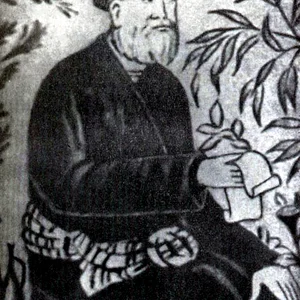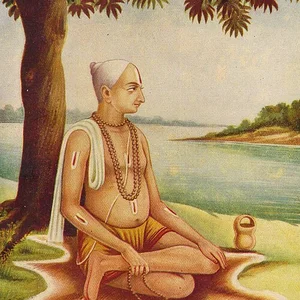

Hindu poet and saint from North India, a major figure of the bhakti devotional movement. He is the author of the Ramcharitmanas, a Hindi (Awadhi) retelling of the Ramayana epic, which popularized the worship of Rama among the common people.
Tulsidas(1532 — 1623)
Tulsīdās
6 min read
Frequently asked questions
Key Facts
- Born around 1532 in the region of present-day Uttar Pradesh, in North India
- Composed the Ramcharitmanas from 1574 onward, an Awadhi Hindi version of Valmiki's Ramayana
- Made the epic of Rama accessible to the common people by writing it in a vernacular language rather than in Sanskrit
- Author of the Hanuman Chalisa, a devotional hymn still recited today
- Died in 1623 in Varanasi (Benares), a holy city of Hinduism
Works & Achievements
A retelling of the Ramayana in Awadhi Hindi, a masterpiece of Hindi literature. It made the epic of Rama accessible to ordinary people and is still recited and performed (Ramlila) to this day.
A hymn of forty verses praising the monkey-god Hanuman. It is one of the most popular and most frequently recited Hindu prayers in the world.
A collection of poem-prayers addressed to Rama, expressing humble devotion and repentance. One of the poet's most intimate works.
A poetic anthology recounting episodes from the life of Rama in a variety of metres. It showcases the literary virtuosity of Tulsidas.
A collection of devotional songs retelling the story of Rama in lyrical form, meant to be sung. It enriches the bhakti musical tradition.
A collection of couplets (doha) condensing moral and spiritual teachings. Many have become popular proverbs in North India.
A poem on detachment and the wisdom of the renunciant. It sets out the ascetic ideal so dear to Tulsidas.
Anecdotes
Tradition holds that Tulsidas was so attached to his wife Ratnavali that one monsoon day he followed her all the way to her parents' home. She is said to have rebuked him, telling him that if he loved Rama as much as he loved her body, he would already have attained deliverance. These words are said to have triggered his renunciation of the world and his life as a devout ascetic.
It is said that Tulsidas began writing the Ramcharitmanas in Ayodhya in 1574, on the day of Rama Navami, the festival of Rama's birth. He took about two years and seven months to compose this immense poem of several thousand verses in Awadhi, the language of the common people rather than scholarly Sanskrit.
Legend has it that orthodox Brahmins of Benares, shocked that he was writing the sacred epic in a vulgar tongue rather than in Sanskrit, placed his manuscript at the bottom of the Vishvanath temple to put it to the test. By morning, the Ramcharitmanas is said to have been found at the top of the pile of holy Scriptures, bearing the inscription “satyam shivam sundaram” (the True, the Good, the Beautiful).
Tulsidas is traditionally credited with founding the Sankat Mochan temple in Benares, dedicated to the monkey-god Hanuman. Tradition asserts that Hanuman appeared to him in person at this spot, and that it was thanks to him that the poet was able to obtain a vision of Rama himself.
He is credited with the Hanuman Chalisa, a hymn of forty verses in honour of Hanuman, which remains today one of the most recited Hindu prayers in the world, from morning to night, in millions of homes across northern India.
Primary Sources
I bow before Sita and Rama, sovereigns of the universe, whose form is beyond words, the source of all beauty, an ocean of compassion.
Having cleansed the mirror of my mind with the dust of my master's feet, I sing the spotless glory of Raghuvar (Rama), who grants the four fruits of life.
O Rama, I have neither strength, nor intelligence, nor wealth; you alone are my refuge and my support, just as a child knows only its mother.
Tulsidas has no master other than Rama; a beggar, he sings from door to door the name that saves, without bowing before the powerful of this world.
Key Places
Village on the banks of the Yamunâ traditionally presented as the birthplace of Tulsîdâs. An ancient manuscript of the Ramcharitmanas is said to be preserved there.
Holy city regarded as the birthplace of the god Râma, where Tulsîdâs began composing his epic in 1574. The geographic heart of the cult of Râma.
Great spiritual city on the Ganges where Tulsîdâs spent much of his life, taught, and died. He is said to have founded the Sankat Mochan temple there.
Sanctuary dedicated to Hanumân whose founding is attributed to Tulsîdâs. Tradition places here the appearance of the monkey-god to the poet.
Sacred steps at the confluence of the Assi river and the Ganges, the traditional place of Tulsîdâs's death. A site of remembrance for his devotees.
Forested pilgrimage region linked to Râma's exile in the Râmâyana, frequented by Tulsîdâs. Tradition places here his vision of the god thanks to Hanumân.
Typical Objects

A string of 108 beads carved from the wood of the sacred tulsi plant (holy basil), used to tell and count the repetitions of the name of Rama. The japa, a murmured recitation, set the rhythm of the ascetic's day.

Handwritten scrolls or leaves in Devanagari script bearing the poem in Awadhi. Copied by hand by disciples, they spread the epic from village to village.

A vertical line of sandalwood paste or sacred clay drawn on the forehead, a sign of belonging to the Vaishnava devotees of Rama. It visibly marked one's consecration to the god.

A small water vessel, made from a dried gourd or copper, carried by wandering renunciants for ablutions and drinking. A symbol of the sadhu's stripped-down life.

A long wooden staff carried by the mendicant ascetic on the roads between Ayodhya, Benares and the holy places. A support for walking and an emblem of the renunciant.

A cloth dyed ochre-orange worn by Hindu renunciants, the colour of fire and detachment. It signalled to all the status of a man withdrawn from the world.
School Curriculum
Vocabulary & Tags
Key Vocabulary
Daily Life
Morning
Before dawn, Tulsidas would bathe in the cold waters of the Ganges, then draw the tilak on his forehead. He devoted the first hours to japa, murmuring the name of Rama as he told the beads of his tulsi rosary, and to the recitation of the Scriptures.
Afternoon
His days were spent composing and dictating his poems, teaching his disciples, and commenting on the Ramayana. He received pilgrims and devotees who came to hear him recite episodes from the epic of Rama.
Evening
Evenings gathered the faithful for kirtan, devotional songs accompanied by drums and cymbals, and for the public reading of the Ramcharitmanas. The night was given over to meditation and to the ascetic's sober rest.
Food
As a strict vegetarian renunciant, he lived on rice, wheat flatbread (roti), vegetables, milk, and fruit, often obtained through alms. He observed fasts and abstinences on holy days, refusing meat and alcohol.
Clothing
He wore the ochre-saffron robe of the sadhus, often a simple loincloth (dhoti) and a cotton shawl. The tulsi rosary around his neck and the Vaishnava mark on his forehead signaled his consecration to Rama.
Housing
He lived with great austerity, dwelling in hermitages (ashram), temples, or huts near the ghats of Benares. The renunciant owned almost nothing, content with a modest shelter on the banks of the sacred river.
Historical Timeline
Period Vocabulary
Liens externes & ressources
Références
Œuvres
Ramcharitmanas (Le Lac sacré des exploits de Râma)
vers 1574-1576
Hanumân Châlîsâ
fin XVIe siècle
Vinaya Patrikâ (La Pétition de l'humilité)
début XVIIe siècle
Kavitâvalî
début XVIIe siècle
Gîtâvalî
fin XVIe — début XVIIe siècle
Dohâvalî
début XVIIe siècle
Vairâgya Sandîpinî
début XVIIe siècle