 flip
flipPua'a tunu ahima'a
Pua'a tunu ahima'a
Why this dish? As tahu'a (high priest) of Ra'iatea, Tupaia presided over ceremonies on the marae where earth-oven pork was the central offering to the gods and the dish of honor at feasts. The ahima'a oven was a communal and sacred act, inseparable from the ritual life Tupaia mastered.
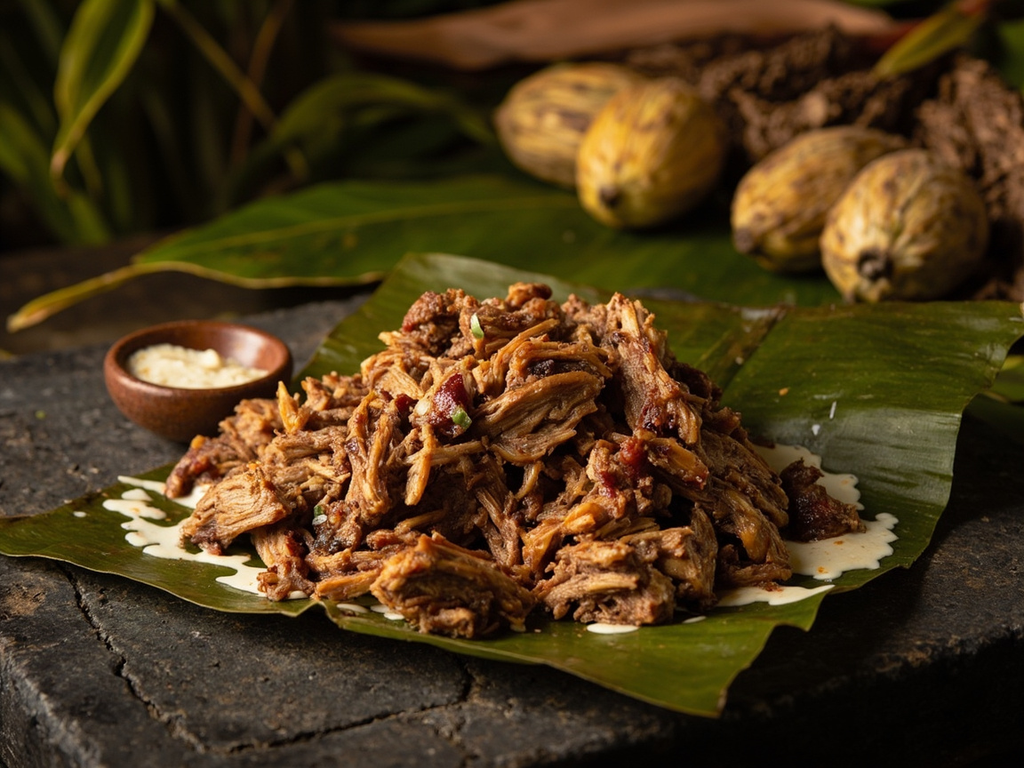
Whole pig or pieces slow-cooked in a pit dug in the earth, on a bed of hot volcanic stones, wrapped in banana and ti leaves. The residual heat of the stones roasts the meat for several hours, giving it incomparable tenderness and smoky flavor.
The pua'a of the ahima'a, that is the food the gods await on the marae. We dig the earth before dawn, we burn wood in it until the stones are white with heat. Then we lay the pig on those stones, cover it with ti and banana leaves, then with earth, and the earth cooks what fire alone could not cook so well. When we open the oven at nightfall, the scent rises like a prayer. I have seen English captains taste this meat and admit they had known nothing like it in London.
- •Whole pig or half carcass — A young pig (Main piece)
- •Ti leaves (Cordyline) — Several armfuls (Protective wrap and aroma)
- •Banana leaves — Several large leaves (Airtight wrap)
- •Volcanic stones — Enough to cover the oven floor (Heat source)
- •Sea salt — Rubbed onto the meat (Seasoning)
- •Coconut milk — One bowl to baste (Cooking juice)
Pua'a tunu ahima'a
Whole pig or pieces slow-cooked in a pit dug in the earth, on a bed of hot volcanic stones, wrapped in banana and ti leaves. The residual heat of the stones roasts the meat for several hours, giving it incomparable tenderness and smoky flavor.
Why this dish? As tahu'a (high priest) of Ra'iatea, Tupaia presided over ceremonies on the marae where earth-oven pork was the central offering to the gods and the dish of honor at feasts. The ahima'a oven was a communal and sacred act, inseparable from the ritual life Tupaia mastered.
The pua'a of the ahima'a, that is the food the gods await on the marae. We dig the earth before dawn, we burn wood in it until the stones are white with heat. Then we lay the pig on those stones, cover it with ti and banana leaves, then with earth, and the earth cooks what fire alone could not cook so well. When we open the oven at nightfall, the scent rises like a prayer. I have seen English captains taste this meat and admit they had known nothing like it in London.
Ingredients (period version)
- Whole pig or half carcass — A young pig (Main piece)
- Ti leaves (Cordyline) — Several armfuls (Protective wrap and aroma)
- Banana leaves — Several large leaves (Airtight wrap)
- Volcanic stones — Enough to cover the oven floor (Heat source)
- Sea salt — Rubbed onto the meat (Seasoning)
- Coconut milk — One bowl to baste (Cooking juice)
Ingredients
- Bone-in pork shoulder — 1.5 to 2 kg (Main piece)
- Banana leaves (Asian grocery or online) — 4 to 6 large leaves (Cooking wrap)
- Aluminum foil — Several sheets (replacing ti leaves) (Airtight wrap)
- Coarse salt — 2 tbsp (Seasoning)
- Coconut milk — 200 ml (Cooking juice)
- Water — 100 ml (Moisture)
Method
- Preheat oven to 150°C. Generously salt the pork shoulder on all sides.
- Briefly pass banana leaves over a flame or blanch them to soften.
- Lay the banana leaves crosswise in a large baking dish (or Dutch oven). Place the pork shoulder in the center.
- Pour coconut milk and water over it. Fold the banana leaves over to wrap the meat. Cover tightly with aluminum foil.
- Bake for 4 to 5 hours, until the meat falls apart with a fork.
- Open the wrap, increase oven to 220°C, and let the surface brown for 15 minutes.
- Shred the meat and serve with the reduced cooking juices, accompanied by taro or breadfruit.
How it was made : The ahima'a (earth oven) is the ceremonial cooking method throughout Polynesia, described in detail by Cook, Banks, and Parkinson in Tahiti in 1769. Pigs, introduced by the first Polynesians, were the sacrificial animal par excellence on the marae. Only men of rank — including tahu'a like Tupaia — had access to the finest cuts during rituals.
The contemporary twist : Serve the shredded meat on a bed of purple taro purée, drizzled with reduced coconut juice, for a spectacular visual effect.
Sources : Cook, James. The Journals of Captain James Cook. Hakluyt Society, 1955–1974. · Oliver, Douglas L. Ancient Tahitian Society. University of Hawaii Press, 1974. · Kirch, Patrick V. On the Road of the Winds: An Archaeological History of the Pacific Islands. University of California Press, 2000.
Tupaia · Charactorium