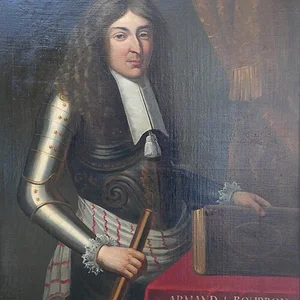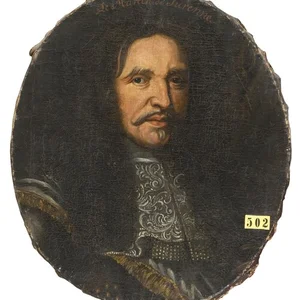

Turenne was one of the greatest French military commanders of the 17th century. Marshal General under Louis XIV, he distinguished himself during the Thirty Years' War and the campaigns in Holland, where he was killed by a cannonball at Sasbach in 1675.
Turenne(1611 — 1675)
Henri de La Tour d'Auvergne
France
6 min read
Frequently asked questions
Key Facts
- Born in 1611 in Sedan into a Protestant family, son of the Duke of Bouillon
- Appointed Marshal of France in 1643 after his victories during the Thirty Years' War
- An ambiguous figure in the Fronde (1648-1653), first against and then in the service of the king
- Granted the exceptional dignity of Marshal General of the King's Camps and Armies in 1660
- Killed by a cannonball at Sasbach on 27 July 1675 during the Franco-Dutch War
Works & Achievements
During the Fronde, Turenne defeats Condé at the gates of Paris and saves the authority of the young Louis XIV, sealing his loyalty to the crown.
A decisive victory against Spain near Dunkirk, which hastened the signing of the Peace of the Pyrenees in 1659.
A masterpiece of mobile warfare: through a surprise march in the dead of winter, Turenne drove the Imperial forces back beyond the Rhine and liberated Alsace.
Turenne perfected maneuver, the coordination of infantry, cavalry, and artillery, and positional warfare; his campaigns were studied by the great strategists, including Napoleon.
An account of his campaigns left by Turenne, a valuable testimony on the art of war and the strategy of his time.
An exceptional title created for him, placing him at the summit of the French military hierarchy, above the other marshals.
Anecdotes
Turenne was famous for his legendary calm in battle. The story goes that before one engagement, feeling his body tremble with fear, he reproached himself: “You tremble, carcass, but you would tremble far more if you knew where I am about to take you!” The line has remained celebrated as the very image of courage mastering fear.
Born a Protestant and raised in his family's Calvinist faith, Turenne converted to Catholicism in 1668, at the age of 57, after long reflection and under the influence of **Bossuet**. His conversion caused a great stir at the court of **Louis XIV**, for he was one of the most illustrious Protestants in the kingdom.
Turenne was killed on **27 July 1675** at **Sasbach**, struck by a cannonball as he observed the enemy before battle. His death caused immense shock throughout the army and the whole kingdom; it is said that his soldiers wept and that **Louis XIV** ordered an exceptional period of mourning.
In a signal honour, **Louis XIV** had Turenne buried in the **Basilica of Saint-Denis**, the necropolis of the kings of France — an extremely rare privilege for a man who was not of royal blood. Later, **Napoleon** had his tomb moved to **Les Invalides**, placing him among the great military glories of the nation.
As an adolescent, the young **Henri**, frail of health and afflicted with a stutter, wanted to prove his toughness. Legend has it that he spent an entire night asleep on the carriage of a cannon on the ramparts to demonstrate his endurance — a foretaste of the hard soldier's life he would go on to lead.
Primary Sources
My design was to cross the Rhine and attack the enemy in his quarters, in order to compel him to withdraw from Alsace.
Nothing remains now but the tomb of Turenne and his glory. This great man, whose modesty equaled his valor, has fallen in the midst of his triumphs.
Monsieur de Turenne was killed this morning... The whole army weeps; this is all I know, and the extreme grief in which we all find ourselves.
Of all the captains, Turenne was the one who spared himself the least and who exposed his person with the greatest composure.
Key Places
Protestant principality where Turenne was born in 1611, a stronghold of the powerful La Tour d'Auvergne family.
Village in Germany, on the right bank of the Rhine, where Turenne was killed by a cannonball on 27 July 1675. A monument there commemorates his death.
Site of the decisive victory of January 1675 which, at the end of a daring winter campaign, freed Alsace from the Imperial forces.
Site of the Battle of the Dunes in 1658, a Franco-English victory over Spain that opened the way to the Peace of the Pyrenees.
Necropolis of the kings of France where Louis XIV had Turenne buried, an exceptional honour for a non-royal subject.
Place where Napoleon had Turenne's tomb transferred, ranking him among the great military glories of France.
Typical Objects

Blue baton strewn with golden fleurs-de-lis, the supreme insignia of military command. **Turenne** received it in **1643**, then became Marshal General in **1660**.

A long straight sword carried by officers and cavalry in the 17th century, a hand-to-hand weapon and a mark of the warrior nobility.

A steel breastplate protecting the torso, still worn by heavy cavalry officers. **Turenne** often fought on the front line, in his cuirass.

A spherical iron projectile fired by artillery. It was a cannonball that killed **Turenne** at **Sasbach** in **1675**, making this object the symbol of his death.

A portable firearm, first matchlock then flintlock, that equipped the infantry. **Turenne** knew how to integrate musketeers and pikemen into mobile tactics.

A handwritten map of the theaters of operations, rivers and fortified strongholds, an essential tool for planning campaigns and maneuvers.

The indispensable mount of the army commander, who directed operations on horseback and sometimes led the cavalry charges.
School Curriculum
Vocabulary & Tags
Key Vocabulary
Daily Life
Morning
On campaign, Turenne rose early to inspect the outposts and read the scouts' reports. He studied terrain maps and held council with his officers before the heat or the enemy dictated the day's movements.
Afternoon
The afternoon was spent directing marches, scouting enemy positions on horseback, and organizing the camps. Renowned for exposing himself to danger, he often went to observe the opposing line himself, sometimes perilously close.
Evening
In the evening, he dictated his correspondence to the court and to Louvois, reviewed the state of provisions and ammunition, and prepared the next day's orders. A sober man, he allowed little room for amusement in time of war.
Food
On campaign, Turenne shared a frugal fare: ration bread, salted meat, soup, and wine cut with water. He was known for his simplicity and did not seek out the lavish table of the great lords.
Clothing
He wore the military dress of the time: a *justaucorps*, leather boots, a plumed hat, and a command sash, donning his cuirass in battle. His attire remained plain compared with the splendor of the court.
Housing
In war, he lodged in the general's tent or in houses requisitioned over the course of the campaigns. In peacetime, he resided in Paris at his town house and frequented the court of **Louis XIV**.
Historical Timeline
Period Vocabulary
Liens externes & ressources
Références
Œuvres
Victoire du faubourg Saint-Antoine
1652
Bataille des Dunes
1658
Campagne d'hiver d'Alsace et victoire de Turckheim
1674-1675
Réforme de l'art militaire français
milieu du XVIIe siècle
Mémoires
rédigés vers 1659-1675
Dignité de maréchal général des camps et armées du roi
1660