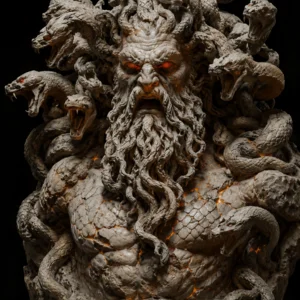

Typhon is the ultimate monster of Greek mythology, born of Gaia and Tartarus. A giant with a hundred fire-breathing serpent heads, he challenged Zeus for dominion over the cosmos and was ultimately crushed beneath Mount Etna. He is considered the father of all monstrous creatures.
Typhon
Typhon
8 min read
Frequently asked questions
Key Facts
- Born of Gaia (the Earth) and Tartarus, he is one of the last primordial children
- Possesses a hundred serpent heads and a voice capable of imitating every animal
- Challenges Zeus in a titanic battle for sovereignty over the world
- Defeated, he is imprisoned beneath Mount Etna in Sicily, whose volcanic eruptions he causes
- Father, with Echidna, of famous monsters: Cerberus, the Lernaean Hydra, the Chimera, and the Sphinx
Works & Achievements
The first complete account of the Typhon myth in Greek literature. Hesiod describes his birth, his battle against Zeus, and his imprisonment beneath Mount Etna, establishing the definitive mythological canon.
This text evokes the defeated Typhon and links his downfall to Apollo's founding of Delphi, connecting the primordial monster to the cultural and religious order of ancient Greece.
Pindar celebrates the victory of King Hiero of Syracuse over his enemies by comparing it to Zeus's triumph over Typhon, turning the myth into a political metaphor for the victory of order over chaos.
Aeschylus invokes Typhon as the embodiment of primordial forces opposed to Zeus, placing the monster within a broader reflection on divine power and resistance to the cosmic tyrant.
Ovid retells and Latinizes the myth of the gods' flight from Typhon, using it to explain the animal forms of Egyptian deities and ensuring the transmission of the myth into Roman culture.
The most detailed mythological compilation from Antiquity concerning Typhon: his birth, the battle, the episode of the severed sinews, and Zeus's ultimate victory. This text is the primary reference for modern scholars.
Anecdotes
Typhon was so terrifying that the gods of Olympus fled all the way to Egypt, disguising themselves as animals to escape him. Even Zeus hesitated before facing the monster — something utterly unique in all of Greek mythology: never before had the master of the gods shrunk back from an opponent.
During their titanic battle, Typhon managed to sever the tendons of Zeus's hands and feet, leaving him temporarily powerless. It was the god Hermes, aided by Pan, who recovered the stolen tendons and returned them to Zeus, allowing the king of the gods to re-enter the fight.
Typhon and his mate Echidna — half woman, half serpent — gave birth to the most famous monsters in mythology: Cerberus the three-headed dog, the Lernaean Hydra, the Chimera, the Sphinx, the Caucasian Eagle, and Orthrus. They are known as 'the parents of all monsters.'
The ancient Greeks believed that the volcanic eruptions of Mount Etna were caused by Typhon, imprisoned beneath the Sicilian volcano. Each time the monster struggled against his chains, the mountain spewed fire and ash — a mythological explanation for very real volcanic phenomena.
The name 'Typhon' gave rise to the word 'typhoon' in modern languages, used to describe violent tropical storms. Greek sailors associated storms with the monster's rage, keeping his memory alive in our everyday weather vocabulary.
Primary Sources
When Zeus had driven the Titans from heaven, the great Earth bore her youngest child Typhon, by the union of golden Aphrodite — a monster with a hundred dreadful serpent heads, who licked with their dark tongues.
Where Typhon lies, struck down by the thunderbolt of Cronus's son, on the broad plains of Cilicia, beneath the waters of the sea.
Typhon of the hundred heads, once nurtured in the famous Cilician cave, is now held fast by the sea cliffs and Mount Etna pressing upon him with its snowy breast.
Typhon rushed upon the gods; seized with fear, they fled to Egypt and, pursued, transformed themselves into animals. Zeus struck the monster with his thunderbolts and attacked him with a sickle of adamant.
The heavenly gods concealed their forms beneath false shapes. Jupiter became a ram, Apollo a crow, Bacchus a goat, Diana a cat, Venus a fish, to flee from Typhon.
Key Places
Volcano beneath which Typhon is imprisoned according to the most widespread myth. Eruptions were explained by the monster's efforts to break free from his divine chains.
Region on the southern coast of Anatolia where some versions place Typhon's birth and the site where Zeus had his tendons stolen before resuming the battle.
The primordial abyss beneath the Underworld, said to be Typhon's birthplace according to Hesiod. Tartarus is the deepest place in the Greek universe, as far below the Earth as the sky is above it.
Home of the Olympian gods, which Typhon sought to conquer by storming Olympus. His attempt to overthrow Zeus represents the greatest threat ever faced by the divine order.
Land of refuge where the Olympian gods, terrified by Typhon, fled by transforming themselves into animals. This myth explained to the Greeks why Egyptian gods took animal forms.
Typical Objects

A divine weapon forged by the Cyclopes, the thunderbolt is the instrument of Zeus's victory over Typhon. It is by striking the monster with his lightning bolts that Zeus finally manages to overpower him and imprison him.

A razor-sharp blade made of adamant (an indestructible divine metal), used by Zeus in battle against Typhon according to some versions of the myth. This same sickle had previously been wielded by Cronus and Perseus.

A defining feature of Typhon himself, his hundred dragon heads breathed flames and produced the cries of every wild beast. They symbolize primordial chaos and the multiplicity of threats against the divine order.

After his defeat, Typhon is bound beneath Mount Etna by indestructible divine chains. These chains represent the Olympian order triumphing once and for all over primordial chaos.

The Sicilian volcano serves as both the prison and the emblem of the defeated Typhon. The ancient Greeks interpreted Etna's eruptions as the thrashings of the chained monster struggling to break free.

During the battle, Typhon manages to sever the sinews from Zeus's limbs and hides them in a cave in Cilicia. This unique episode reveals the terrifying power of the monster, who is capable of temporarily incapacitating the king of the gods.
School Curriculum
Vocabulary & Tags
Key Vocabulary
Daily Life
Morning
As a primordial mythological entity, Typhon experiences no day in the human sense. Imprisoned beneath Mount Etna, his first morning convulsions shake Sicily, sending up the day's earliest plumes of vapor and ash. The lava rising through the craters corresponds to the monster's first furious sighs at dawn.
Afternoon
At the height of the day, when the heat is most intense, the ancient Greeks imagined Typhon straining to break his divine chains. His hundred serpent heads breathe fire, feeding the volcanic furnace. The tremors of the afternoon match the volcano's most intense rumblings.
Evening
With the coming of night, Typhon rages against Zeus and the Olympians in the subterranean darkness. The nocturnal lava flows lighting up the slopes of Etna represented, for the Greeks, the still-burning fury of the imprisoned monster — unable to forget his defeat at the hands of the king of the gods.
Food
Typhon is a cosmic force, not a biological being: he does not feed the way humans or animals do. In mythological accounts, he symbolically devours everything that stands against him — he represents the chaos that 'consumes' order. Some texts suggest he absorbs the energy of the earth itself through his mother Gaia.
Clothing
Typhon is described as an entirely primal, natural being — he wears no clothing and bears no artificial attributes. His immense body is covered in serpent scales from the thighs down, his hundred dragon heads form a terrifying crown, and his vulture wings serve as his only 'cloak.' He embodies wild, untamed nature in its most extreme form.
Housing
Before his defeat, Typhon dwelt in a vast cave in Cilicia (along the southern coast of present-day Turkey), a sprawling underground cavern befitting a monster of his size. After his defeat, his eternal 'home' became the belly of Mount Etna in Sicily — a volcanic prison imposed by Zeus. This forced dwelling is at once his jail and his symbolic tomb.
Historical Timeline
Period Vocabulary
Visual Style
Style illustration sombre inspiré de la céramique grecque antique et de l'art fantastique épique : géant serpentin aux cent têtes crachant le feu, foudre dorée de Zeus, éruption volcanique, contrastes dramatiques noir et rouge volcanique.
Sound Ambience
Ambiance sonore volcanique et primordiale mêlant sifflements de serpents, grondements souterrains de l'Etna, tonnerre divin et rugissements chaotiques des bêtes sauvages.
Liens externes & ressources
Références
Œuvres
Théogonie — Hésiode
vers -700
Hymne à Apollon pythien — Hymnes homériques
vers -650
Pythiques I — Pindare
vers -470
Prométhée enchaîné — Eschyle
vers -460
Métamorphoses — Ovide
vers -1
Bibliothèque — Apollodore
IIe siècle