
Cixi was the true ruler of imperial China for nearly fifty years, first as regent and then as the actual holder of power. Born into modest rank, she established herself at the Qing court and profoundly shaped China's destiny in the face of Western imperialism.
Tzu-Hsi (Cixi)
Cixi (Tzu-Hsi), Empress Dowager of China
10 min read
Frequently asked questions
Famous Quotes
« Better to rule than to serve.»
« I have never wanted anything but power, and now that I have it, I must wield it alone.»
Key Facts
- 1835: Birth of Cixi into a Manchu family of modest rank
- 1861: Becomes regent upon the death of Emperor Xianfeng, alongside Empress Ci'an
- 1898: Ends Emperor Guangxu's Hundred Days' Reform and has him placed under arrest
- 1900: Ambiguous support for the Boxer Rebellion, followed by flight from Beijing during the Eight-Nation Alliance intervention
- 1908: Dies the day after Emperor Guangxu, having effectively ruled China for nearly 50 years
Works & Achievements
Cixi had the Summer Palace — destroyed by Anglo-French troops in 1860 — rebuilt, partly using funds earmarked for the imperial navy. The complex is today a UNESCO World Heritage Site and remains one of the most beautiful imperial gardens in the world.
Cixi retook full control of the government by annulling Emperor Guangxu's reforms, having six reformers executed, and placing the emperor under house arrest. This act illustrates her absolute political mastery and her rejection of a modernization that would have marginalized her.
Following the humiliation of the Boxer Uprising, Cixi paradoxically launched the most ambitious reforms of her life: abolition of the imperial examination system in 1905, the establishment of modern schools, judicial reform, and the drafting of a constitution. Too late to save the dynasty, they nonetheless brought lasting change to Chinese society.
Cixi practiced traditional Chinese ink painting daily and signed her works with her own imperial seal. Several of her paintings are held in American and European museums, where they were sent as diplomatic gifts.
To restore China's image after the Boxer disaster, Cixi organized official receptions at the Forbidden City for the wives of foreign ambassadors, breaking with centuries of ceremonial isolation maintained by the imperial court.
Anecdotes
Born into a modest Manchu family, Yehe Nara was selected as a concubine of Emperor Xianfeng at around the age of sixteen. Her rise was accelerated by the birth, in 1856, of the emperor's only son: upon Xianfeng's death in 1861, she established herself as regent, skillfully outmaneuvering the eight officials appointed to govern in her place.
A passionate devotee of Peking opera, Cixi had a lavish three-story theater built at the Summer Palace and did not hesitate to correct performers mid-show if a note or gesture displeased her. She readily identified with Guanyin, the Buddhist goddess of compassion, and had herself photographed dressed in the goddess's robes — an entirely unprecedented display for a Chinese sovereign.
In 1898, Emperor Guangxu attempted to modernize China through one hundred days of sweeping reforms. Cixi responded with ruthless speed: she had the reformers arrested, ordered the execution of six of them — the “Six Martyrs of Wuxu” — and placed the emperor under house arrest on an island in the imperial lake, where he remained a prisoner until his death ten years later.
When the Eight-Nation Alliance seized Beijing in August 1900, Cixi fled the Forbidden City disguised as an ordinary Manchu peasant woman, leaving for the first time in her life the palace she had almost never left. She made her way to Xi’an, over 1,000 kilometers away, in covered carts, passing through devastated provinces, before negotiating from a distance the Boxer Protocol — a treaty that condemned China to pay 450 million taels of silver.
Cixi died on November 15, 1908, one day after Emperor Guangxu, whose sudden death at the age of 37 remains suspicious: modern analyses carried out in 2008 revealed massive levels of arsenic in his hair, confirming the hypothesis that he was poisoned on orders to prevent him from reclaiming power. Her last words, as recorded in court chronicles, are said to have been: “Never again allow a woman to rule China.”
Primary Sources
The Empress Dowager resumes the conduct of State affairs. The Emperor, whose health is gravely impaired, has beseeched Us to govern in his name. We answer this call in a spirit of devotion to the dynasty and the people.
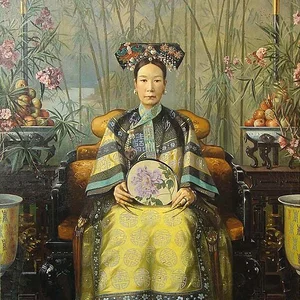
The Empress Dowager was clad in imperial yellow silk embroidered with golden dragons, and wore a headdress adorned with fresh flowers and green jade jewels. Her gaze was piercing, and her natural authority commanded everyone present without her ever needing to raise her voice.
The Peking court is entirely dominated by the will of the Empress Dowager. No important decision is made without her approval. She possesses an exceptional political intelligence and an ability to maneuver between factions that commands the admiration of anyone who follows Chinese affairs.
China undertakes to pay an indemnity of four hundred and fifty million taels of silver, payable over thirty-nine years with interest. Fortifications shall be erected in Peking for the permanent protection of the foreign legations.
Her Majesty took up her brush each morning before any audience. She painted her peonies with a confidence that was hers alone, and presented the finest canvases to foreign ambassadors as a sign of imperial favor.
Key Places
Imperial palace where Cixi lived and ruled for most of her life, presiding over audiences in the Hall of Heavenly Purity. She died there on 15 November 1908, after half a century in power.
Summer residence rebuilt by Cixi between 1888 and 1895, partly with funds diverted from the imperial navy. She spent several months there each year; this complex of gardens and pavilions surrounding an artificial lake is now a UNESCO World Heritage Site.
Imperial summer retreat where Emperor Xianfeng died in 1861. It was here that Cixi orchestrated her coup against the eight regents appointed by the late emperor, laying the foundation for her rise to power.
City where Cixi took refuge when international forces seized Beijing in 1900, spending over a year in exile before negotiating the Boxer Protocol and making a triumphant return to the capital in 1902.
Necropolis of the Qing dynasty where Cixi was interred in a lavish tomb she had commissioned and decorated during her lifetime. The tomb was looted by soldiers in 1928, and Cixi's remains were desecrated.
Typical Objects
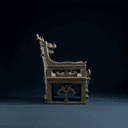
The imperial seat lacquered in red and gold, adorned with carved dragons, the supreme symbol of power in China. Cixi presided over it during grand audiences, sometimes concealed behind a curtain of yellow gauze in accordance with the regency protocol.

Cixi was an accomplished painter who practiced the art of the brush each morning in the traditional Chinese style. Her paintings of peonies, wisterias, and bamboo — bearing her personal seal — were offered to foreign dignitaries as diplomatic gifts.

Bracelets, hairpins, and medallions made of green nephrite jade, a color reserved for the imperial family. Cixi owned one of the largest jade collections at the Qing court and wore pieces on every occasion.
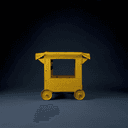
A litter of lacquered wood and yellow silk carried by sixteen eunuchs, used for all of Cixi's movements within the Forbidden City and to the Summer Palace. Yellow was the exclusive color of supreme imperial authority.
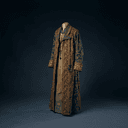
Elaborately embroidered stage garments in vivid colors, of which Cixi was a devoted admirer. She had a three-story theater built at the Summer Palace and knew many classical roles by heart.
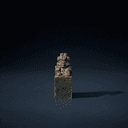
A jade stamp affixed to official edicts, whose possession conferred legal authority over all acts of government. Cixi jealously controlled the imperial seals — the concrete and symbolic instrument of her power.

From 1903 onward, Cixi agreed to be photographed — notably by her lady-in-waiting Xunling. These official portraits, among the first ever taken of a Chinese sovereign, were circulated abroad to rehabilitate her image in the wake of the Boxer catastrophe.
School Curriculum
Vocabulary & Tags
Key Vocabulary
Daily Life
Morning
Cixi rose before dawn and began her day with a lengthy ritual toilette: her attendants helped style her Manchu wide-tray coiffure, adorned with fresh flowers and jade jewelry renewed each morning. She then took a light first meal — rice porridge and vegetables — before a session of painting or calligraphy, which she regarded as a spiritual discipline as much as an artistic one.
Afternoon
Afternoons were devoted to official audiences, which Cixi presided over from her throne, sometimes concealed behind a curtain of yellow gauze in keeping with regency protocol. She received ministers, generals, and, from 1902 onward, occasionally foreign female representatives. Between sessions, she enjoyed boating on Kunming Lake at the Summer Palace, accompanied by her ladies-in-waiting.
Evening
Evenings were often enlivened by Beijing opera performances, which Cixi followed with an expert's attention, sometimes interrupting the performers to correct a note or a gesture. She then dined on an elaborate meal served in silence by eunuchs, before retiring to her apartments, decorated with her own paintings and precious vases.
Food
Cixi's table theoretically featured more than a hundred dishes at each meal, prepared by a brigade of over a hundred cooks, though she would actually taste only about ten of them. She was fond of lacquered duck, lotus soup, millet porridge, and pork dumplings; she was also renowned for her pronounced taste for sweets and candied fruit.
Clothing
Cixi wore Manchu-style robes (qipao) in embroidered silk in shades of imperial yellow, mauve, or purple, adorned with peony, dragon, and phoenix motifs. She wore platform shoes of lacquered wood, a traditional Manchu style that gave her a distinctive gait. Her outfits changed several times a day according to protocol requirements.
Housing
Cixi resided primarily in the Dowager Empress's apartments in the Forbidden City, and later at the Summer Palace, which she had lavishly embellished at great expense. Her apartments were furnished with rosewood and lacquered furniture, Jingdezhen porcelain, and her walls were adorned with her own paintings as well as calligraphy by great masters.
Historical Timeline
Period Vocabulary
Liens externes & ressources
Références
Œuvres
Reconstruction du Palais d'Été (Yiheyuan)
1888-1895
Coup d'État du 21 septembre 1898 et répression des Cent Jours
Septembre 1898
Nouvelles Politiques (Xinzheng, 新政)
1901-1908
Peintures à l'encre : pivoines, wistérias, bambous
circa 1890-1908
Protocole d'ouverture diplomatique — réceptions des épouses d'ambassadeurs
1902