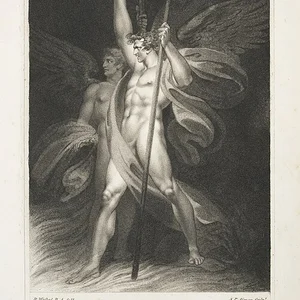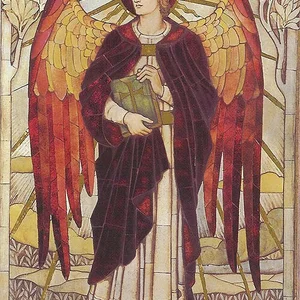

Uriel is one of the major archangels of the Abrahamic traditions, whose name means "Fire of God" or "Light of God". He is associated with divine wisdom, repentance, and the guardianship of Eden with a flaming sword.
Uriel
Uriel
8 min read
Frequently asked questions
Key Facts
- Uriel appears in the Book of Enoch (2nd–1st century BCE), one of the most influential apocryphal texts
- His name means "Fire of God" or "Light of God" in Hebrew
- He is charged with guarding the gate of Eden with a flaming sword, according to certain traditions
- Recognized as an archangel in the Orthodox Church and in some Catholic traditions, but not canonized in the standard Christian Bible
- Associated with the transmission of the Torah to Moses according to certain apocryphal texts
Works & Achievements
A foundational text of Jewish angelology in which Uriel appears as Enoch's guide through the heavens and revealer of celestial mysteries. It is the richest and oldest document on Uriel's role.
A Jewish apocalyptic text preserved in the Latin Vulgate in which Uriel answers the prophet Ezra's existential questions about divine justice following the destruction of the Temple. He plays the central role of interpreting angel.
A retelling of Genesis and Exodus, this text presents Uriel as the angel who reveals the Law to Moses and warns Noah of the flood, extending his role as a protective messenger of humanity.
An apocryphal text that depicts Uriel at the expulsion of Adam and Eve from paradise, brandishing a flaming sword. It is one of the essential sources for the iconography of Uriel as guardian of Eden.
The English astrologer John Dee claimed to have received from the archangel Uriel an angelic alphabet and language (Enochian). This work had a lasting influence on Western esotericism and the modern portrayal of Uriel.
Anecdotes
In the Book of Enoch, written between the 3rd and 1st centuries BCE, Uriel guides the patriarch Enoch through the celestial spheres and reveals to him the secrets of the cosmos: the movement of the stars, the reckoning of the solar calendar, and the divine laws governing the universe. This role as revealer makes Uriel a central figure in Jewish apocalyptic literature.
In the book of 4 Ezra (2nd century CE), Uriel appears to the prophet Ezra, who is in despair following the destruction of Jerusalem by the Babylonians. He poses a series of riddles about the nature of the world — weighing fire, measuring the wind — to help him understand that human reason cannot grasp the ways of God.
According to several Jewish apocryphal traditions, it was Uriel who was sent to warn Noah of the impending flood, commanding him to build the ark to save the living. This role as a forewarning messenger illustrates his function as a protector of humanity in the face of divine catastrophe.
In 745, at a synod held in Rome under Pope Zachary, Uriel was officially removed from the list of archangels recognized by the Catholic Church, on the grounds that his veneration was spreading in an uncontrolled manner. This episode reveals the historical tension between popular angelology and ecclesiastical authority.
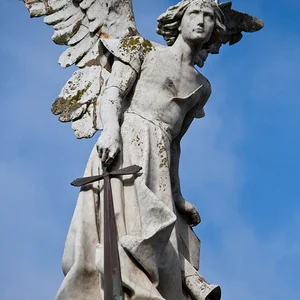
In medieval iconographic tradition, Uriel is often depicted holding a flame or a flaming sword, symbolizing his guardianship of the Garden of Eden following the expulsion of Adam and Eve. Some theologians identify him with the angel of 'four faces' mentioned in the Book of Ezekiel.
Primary Sources
And Uriel said to me: these are the angels who fornicated with women. Their spirits, taking many forms, defile men and will lead them into error until the great day of judgment.
The angel who had been sent to me, whose name was Uriel, answered me: has your heart been troubled on account of this present life? If you are troubled now, what will it be when you see what the Most High has reserved?
Michael called all the angels saying: worship the image of God, as the Lord God has fashioned it. And Uriel bore the fire of the sword before Adam to drive him out of paradise.
And the Lord commanded the angel Uriel to descend and reveal to Noah all the remedies against the diseases that the demons brought upon his children.
The names of the angels reveal their properties: some carry the divine light like a purifying fire, illuminating those they visit with the splendor of heavenly wisdom.
Key Places
Uriel is identified as the guardian of the entrance to the Garden of Eden after the expulsion of Adam and Eve, wielding the flaming sword. This mythical place is the setting of his first and most celebrated divine mission.
The Essene community of Qumran, whose manuscripts were discovered in 1947, gave a central place to the solar calendar revealed by Uriel to Enoch. These texts are among the oldest testimonies to Uriel's role.
The center of Jewish prophetic and apocalyptic traditions, Jerusalem is where 4 Ezra was written and the historical context for most of the texts in which Uriel appears as a divine messenger to the prophets.
A major hub of Hellenistic Judaism and syncretic thought, Alexandria played a crucial role in the spread and translation of apocryphal texts featuring Uriel, particularly within the circles responsible for the Septuagint.
In 745, it was in Rome that the synod of Pope Zachary officially debated and settled the question of Uriel's status, deciding to remove him from the archangels recognized by the Catholic Church.
Typical Objects

Uriel's most iconic symbol, the sword of fire is the weapon that guards the entrance to the Garden of Eden after the expulsion of Adam and Eve (Genesis 3:24). It represents both divine justice and the impassable boundary between the earthly world and paradise.

Uriel is often depicted carrying a flame in his hand, a symbol of the divine light from which his name derives its meaning. This flame illuminates souls and guides humanity toward heavenly wisdom.

In the Enochic texts, Uriel transmits to Enoch the secrets of the cosmos recorded on heavenly tablets or scrolls. He embodies the angel of revelation and transmitted knowledge.

Uriel reveals to Enoch the laws of the solar calendar, regarded as the only divine calendar. This role as revealer of time is symbolized by astronomical measuring instruments in certain medieval depictions.

In certain late apocryphal traditions, Uriel is associated with the judgment of souls and depicted holding a set of scales — the universal instrument for weighing merit — sometimes wreathed in divine flames.

As the guardian of the celestial luminaries in the Book of Enoch, Uriel is sometimes depicted with an armillary sphere or globe, symbolizing his dominion over the sun, the moon, and the stars.
School Curriculum
Vocabulary & Tags
Key Vocabulary
Tags
Daily Life
Morning
According to apocryphal texts, Uriel presides over the rising of the sun and guides the celestial luminaries in their daily course. Each dawn, he carries out the mission God entrusted to him: maintaining cosmic order and divine light over the world.
Afternoon
In the imagery of the Enochic texts, Uriel watches from the heavenly heights over the entrance to the Garden of Eden, flaming sword in hand, ensuring that no mortal may enter. He also answers the calls of prophets seeking divine revelations.
Evening
In the evening, Uriel accompanies the stars in their nightly course and watches over the cycles of time revealed to Enoch. In 4 Esdras, it is often at nightfall that he visits the prophet to deliver God's visions and answers.
Food
As a purely spiritual being in Abrahamic theology, Uriel has neither body nor material needs. His 'nourishment' is divine contemplation and the light of God — the very meaning his name embodies. Some apocryphal texts speak of angels who feed on divine glory.
Clothing
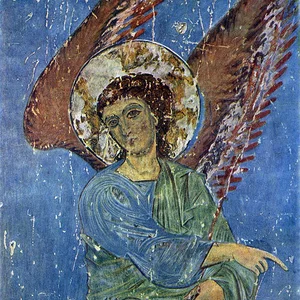
Medieval iconographic representations clothe Uriel in sumptuous robes in the colors of fire — red, gold, and white — adorned with celestial motifs. He is always surrounded by a golden light, and his six wings are spread wide, symbolizing his nature as a superior being in the celestial hierarchy.
Housing
Uriel dwells in the upper celestial spheres, at the edge of the paradise he is charged with guarding. In the cosmology of the Book of Enoch, he inhabits the fourth heaven, near the sun of which he is the driver and keeper, in a dwelling of light and fire.
Historical Timeline
Period Vocabulary
Visual Style
Style enluminure byzantine sur fond or, avec des tonalités de feu (ambre, cramoisi) contrastant avec des bleus célestes profonds, évoquant la lumière divine et la frontière entre ciel et terre.
Sound Ambience
Une atmosphère majestueuse et solennelle mêlant chants sacrés, crépitement du feu divin et murmures cosmiques, évoquant la frontière entre le monde céleste et la terre.
Liens externes & ressources
Références
Œuvres
1 Hénoch (Livre d'Hénoch éthiopien)
IIIe-Ier siècle av. J.-C.
4 Esdras (2 Esdras)
Fin Ier siècle apr. J.-C.
Livre des Jubilés
IIe siècle av. J.-C.
Vie d'Adam et Ève (Apocalypse de Moïse)
Ier siècle apr. J.-C.
Révélations enochéennes de John Dee
1582-1589