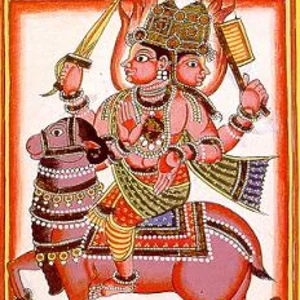

Ushas is the goddess of the dawn in Vedic and Hindu mythology. Celebrated in the Rigveda, she personifies the rising morning light that chases away the darkness and awakens the living world.
Ushas
Ushas
6 min read
Frequently asked questions
Key Facts
- Goddess of the dawn and one of the most celebrated deities of the Rigveda (around 1500-1000 BCE)
- Around twenty hymns of the Rigveda are entirely dedicated to her
- Daughter of Dyaus (the Sky) and sister of Ratri (the Night), she is associated with the twin Ashvins
- Depicted as a radiant young woman who chases away the darkness and awakens living beings each morning
- Related by function to other Indo-European dawn goddesses such as the Greek Eos or the Roman Aurora
Works & Achievements
Some twenty hymns devoted entirely to the goddess, among the most poetic in the whole collection.
An emblematic hymn to the dawn, often cited as one of the most beautiful poems of ancient India.
A series of hymns to the dawn attributed to the sage Vasishtha, describing the daily return of Ushas.
Ushas's daily feat: she dispels the night and opens the way for Surya, the Sun.
At daybreak, Ushas wakes humans, beasts, and birds, setting the world back into motion and to work.
Ushas precedes and announces the Ashvins, the twin horseman gods associated with the dawning light.
Anecdotes
Ushas is one of the most celebrated goddesses in the Rigveda: around twenty hymns are entirely devoted to her, and her name appears more than three hundred times. Yet, surprisingly, she would almost completely vanish from classical Hinduism over the following centuries.
The name Ushas shares the same origin as the Romans' Aurora and the Greeks' Eos: all three go back to a dawn goddess of the distant Indo-European language, reconstructed by linguists as *Hausōs. Comparing these three goddesses is like reuniting three sisters separated more than 4,000 years ago.
Vedic poets highlight a paradox: Ushas is reborn identical and forever young each morning, yet with each of her returns she 'wears away' a little more of the lives of the mortals who watch her pass by. She is thus both immortal and a maker of old age.
Ushas has a sister, Ratri, the Night. Far from fighting each other, the two sisters follow the same path and relieve one another endlessly: when one withdraws, the other steps forward, sharing time with perfect regularity.
A famous hymn (Rigveda 1.92) compares Ushas to a dancer who puts on her finest attire and bares her breast of light "like a cow offers its udder" — a bold image for how the dawn gradually reveals itself to the world.
Primary Sources
This light has come, the fairest of all lights; born is the brilliant brightness that spreads afar. Night, sent away for the coming of Savitar, has yielded her place to the Dawn.
Dawn upon us with prosperity, O Ushas, Daughter of the Sky; dawn with great glory, goddess, Lady of the Light, dawn upon us with riches, O bounteous one.
Like a dancer, she puts on her gleaming ornaments; she bares her breast as the cow offers her udder.
She has shone forth like a young woman, stirring every living creature into motion. Agni has come to feed on the fuel of mortals; she has made the light and driven away the darkness.
Key Places
Mythical place where Ushas is born each morning and opens the gates of heaven; she rises from the east, on the side of the rising sun.
Region in the northwest of the Indian subcontinent where the hymns of the Rigveda dedicated to Ushas were composed and sung.
Sacred river celebrated by the Vedic hymns, setting for the fire rituals performed at dawn in honor of Ushas and Agni.
Gateway for the Indo-Aryan peoples and their pantheon, including the goddess of the dawn, into the Indian subcontinent.
Typical Objects

Ushas travels across the sky on a resplendent chariot that spreads the morning light over the world and goes before that of the Sun.

Her chariot is drawn by cows or horses of a brilliant russet hue, an image of the first reddening rays of dawn; the cows also symbolize the glimmers of morning.

Like a dancer, Ushas dons dazzling ornaments and veils of gold and purple to reveal herself to the world.

Each morning, Ushas opens the gates of the east to let the light through and bring the day to birth.

Her light unfurls across the sky like a raised standard, heralding the imminent coming of Surya, the Sun.

She is invoked to reveal the riches concealed by the night and to bring abundance, offspring, and long life.
School Curriculum
Vocabulary & Tags
Key Vocabulary
Tags
Daily Life
Morning
Dawn is the hour of Ushas. Clothed in light, she opens the gates of heaven, drives away the darkness, and awakens men, animals, and birds. It is the moment when the priests light the sacred fire and sing her hymns.
Afternoon
Once the day has fully broken, Ushas fades away: she has accomplished her task and yields her place to Surya, the Sun, whom she precedes like a messenger. The hymns describe her moving off on her radiant chariot.
Evening
When evening comes, her sister Ratri, the Night, takes over and spreads her dark veil over the world. Ushas and Ratri thus share time between them, alternating endlessly like two sisters relieving each other.
Food
Like all Vedic deities, Ushas feeds not on earthly dishes but on the offerings of the sacrifice: soma (the sacred drink), the clarified butter (ghrita) poured into the fire, and above all the praises of the poets.
Clothing
The hymns adorn her with dazzling light: 'like a dancer, she puts on her ornaments'. She reveals her shining breast, wears veils of gold and crimson, and advances radiant like a young woman dressed for a festival.
Housing
Ushas does not dwell in a house but in the eastern sky, the domain of her father Dyaus, the Sky-Father. Each morning she rises from the horizon to spread her light over the world of the Seven Rivers.
Historical Timeline
Period Vocabulary
Liens externes & ressources
Références
Œuvres
Les hymnes à Ushas (Ushas-sukta) du Rigveda
vers 1500-1000 av. J.-C.
Rigveda, hymne 1.113
vers 1500-1000 av. J.-C.
Cycle de Vasishtha (Mandala VII, hymnes 7.75 à 7.81)
vers 1500-1000 av. J.-C.
Chasser les ténèbres et révéler le Soleil
récit mythologique védique
Éveiller les vivants
récit mythologique védique
Annoncer les Ashvins
récit mythologique védique