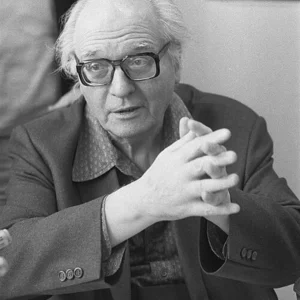

Olivier Messiaen (1908-1992) was a French composer, organist and teacher, one of the major figures of 20th-century music. A deeply devout Catholic and a passionate ornithologist, he renewed musical language through his research into rhythm, sound color and birdsong.
Olivier Messiaen(1908 — 1992)
Olivier Messiaen
France
6 min read
Frequently asked questions
Key Facts
- Born on 10 December 1908 in Avignon, died on 27 April 1992 in Clichy
- Resident organist of the Church of the Trinity in Paris from 1931, a position he held for more than 60 years
- Composed the Quartet for the End of Time in 1940-1941, premiered in captivity at Stalag VIII-A during his detention as a prisoner of war
- Professor at the Paris Conservatory from 1941, he trained a generation of composers including Pierre Boulez and Karlheinz Stockhausen
- Completed the Catalogue d'oiseaux (1956-1958), the fruit of his transcriptions of birdsong that he notated in the wild
Works & Achievements
A chamber music work composed in captivity, inspired by the Book of Revelation. It is one of his most frequently performed pieces and a high point of the 20th century.
A theoretical treatise setting out his innovations: modes of limited transposition and non-retrogradable rhythms. A major reference for composers.
A vast symphony in ten movements celebrating love and joy, featuring solo piano and ondes Martenot. A commission from the Boston Symphony Orchestra.
A piano cycle of thirteen pieces evoking French birds and their landscapes. The culmination of his ornithological research.
A monumental work for winds and percussion, a state commission in tribute to the dead of the two world wars.
A grand sacred fresco for choir, orchestra and soloists, a high point of his religious music.
His only opera, the sum of his entire musical and spiritual life, premiered at the Paris Opera. A work lasting more than four hours.
A monumental piano cycle meditating on the Nativity, one of the great piano works of the 20th century.
Anecdotes
A devout Catholic, Messiaen served for more than sixty years as principal organist of the Church of the Trinity in Paris, appointed in 1931 when he was only 22 years old. He improvised there every Sunday and remained until his death.
Taken prisoner by the Germans in 1940, he composed his famous 'Quartet for the End of Time' in the Görlitz camp (Stalag VIII-A). The work premiered in January 1941 before fellow prisoners, played on instruments in poor condition, including a cello with only three strings.
Messiaen was passionate about ornithology: he roamed the countryside, notebook in hand, to record birdsong with meticulous precision, which he then transcribed into music. He regarded birds as the greatest of all musicians.
He possessed a form of synesthesia: he associated certain chords and sounds with specific colors, and spoke of his music in terms of hues and stained-glass windows, like those of the Gothic cathedrals he admired.
A professor at the Paris Conservatory, he trained several generations of major composers, among them Pierre Boulez, Karlheinz Stockhausen, and Iannis Xenakis, exerting a considerable influence on the music of the second half of the 20th century.
Primary Sources
The charm of impossibilities... This idiom, this language, I would like to justify it theoretically, to reveal its inner workings.
Conceived and written during my captivity, the Quartet for the End of Time was given its first performance at Stalag VIII A, on 15 January 1941.
Birds: that is what comforts me... they are our longings for light, for stars, for rainbows, and for jubilant vocalises.
Sacred music must awaken in the listener the feeling of the divine, of the sacred, of the supernatural.
Key Places
City in the south of France where Olivier Messiaen was born in 1908.
Messiaen studied here from the age of 11, then became a professor of harmony, analysis and composition, training many great composers.
Parisian church where Messiaen was the principal organist from 1931 until his death, more than sixty years.
Prisoner-of-war camp in Germany where Messiaen, held captive in 1940-1941, composed and premiered the Quartet for the End of Time.
Village on the shore of Lake Laffrey where Messiaen owned a house and came to compose in peace, close to nature and the birds.
Town in the suburbs of Paris where Olivier Messiaen died in 1992.
Typical Objects

The great Cavaillé-Coll organ of the Church of Sainte-Trinité, the instrument Messiaen played every Sunday for more than sixty years. There he developed his unique harmonic language.

An electronic instrument invented in 1928, with an undulating, celestial sound, which Messiaen famously incorporated into the *Turangalîla-Symphonie*. He loved its glissandos and its otherworldly colors.

A notebook in which Messiaen transcribed birdsong in the field with scientific precision. These notes later fed into his compositions.

Messiaen wrote his scores by hand, with colored markings and annotations on rhythms and sound colors. His manuscripts bear witness to his complex rhythmic system.

The central instrument of his work as a composer and teacher, on which he analyzed and taught. His wife, the pianist Yvonne Loriod, premiered many of his works for piano.

The stained-glass windows of Gothic cathedrals fascinated Messiaen, who compared his colored chords to their play of light. For him they symbolized the union of the sacred and color.
School Curriculum
Vocabulary & Tags
Key Vocabulary
Daily Life
Morning
Messiaen often devoted his mornings to composition, pen in hand, working methodically on his colorful scores. A fervent believer, he sometimes began the day with prayer or spiritual meditation.
Afternoon
The afternoon might be dedicated to teaching at the Conservatoire, where he analyzed the great works in front of his students. He also loved to head out into nature to listen to and transcribe birdsong.
Evening
In the evening, he prepared his lessons, read religious and theological texts, or continued his ornithological transcriptions. His wife Yvonne Loriod often played his piano works.
Food
Messiaen led a sober life free of extravagance, in keeping with his faith. His meals were simple, and he placed little importance on fine dining.
Clothing
He wore the classic attire of a 20th-century professor and musician: a suit, tie, and neat, sober, understated dress, befitting his reserved temperament.
Housing
He lived in Paris, near the Church of the Trinity, and owned a house in Petichet, in the Isère, where he retreated in summer to compose in peace, surrounded by nature and the lake.