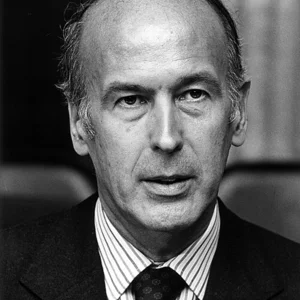

French statesman, President of the Republic from 1974 to 1981. A liberal reformer at the start of his term, he modernized French society before being defeated by François Mitterrand. He was also a key architect of European integration.
Valéry Giscard d'Estaing(1926 — 2020)
Valéry Giscard d'Estaing
France
5 min read
Frequently asked questions
Famous Quotes
« You do not have a monopoly on the heart.»
Key Facts
- Minister of Finance under de Gaulle and then Pompidou during the 1960s and 1970s
- Elected President of the Republic in 1974 against François Mitterrand
- Lowering of the voting age to 18 (1974) and the Veil Law on abortion (1975)
- Co-founder of the European Council (1974) and the European Monetary System (1979)
- Defeated by François Mitterrand in the 1981 presidential election
Works & Achievements
A major reform granting the right to vote and full citizenship to young people aged 18.
Legalization of voluntary termination of pregnancy, championed by his minister Simone Veil; a decisive social reform.
A modernization of family law, making divorce easier and reflecting changing social attitudes.
The institutionalization of regular summits of European heads of state and government, on Giscard's initiative.
A mechanism for stabilizing European currencies, an important milestone on the road to a single currency.
The first election of European members of parliament directly by citizens, strengthening the democratic legitimacy of Europe.
A text drawn up under his chairmanship of the Convention on the Future of Europe, the basis for the future Treaty of Lisbon.
An autobiographical work in which Giscard shares his perspective on the exercise of presidential power.
Anecdotes
In 1974, at the age of 48, Valéry Giscard d'Estaing became the youngest president of the French Republic of his time. To give the office a more youthful image, he walked down the Champs-Élysées on the day of his inauguration, instead of the traditional motorcade.
Giscard liked to show himself as close to the French people. He invited ordinary citizens to come and have breakfast at the Élysée Palace, and even had himself filmed playing the accordion, an instrument he had played since his youth.
Under his term, the age of majority was lowered from 21 to 18 in 1974, giving the right to vote to millions of young people. It was also during his presidency that the Veil Act was passed in 1975, legalizing the voluntary termination of pregnancy.
A great builder of Europe, Giscard formed a famous political friendship with German Chancellor Helmut Schmidt. Together, in 1979, they launched the European Monetary System, a distant ancestor of the euro.
Late in his life, having become a member of the Académie française, he chaired the Convention tasked with drafting a proposed Constitution for Europe in 2002–2003. He liked to compare his role to that of the American “founding fathers.”
Primary Sources
Goodbye. (followed by a long silence and the image of an empty chair)
I would like to look France straight in the eye, I would like to tell it my message and listen to it.
France aspires to change and wishes that this change be carried out in peace.
You do not, Monsieur Mitterrand, have a monopoly on the heart.
Key Places
City where Valéry Giscard d'Estaing was born in 1926, while the region was under French occupation after the First World War.
Residence and workplace of the President of the Republic from 1974 to 1981.
Giscard served here as Minister of Finance during the 1960s and early 1970s, building his reputation as an economic expert.
Giscard trained at France's most prestigious schools, a symbol of his career as a high-ranking technocrat.
Site of the first G6 summit organized by Giscard in 1975, bringing together the major industrial powers.
Town where Valéry Giscard d'Estaing died in 2020, at his family estate.
Typical Objects

An instrument Giscard played and used publicly to connect with the everyday image of the French people.

Television becomes the central arena of political life: Giscard masters televised addresses and the TV debate against Mitterrand.

A symbol of the presidential office and of the Republic, worn during official ceremonies.

Lowering the voting age in 1974 turned the ballot paper into a symbol of openness toward younger generations.

The EMS of 1979 launched the coordination of European currencies, a step toward the euro.

The understated, elegant attire of the senior civil service, the hallmark of Giscard's technocratic style.
School Curriculum
Vocabulary & Tags
Key Vocabulary
Daily Life
Morning
An early riser and hard worker, Giscard devoted his mornings to economic matters and to small working meetings at the Élysée Palace. Known for the rigor of a senior civil servant, he had a command of his files down to the smallest figure.
Afternoon
His afternoons were filled with audiences, cabinet meetings, and meetings with foreign leaders, notably German Chancellor Helmut Schmidt. European diplomacy held a central place in his schedule.
Evening
In the evening, he prepared his carefully rehearsed televised addresses and sometimes hosted guests for dinner. A lover of culture, he set aside time for reading and music.
Food
Born into the upper bourgeoisie, Giscard enjoyed classic French cuisine and refined official meals. Mindful of his modern image, however, he sought to convey an impression of simplicity.
Clothing
He wore elegant, understated dark suits, in keeping with the style of the senior civil service. At ceremonies, he wore the tricolor sash, the insignia of the presidency.
Housing
As president, he resided at the Élysée Palace in Paris. Born into a wealthy family, he also owned several properties, including the family château where he would end his life.
Historical Timeline
Period Vocabulary
Liens externes & ressources
Références
Œuvres
Abaissement de la majorité à 18 ans
1974
Loi Veil sur l'IVG
1975
Loi sur le divorce par consentement mutuel
1975
Création du Conseil européen
1974
Système monétaire européen (SME)
1979
Élection du Parlement européen au suffrage universel
1979
Projet de Constitution européenne
2003