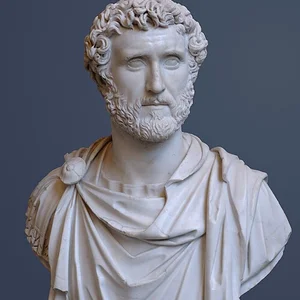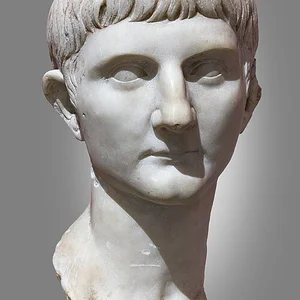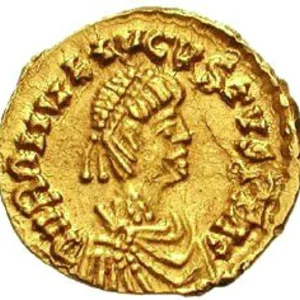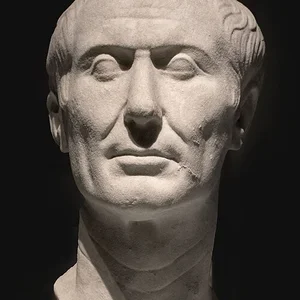
Portrait de Julius Caesar

Julius Caesar

Julius Caesar

99 av. J.-C. — 43 av. J.-C.

Rome antique

MilitaryPoliticsChef militairePolitiqueAntiquity1st century BC, late Roman Republic

Roman general and statesman (100–44 BC), Julius Caesar conquered Gaul between 58 and 50 BC and established his political dominance in Rome. His assassination in 44 BC hastened the fall of the Roman Republic.

Émotions disponibles (6)

N

Neutre

par défaut

I

Inspiré

P

Pensif

S

Surpris

T

Triste

F

Fier

Famous Quotes

« Veni, vidi, vici (I came, I saw, I conquered) — on the Battle of Zela in 47 BC »
« Et tu, Brute? (And you, Brutus?) — attributed to Caesar before his assassination »

Key Facts

  • 58–50 BC: conquest of Gaul over eight military campaigns, doubling Roman territory
  • 52 BC: siege of Alesia and final defeat of Vercingetorix, consolidating Roman rule in Gaul
  • 49 BC: crossing of the Rubicon and the start of the civil war against Pompey
  • 48 BC: victory at Pharsalus against Pompey and his supporters
  • March 15, 44 BC: assassination on the Ides of March by a group of Roman senators including Brutus

Works & Achievements

De Bello Gallico (Commentaries on the Gallic War) (58-51 av. J.-C.)

An account in seven books (plus an eighth added by Hirtius) of Caesar's campaigns in Gaul. A major work of Latin literature, serving both as a historical source and a tool of political propaganda.

De Bello Civili (Commentaries on the Civil War) (vers 47 av. J.-C.)

An account of the events of the civil war against Pompey (49-48 BC), presented from Caesar's point of view. A valuable but biased source for understanding the end of the Republic.

Reform of the Julian Calendar (46 av. J.-C.)

Caesar, advised by the astronomer Sosigenes of Alexandria, replaced the Roman lunar calendar with a solar calendar of 365 days with a leap year every four years. This calendar was used in Europe until 1582.

Foundation of Roman Colonies (46-44 av. J.-C.)

Caesar founded or re-founded numerous colonies (Corinth, Carthage, Arles
) to accommodate his veterans and spread Roman civilization. These foundations lastingly shaped Mediterranean urbanism.

Reform of Roman Administration (49-44 av. J.-C.)

As dictator, Caesar increased the number of senators, reorganized the provinces, reduced debts, and regulated trade. His reforms anticipated the organization of the Roman Empire.

Anecdotes

As a young man, Julius Caesar was captured by Cilician pirates who demanded a ransom of twenty gold talents. Caesar mocked them, claiming he was worth at least fifty talents. Once freed, he returned with a fleet, captured the pirates and had them crucified, just as he had promised them in jest during his captivity.

Caesar suffered from epilepsy, known at the time as the 'sacred disease'. Despite this condition, he led exhausting military campaigns and sometimes slept on horseback to save time. His soldiers respected him all the more because he shared their harsh living conditions.

During the crossing of the Rubicon in 49 BC, Caesar is said to have uttered the famous phrase 'Alea iacta est' ('The die is cast'). By crossing this river with his army, he was violating Roman law and triggering the civil war against Pompey and the Senate.

Caesar was renowned for his ability to dictate several letters simultaneously to different secretaries while reading or writing himself. This extraordinary power of concentration was legendary among his contemporaries and speaks to his exceptional intelligence.

After his victory over Pharnaces II of Pontus in 47 BC, Caesar sent Rome a victory dispatch so brief that it has remained famous ever since: 'Veni, vidi, vici' ('I came, I saw, I conquered'). This phrase perfectly encapsulates the lightning speed of the campaign.

Primary Sources

De Bello Gallico (The Gallic War) (58-51 BC)
Gallia est omnis divisa in partes tres, quarum unam incolunt Belgae, aliam Aquitani, tertiam qui ipsorum lingua Celtae, nostra Galli appellantur.
De Bello Civili (The Civil War) (c. 47 BC)
Caesar, etsi intellegebat magna cum difficultate rem geri, tamen optimum factu iudicavit omnia experiri.
Cicero, Letters to Atticus (49 BC)
Caesar has arrived near Rome with his army; the Senate trembles. No one knows what this man truly wants, but his power is now unrivalled in the Republic.
Suetonius, The Twelve Caesars — Julius Caesar (c. 121 AD)
He was tall, fair-skinned, well-built, with a somewhat full face and dark, lively eyes. He enjoyed very robust health, except for the sudden fainting spells that afflicted him towards the end of his life.
Plutarch, Life of Caesar (c. 100 AD)
Caesar, it is said, upon seeing a statue of Alexander the Great at Gades, was seized with deep dejection at the thought that at the age when Alexander had already subjugated so many peoples, he himself had not yet accomplished anything memorable.

Key Places

Rome — Roman Forum

The political and religious heart of the Roman Republic, where Caesar delivered his speeches, served as consul, and received his honors. It was also nearby, at the Theatre of Pompey, that he was assassinated.

Alesia (Alise-Sainte-Reine, CĂŽte-d'Or)

Site of the decisive siege of 52 BC where Caesar defeated Vercingetorix and the Gallic coalition, completing the conquest of Gaul and securing his military glory.

Rubicon (river, northern Italy)

A small border river between the province of Cisalpine Gaul and Italy. Caesar's crossing of this river with his army in January 49 BC marked the beginning of the civil war.

Alexandria (Egypt)

A great Mediterranean metropolis where Caesar stayed in 48–47 BC and met Cleopatra VII, becoming involved in Egyptian dynastic conflicts.

Pharsalus (central Greece)

Site of the decisive battle of 48 BC where Caesar crushed Pompey's forces, establishing himself as the undisputed master of the Roman world.

Lutetia (Paris)

The oppidum of the Parisii on the Île de la CitĂ©, mentioned in ancient sources. Caesar summoned an assembly of the Gauls there in 53 BC during the Gallic Wars.

Typical Objects

Roman sword (gladius)

Short double-edged sword carried by Roman legionnaires. Caesar used it during his military campaigns and personally oversaw the equipment of his troops.

The purple-bordered toga praetexta

Official garment of high-ranking Roman magistrates, adorned with a purple stripe. Caesar wore it during official ceremonies, a symbol of his authority.

Wax tablets and stylus (stilus)

Common writing tools in ancient Rome. Caesar used them to dictate his letters, draft his Commentaries, and correspond with his legates in the field.

The laurel wreath

Symbol of military victory in ancient Rome. According to Suetonius, Caesar wore it willingly as it concealed his baldness, about which he was greatly self-conscious.

Pilum (Roman javelin)

Throwing weapon characteristic of the Roman legions, with an iron tip designed to bend on impact. Caesar describes its tactical use in The Gallic Wars.

Military tessera

Wooden or bone token on which the daily password was inscribed in Roman camps. Caesar placed great importance on the discipline and security of his legions.

Scroll (volumen)

Papyrus or parchment roll on which Caesar wrote his Commentaries. He was among the first to use folded notebooks (codex) for his military correspondence.

School Curriculum

Cycle 3 (CM1-6e)Histoire
Cycle 3 (CM1-6e)Latin — La fin de la RĂ©publique romaine et l'Ă©mergence du pouvoir personnel
Cycle 4 (5e-3e)Histoire
Cycle 4 (5e-3e)Latin — La fin de la RĂ©publique romaine et l'Ă©mergence du pouvoir personnel
Cycle 4 (5e-3e)Histoire — L'expansion territoriale de Rome et les conquĂȘtes militaires
Cycle 4 (5e-3e)Histoire — Les guerres gaulliques et la romanisation de la Gaule
Cycle 4 (5e-3e)Histoire — Les conflits politiques romains : CĂ©sar, PompĂ©e et le SĂ©nat
Cycle 4 (5e-3e)Histoire — La rĂ©sistance gauloise : Vercingetorix et la bataille d'AlĂ©sia
Cycle 4 (5e-3e)Histoire — Les institutions romaines et la dictature dans l'AntiquitĂ©

Vocabulary & Tags

Key Vocabulary

legion: the fundamental Roman military unitdictatorship: concentration of absolute power in the hands of a single individualRepublic: the Roman political system based on rule by the Senate and the peopleSenate: assembly of Roman aristocrats holding political powerGaul: territory corresponding to modern-day France, conquered by CaesarVercingetorix: Arvernian chieftain and symbol of Gallic resistancetriumvirate: alliance between three powerful political figurespatrician: member of the Roman aristocracy

Tags

Jules Césarempire-romainEmpire romainlégion : unité militaire romaine fondamentaledictature : concentration du pouvoir absolu entre les mains d'une seule personneRépublique : régime politique romain basé sur le gouvernement par le Sénat et le peupleSénat : assemblée des aristocrates romains exerçant le pouvoir politiqueGaule : territoire correspondant à la France actuelle, conquis par CésarVercingetorix : chef arverne et symbole de la résistance gauloisetriumvirat : alliance entre trois personnages politiques puissantspatricien : membre de l'aristocratie romaineIer siÚcle av. J.-C., fin de la République romaine

Daily Life

Morning

Caesar rose early, often before dawn. He began his day with the salutatio, receiving clients and petitioners in his atrium. He used this time to dictate letters to his secretaries while reviewing his military reports.

Afternoon

The afternoon was devoted to public affairs: debates in the Senate, pleadings in the Forum, hearings with magistrates. On military campaign, Caesar personally inspected the fortifications, planned operations, and addressed his legions.

Evening

Caesar often dined with friends or political allies at lavish banquets where the affairs of Rome were discussed. He was reputed to be sober in his consumption of wine, but refined in his culinary tastes. He would sometimes work late into the night writing his Commentarii.

Food

Caesar enjoyed varied and sometimes refined cuisine, typical of the Roman elite: wheat bread, vegetables, fruits, fish, roasted meats, and sauces based on garum (fermented fish sauce). He was known for his sobriety regarding alcohol, unlike many of his contemporaries.

Clothing

In the city, Caesar wore the toga praetexta bordered with purple, the mark of his dignity as a magistrate. On campaign, he donned the paludamentum, the general's red military cloak, over his cuirass. He was known for taking care of his appearance and wore his toga in a slightly casual manner, which was remarked upon.

Housing

On the Campus Martius and later on the Palatine, Caesar resided in patrician houses richly decorated with mosaics, frescoes, and sculptures. On campaign, he occupied the praetorium tent at the center of the military camp, surrounded by his legates and personal guard.

Historical Timeline

133 av. J.-C.Réformes agraires des Gracques, début des grandes crises politiques de la République romaine.
107 av. J.-C.Marius réforme l'armée romaine en la professionnalisant, créant des légions loyales à leur général plutÎt qu'à Rome.
91-87 av. J.-C.Guerre sociale : les alliés italiens se révoltent et obtiennent la citoyenneté romaine.
82 av. J.-C.Sylla s'empare de Rome et instaure une dictature ; César, lié aux populares, est menacé.
73-71 av. J.-C.RĂ©volte de Spartacus : un soulĂšvement d'esclaves menace l'Italie avant d'ĂȘtre Ă©crasĂ© par Crassus et PompĂ©e.
63 av. J.-C.Conjuration de Catilina déjouée par Cicéron ; César, consul élu, commence à s'imposer politiquement.
60 av. J.-C.Formation du premier triumvirat : César, Pompée et Crassus s'allient pour dominer la vie politique romaine.
58-50 av. J.-C.ConquĂȘte de la Gaule par CĂ©sar, qui soumet progressivement les peuples gaulois et rĂ©dige ses Commentaires.
52 av. J.-C.SiĂšge d'AlĂ©sia : CĂ©sar bat VercingĂ©torix, chef de la coalition gauloise, achevant la conquĂȘte de la Gaule.
49 av. J.-C.César franchit le Rubicon avec son armée, déclenchant la guerre civile contre Pompée et le Sénat.
48 av. J.-C.Bataille de Pharsale : CĂ©sar Ă©crase PompĂ©e en GrĂšce ; PompĂ©e fuit en Égypte oĂč il est assassinĂ©.
47 av. J.-C.CĂ©sar en Égypte aux cĂŽtĂ©s de ClĂ©opĂątre VII, qu'il soutient pour asseoir son pouvoir sur le trĂŽne.
46 av. J.-C.César est nommé dictateur pour dix ans et entreprend de vastes réformes (calendrier julien, distribution de terres).
44 av. J.-C.Assassinat de César aux ides de mars par un groupe de sénateurs républicains menés par Brutus et Cassius.
31 av. J.-C.Octave (Auguste) vainqueur d'Antoine à Actium, fonde l'Empire romain, héritier direct des ambitions de César.

Period Vocabulary

Dictator — Extraordinary magistrate appointed during a serious crisis to exercise supreme power in Rome alone, in principle for a period limited to six months. Caesar was appointed dictator for life in 44 BC.
Legion — Basic military unit of the Roman army, composed of approximately 4,000 to 6,000 soldiers (legionaries). Caesar commanded several legions during the conquest of Gaul.
Oppidum — Fortified Gallic town, generally built on high ground and surrounded by a rampart of wood and stone. Alesia and Gergovia are famous examples.
Triumvirate — Alliance of three Roman politicians sharing power. The First Triumvirate (Caesar, Pompey, Crassus, 60 BC) was unofficial but extremely influential.
Populares — Roman political faction that relied on the people (assemblies) to push through its reforms, as opposed to the Optimates who defended the prerogatives of the Senate. Caesar stood in this tradition.
Consul — The highest ordinary magistracy of the Roman Republic, held by two consuls elected each year. Caesar was consul in 59 BC, which allowed him to obtain command of Gaul.
Ides of March — The 15th of March in the Roman calendar. The date of Caesar's assassination in 44 BC at the Theatre of Pompey, carried out by a group of senators who called themselves the Liberators.
Garum — Highly prized liquid sauce in Roman cuisine, obtained by fermenting fish and salt. An essential condiment at the Roman table, used as a universal seasoning.
Triumph — Grand military ceremony granted by the Senate to a victorious general, who paraded through Rome on a chariot drawn by four white horses. Caesar celebrated four triumphs in 46 BC.
Proscription — Death sentence and confiscation of property of political enemies, whose names were posted publicly. Practiced under Sulla, it inspired fear in the young Caesar.

Gallery

Giulio Campi Portrait eines Gambenspielers

Giulio Campi Portrait eines Gambenspielers


Italian:  Ritratto di Galeazzo CampiPortrait of Galeazzo Campi, the Artist's Fathertitle QS:P1476,it:"Ritratto di Galeazzo Campi"label QS:Lit,"Ritratto di Galeazzo Campi"label QS:Len,"Portrait of Gal

Italian: Ritratto di Galeazzo CampiPortrait of Galeazzo Campi, the Artist's Fathertitle QS:P1476,it:"Ritratto di Galeazzo Campi"label QS:Lit,"Ritratto di Galeazzo Campi"label QS:Len,"Portrait of Gal


Portrait of an Old Man

Portrait of an Old Man

Jules César portrait

Jules César portrait

Portrait de la famille de Carle Van Loo - Attribué à Louis Michel Van LOO

Portrait de la famille de Carle Van Loo - Attribué à Louis Michel Van LOO

Reloxo de sol vertical ortomeridiano. XVII-XVIII. Lugo

Reloxo de sol vertical ortomeridiano. XVII-XVIII. Lugo


Catalogue historique du cabinet de peinture et sculpture françoise

Catalogue historique du cabinet de peinture et sculpture françoise


Recueil de fragmens de sculpture antique en terre cuite

Recueil de fragmens de sculpture antique en terre cuite

Statue en marbre de Jules César au jardin des Tuileries, 1er arrondissement, Paris, PH76468

Statue en marbre de Jules César au jardin des Tuileries, 1er arrondissement, Paris, PH76468

Statue de Jules César au jardin des Tuileries, 1er arrondissement, Paris, PH76467

Statue de Jules César au jardin des Tuileries, 1er arrondissement, Paris, PH76467

Visual Style

Un style visuel associant le réalisme monumental de la peinture historique néoclassique à l'austérité dorée et pourprée de la Rome républicaine.

#8B0000
#C8A951
#F5F0E8
#4A4A6A
#2C5F2E
AI Prompt
Epic historical realism inspired by Roman art: marble busts with sharp, austere features, terracotta and fresco textures, rich crimson and imperial purple togas against white marble columns, golden eagle standards (aquilae) catching Mediterranean sunlight, vast Gallic landscapes with dense forests and wooden oppida fortresses, Roman legions in precise formations with rectangular scuta shields and red transverse-crested helmets, dramatic chiaroscuro lighting recalling grand history paintings by David or Gérome, monumental stone architecture, maps and scrolls as recurring motifs.

Sound Ambience

Une ambiance sonore mĂȘlant la Rome politique et bruyante du Forum aux camps militaires disciplinĂ©s des lĂ©gions de CĂ©sar en Gaule.

AI Prompt
Sounds of ancient Rome at its peak: the echoing footsteps of Roman legionaries marching on stone-paved roads, the clatter of iron armor and gladius swords, Latin voices shouting military commands across a fortified camp, crackling campfires at night, the distant roar of a crowd in the Roman Forum, trumpets (tubae) signaling battle formations, the rhythmic hammering of craftsmen building siege machines, the neighing of warhorses, the murmur of senators debating in marble halls, water flowing in aqueducts, merchants calling out in the busy streets of Rome.

Portrait Source

Wikimedia Commons — domaine public — Ángel M