
Viracocha is the supreme creator deity of the Andean civilizations of Tiwanaku, Huari, and the Incas. According to Inca cosmogony, he created the world, the sun, the moon, the stars, and humanity from Lake Titicaca. He is depicted as a wandering god who taught civilization to mankind before disappearing toward the ocean.
Viracocha
Viracocha
8 min read
Frequently asked questions
Key Facts
- Deity venerated from the Tiwanaku civilization (c. 500–1000 CE) through the Inca Empire (1438–1533)
- According to myth, Viracocha created the world from Lake Titicaca, located on the border of present-day Peru and Bolivia
- His main temple, the Qorikancha (Temple of the Sun), was located in Cusco, capital of the Inca Empire
- 16th-century Spanish chroniclers (Pedro Cieza de León, Juan de Betanzos) recorded the myths about him following the conquest of 1532
- Some Incas reportedly believed at first that the Spanish conquistadors were emissaries of Viracocha, which helped facilitate Pizarro's conquest in 1532
Works & Achievements
The founding act of Andean cosmogony: Viracocha emerged from the dark waters of Lake Titicaca and successively created the earth, the sky, the sun, the moon, the stars, and human beings, bringing light and order to the primordial chaos.
Viracocha carved the first men and women from rock, breathed life into them, and assigned them their names and territories. A first disobedient humanity was turned to stone before he created a second, more accomplished generation.
In the guise of an old beggar, Viracocha traveled throughout the Andes, teaching peoples agriculture, architecture, the arts, and the rules of social life, laying the foundations of all Andean civilizations.
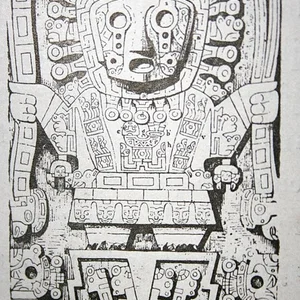
The Sun Gate, a monumental masterpiece of the Tiwanaku civilization, bears at its center the face of Viracocha surrounded by 48 winged figures. It is the oldest and most celebrated visual representation of the Andean creator god.
Built by the Inca, this monumental temple attested to Viracocha's central place in the state religion. It also served as an administrative center and food storehouse along the great Inca road network (Qhapaq Ñan).
Anecdotes
According to Inca cosmogony, Viracocha emerged from the dark waters of Lake Titicaca and created the sun, the moon, and the stars. He carved the first human beings from rock, but displeased with their behavior, he turned them to stone — these statues are said to still be visible among the ruins of Tiwanaku.
Viracocha traveled through the Andes disguised as an old beggar wearing a tattered cloak. He taught the peoples agriculture, the arts, and how to live in society. Those who mocked him or refused his teachings were struck by lightning or turned to stone.
When the Spanish conquistadors landed on the coast of Peru in 1532, some Incas initially mistook them for messengers or incarnations of Viracocha, as prophecy foretold the god's return from the sea. This confusion helped paralyze the initial resistance against Pizarro.
After completing his civilizing work, Viracocha reached the Pacific coast at Manta (in present-day Ecuador) and walked upon the waters toward the setting sun, disappearing on the horizon. This departure toward the west is one of the most poetic scenes in Andean mythology.
At Raqchi, in the region of Cuzco, the Incas built one of the largest temples dedicated to Viracocha. With walls rising over twelve meters high, this sanctuary housed an idol of the god and served as a food distribution center for pilgrims traveling the Qhapaq Ñan, the great imperial road network.
Primary Sources
Viracocha, who is the maker, being at Titicaca, made the sun and the moon and the stars, and commanded that the sun should travel on its course, and so it was done.
They say that Viracocha made the world, and that after having created it, he walked through it teaching men how they were to live and wishing to make them understand their customs.
Viracocha created the earth, the sky, the sun and the moon from the waters of Titicaca. He fashioned the first men and women and gave them their names and their way of life before departing toward the west.
The god Viracocha is the first and principal god of the Incas, creator of the sky and the earth, of the sun and the moon, whom men call Pachayachachi, he who teaches the world.
They called this god Viracocha and held him to be the creator of all things, father and lord of the sun, from whom came all good and all order in the universe.
Key Places
The original place of creation according to Inca cosmogony: Viracocha emerged from its waters to create the world, the sun, the moon, and the first human beings. The lake, at an altitude of 3,812 metres, remains a sacred site for Andean communities.
Capital of the Tiwanaku civilization and a major centre of Viracocha worship. The Gate of the Sun, the emblematic monument of this UNESCO World Heritage site, depicts Viracocha on its lintel with his radiant mask and cosmic attributes.
Capital of the Inca Empire, where Viracocha was venerated in the great Coricancha temple (Temple of the Sun) alongside Inti, the sun god. A golden idol of the creator deity was kept there and honoured during major religious festivals.
A monumental temple built by the Incas in honour of Viracocha, roughly 100 km south of Cusco. Its walls, standing 12 metres tall — adobe construction on stone foundations — make it one of the most impressive Inca structures still standing.
A sacred island regarded as the precise spot where Viracocha created the sun. The Incas built a major sanctuary there and linked it to their own divine origins, making it an essential place of pilgrimage.
According to Spanish chronicles, Viracocha departed from the human world from the Pacific coast, walking westward across the waters. The Manta region is traditionally associated with this mythic departure toward the horizon.
Typical Objects

Viracocha is invariably depicted holding a scepter or staff in each hand. These attributes symbolize his creative power and absolute authority over the forces of the cosmos.

In several Andean mythological accounts, the tears Viracocha sheds for humanity transform into life-giving rain. They symbolize the god's compassion and the water cycle, which is vital for high-altitude farming communities.

The canonical depiction of Viracocha, visible on the Sun Gate at Tiwanaku, shows a face with radiating eyes surrounded by puma and serpent heads. This mask illustrates his dominion over both celestial and chthonic forces.

Inca temples housed statues of Viracocha carved in stone or cast in gold. The principal idol at Cuzco was described as a standing man wearing a long tunic and sandals, with his arms slightly outstretched.

The lightning bolt is Viracocha's instrument of punishment: he uses it to chastise peoples who reject his teachings during his wanderings across the Andes, reminding the recalcitrant of his divine authority.

During his travels, Viracocha disguises himself as an old wanderer dressed in a worn cloak. This garment symbolizes wisdom hidden beneath a humble appearance, and puts the generosity and hospitality of human communities to the test.
School Curriculum
Vocabulary & Tags
Key Vocabulary
Tags
Lieu
Daily Life
Morning
In Andean myths, Viracocha inaugurates his work at the hour when the world is still plunged in darkness. He invokes light from the waters of Lake Titicaca and commands the sun to rise for the first time. Every dawn is thus considered an echo of this original creative act, repeated each day by divine will.
Afternoon
During his legendary wanderings, Viracocha crosses Andean valleys in the guise of an old man walking with a staff. He observes human communities, tests their hospitality and goodness, teaches those who welcome him with respect, and punishes the arrogant and the impious who refuse his lessons with lightning.
Evening
Andean oral tradition associates Viracocha with the contemplation of the night sky he himself created. In Inca temples, his priests burned offerings of copal and llama fat in his honor at nightfall, reciting hymns so that the cosmic cycle would continue and the rains would arrive in their season.
Food
As a deity, Viracocha does not eat as humans do. His faithful nonetheless offered him chicha (fermented corn beer), coca leaves, llama meat, and gold or silver figurines representing animals. These offerings symbolized the sacred sharing between humans and their creator.
Clothing
Spanish chronicles describe him sometimes clad in a simple beggar's cloak during his incognito travels, and sometimes dressed in a long white tunic during divine appearances. Tiwanaku iconography depicts him with a radiant headdress and ornaments simultaneously symbolizing the sun, lightning, and stars.
Housing
Viracocha has no fixed dwelling in Andean myths: he is a fundamentally itinerant deity, bound to open spaces — the waters of Lake Titicaca, the Andean highlands, the coasts of the Pacific Ocean. His earthly sanctuaries, such as the Coricancha or Raqchi, were places of veneration for his faithful, not divine residences.
Historical Timeline
Period Vocabulary
Liens externes & ressources
Références
Œuvres
Création du monde depuis le lac Titicaca
Temps mythiques
Modelage des premières humanités
Temps mythiques
Périple civilisateur à travers les Andes
Temps mythiques
Iconographie de la Porte du Soleil de Tiwanaku
vers 700 apr. J.-C.
Temple de Raqchi (Wiracocha Cancha)
XVe siècle