 flip
flipCaraway Seed Cake for Afternoon Tea
Caraway Seed Cake for Afternoon Tea
Why this dish? Afternoon tea was at the heart of Bloomsbury life, where Virginia and her sister Vanessa received writers and artists around tea and cakes. Seed cake, perfumed with caraway seeds, was the quintessential Victorian-Edwardian cake on family tables like the one at Hyde Park Gate where she grew up.
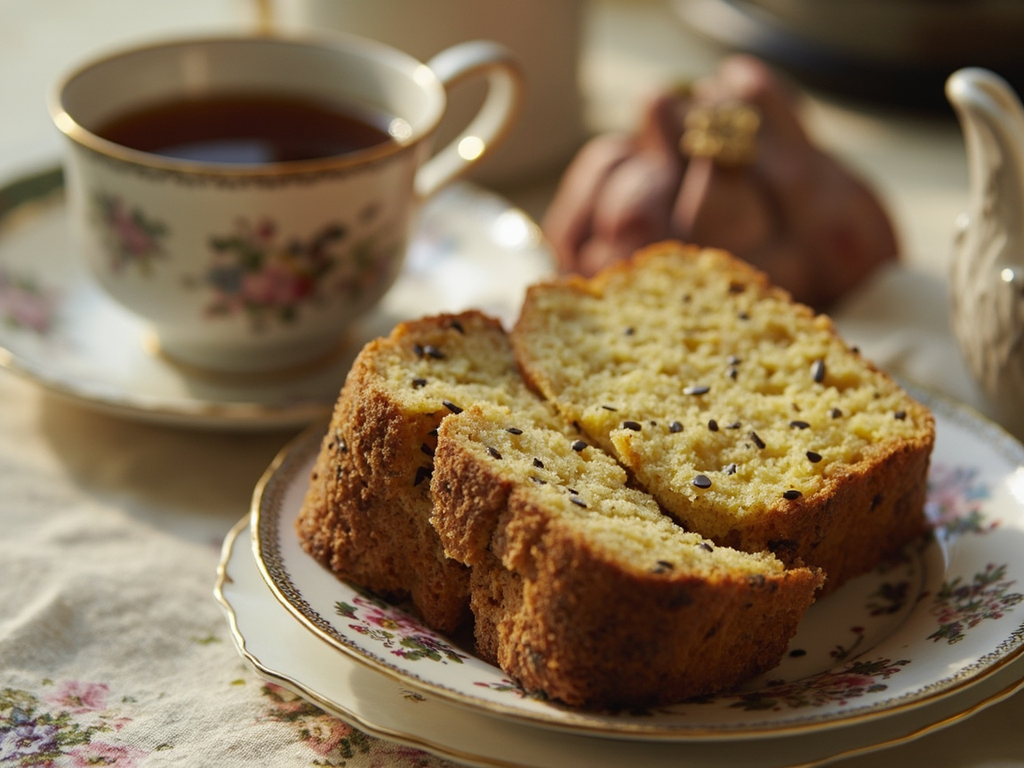
A dense, buttery cake, perfumed with caraway seeds that give it a slightly aniseed note. Served in slices with afternoon tea, it is the classic companion to conversation.
Seed cake, that is what they brought on the tray when the clock struck five and the drawing-room filled with voices. Those little caraway seeds, one either loves them or hates them — I find them curiously alive under the tooth, like a thought taking shape. My mother wanted it cut into equal slices, neither too thick nor too thin, for cake, you see, is a matter of measure as much as taste. We ate it with our fingertips, talking about everything, that is to say about nothing, and that was happiness itself.
- •Butter — half a pound (fat)
- •Sugar — as much as butter (sweetness)
- •Eggs — four (binder)
- •Flour — one pound (structure)
- •Caraway seeds — a good spoonful (signature perfume)
- •Lemon zest — a little (freshness)
Caraway Seed Cake for Afternoon Tea
A dense, buttery cake, perfumed with caraway seeds that give it a slightly aniseed note. Served in slices with afternoon tea, it is the classic companion to conversation.
Why this dish? Afternoon tea was at the heart of Bloomsbury life, where Virginia and her sister Vanessa received writers and artists around tea and cakes. Seed cake, perfumed with caraway seeds, was the quintessential Victorian-Edwardian cake on family tables like the one at Hyde Park Gate where she grew up.
Seed cake, that is what they brought on the tray when the clock struck five and the drawing-room filled with voices. Those little caraway seeds, one either loves them or hates them — I find them curiously alive under the tooth, like a thought taking shape. My mother wanted it cut into equal slices, neither too thick nor too thin, for cake, you see, is a matter of measure as much as taste. We ate it with our fingertips, talking about everything, that is to say about nothing, and that was happiness itself.
Ingredients (period version)
- Butter — half a pound (fat)
- Sugar — as much as butter (sweetness)
- Eggs — four (binder)
- Flour — one pound (structure)
- Caraway seeds — a good spoonful (signature perfume)
- Lemon zest — a little (freshness)
Ingredients
- Softened butter — 200 g (fat)
- Sugar — 200 g (sweetness)
- Eggs — 4 (binder)
- Flour — 250 g (structure)
- Baking powder — 1 tsp (leavening)
- Caraway seeds — 1.5 tbsp (signature perfume)
- Zest of 1 lemon — 1 (freshness)
- Milk — 2 tbsp (softness)
Method
- Preheat the oven to 170 °C and butter a loaf tin.
- Beat the softened butter and sugar until pale and fluffy.
- Add the eggs one by one, then the lemon zest.
- Fold in the flour mixed with baking powder, caraway seeds, and milk; mix gently.
- Pour into the tin and bake for 45 to 55 minutes, until a skewer comes out clean. Let cool slightly before slicing.
How it was made : Seed cake dates back at least to the 17th century in England, where caraway originally celebrated the end of sowing. By Victorian times it had become a domestic classic, beaten long by hand (before electric beaters) to incorporate air, the only means of leavening before baking powder became widespread.
The contemporary twist : Slip a thin layer of bitter orange marmalade between two slices for a 'Bloomsbury' tea-time treat and serve on a plate patterned after the Omega Workshops, Vanessa Bell's decorative studio.
Sources : Mrs Beeton's Book of Household Management · Florence White, Good Things in England (1932)
Virginia Woolf · Charactorium