
Wace was an Anglo-Norman poet and clerk of the 12th century, born on the island of Jersey. He is the author of the Roman de Brut, which adapts into the Romance vernacular the legendary history of the kings of Britain and introduces Arthurian material into French literature.
Wace(1100 — 1174)
Wace
duché de Normandie
6 min read
Frequently asked questions
Key Facts
- Born around 1110 on the island of Jersey, in the Anglo-Norman world
- Completes the Roman de Brut in 1155, a French adaptation of Geoffrey of Monmouth's Historia regum Britanniae
- First to mention King Arthur's Round Table in a work written in a Romance vernacular
- Writes the Roman de Rou, a verse chronicle of the dukes of Normandy, from 1160 onward for Henry II Plantagenet
- Died around 1174, after a career as a reading clerk in Caen
Works & Achievements
French verse adaptation of Geoffrey of Monmouth's *Historia regum Britanniae*; it introduces the Arthurian material into French literature and invents the Round Table.
Verse chronicle of the dukes of Normandy from **Rollo** onward; a valuable source on Norman history, notably the Battle of Hastings, left unfinished.
An early hagiographical poem, one of the oldest works attributed to **Wace**, testifying to his training as a clerk.
A verse account of the life and miracles of Saint Nicholas, intended for a devout Romance-speaking audience.
A poem on the conception and life of the Virgin Mary, helping to spread the Marian cult in the vernacular.
Anecdotes
Wace is one of the few medieval authors to speak about himself: in his *Roman de Rou*, he signs his name and notes that he was born on Jersey, in the Channel Islands, and was then raised in **Caen**. These confidences are precious, for we know almost nothing about the lives of most poets of his time.
It is in Wace's *Roman de Brut* that King Arthur's famous Round Table appears for the first time. Wace explains that the king had this table made with no head and no foot, so that none of his knights could boast of having the best seat: all of them were equal there.
Wace tells how he went himself to the forest of **Brocéliande**, in Brittany, to see the marvellous fountain said to unleash storms. Disappointed, he honestly admitted that he had seen no wonder there at all: “A fool I came back, a fool I went” (I went there a fool, I came back a fool).
King **Henry II Plantagenet** granted Wace a prebend (a canon's income) at **Bayeux** Cathedral, as a reward for his work. This was a common way in the Middle Ages of paying a writer: instead of a salary, he was given a comfortable religious office.
Wace could never finish his great *Roman de Rou*, the history of the dukes of Normandy. He admits with bitterness that King **Henry II** entrusted the same task to another poet, **Benoît de Sainte-Maure**, which discouraged him from continuing his work.
Primary Sources
Fist Artus la Roonde Table / Dont Bretun dient mainte fable. / Iloc seeient li vassal / Tuit chevalment et tuit egal. (Arthur made the Round Table about which the Bretons tell many a tale. There the vassals sat, all as knights and all equals.)
Jo di e dirai que jo sui / Wace de l'isle de Gersui. (I say and shall say that I am Wace, of the isle of Jersey.)
La alai jo merveilles querre, / Vi la forest e vi la terre, / Merveilles quis, mais nes trovai, / Fol m'en revinc, fol i alai. (There I went seeking wonders, I saw the forest and I saw the land, I sought wonders but found none; a fool I went there, a fool I came back.)
Key Places
Wace's native island, which he claims for himself in the *Roman de Rou*. At the time it belonged to the Duchy of Normandy.
A town in Normandy where Wace was raised and where he returned to teach as a “clerc lisant” (reading clerk) after his studies. The heart of his intellectual career.
The city of his cathedral, where Henry II granted him a canon's prebend as a reward for his work.
A Breton forest where Wace went to observe the marvelous fountain of Barenton, and where he admitted he had seen no wonder at all.
Wace frequented the Anglo-Norman court circle of Henry II and Eleanor of Aquitaine, who commissioned and received his works.
Typical Objects

Sheep or calf skin, tanned and scraped, used as a writing surface in the Middle Ages. A long poem like the Roman de Brut required many sheets of it.

The writing instrument of the medieval clerk, cut from a goose feather and dipped in an ink made from oak galls. The everyday tool of the poet who composed and copied his verses.

A literary form of narratives in the Romance vernacular, written in eight-syllable lines with rhyming couplets. Wace made it the supreme form for adapting Latin chronicles into French.

A table with no seat of honour that King Arthur, according to Wace, had built to make his knights equal. A literary object that became one of the major symbols of the Arthurian legend.

Income attached to the office of a canon, here at Bayeux Cathedral, which Henry II granted to Wace. It was the salary of a writer under the king's patronage.

A book copied by hand and adorned with initials and miniatures, through which works such as the Roman de Brut circulated. A precious object, reserved for courts and wealthy abbeys.
School Curriculum
Vocabulary & Tags
Key Vocabulary
Daily Life
Morning
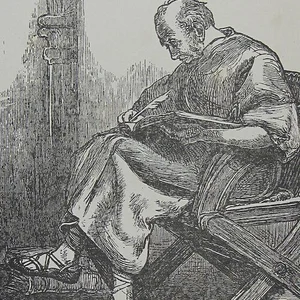
A clerk who "reads," Wace begins his day with religious offices, then devotes himself to reading the Latin chronicles he must adapt. He works in daylight, parchment being too precious to waste it by candlelight.
Afternoon
The afternoon is given over to writing: he composes his octosyllables under his breath, searching for the rhyme, and dictates or copies out his verses. He also teaches, passing on Latin and letters to young pupils.
Evening
In the evening, at court or in the hall of a noble, his verses are read or recited aloud before an audience of lords and ladies. Literature was then a matter of collective listening rather than solitary reading.
Food
As a clerk holding a prebend, Wace eats his fill: bread, pottages, vegetables, fish on meatless days, meat on the others, all washed down with watered wine or Norman cider.
Clothing
He wears the sober dress of the clerk: a long robe or tunic of dark wool, sometimes a cope, and the clerical tonsure at the crown of his head marking his belonging to the Church.
Housing
He lodges in a canon's or clerk's house, near the church or the cathedral, in a dwelling of stone or timber framing with plain rooms, warmed by a fireplace.
Historical Timeline
Period Vocabulary
Liens externes & ressources
Références
Œuvres
Roman de Brut
1155
Roman de Rou
vers 1160-1174 (inachevé)
Vie de sainte Marguerite
vers 1130-1140
Vie de saint Nicolas
vers 1150
La Conception Nostre Dame
vers 1130-1140