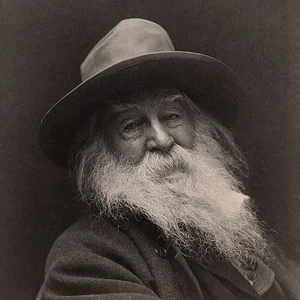

American poet, journalist, and essayist (1819-1892), regarded as the father of modern poetry in the United States. His collection *Leaves of Grass*, with its groundbreaking free verse, celebrates democracy, the body, and nature.
Walt Whitman(1819 — 1892)
Walt Whitman
États-Unis
7 min read
Frequently asked questions
Famous Quotes
« I celebrate myself, and sing myself.»
« Resist much, obey little.»
« I am large, I contain multitudes.»
Key Facts
- Born in 1819 in West Hills (Long Island, New York)
- Published the first edition of *Leaves of Grass* in 1855, which he revised and expanded until his death
- Volunteer nurse to wounded soldiers during the Civil War (1861-1865)
- Wrote *O Captain! My Captain!* after the assassination of Abraham Lincoln in 1865
- Died in 1892 in Camden (New Jersey)
Works & Achievements
The founding collection of modern American poetry, written in free verse. Whitman expanded and rewrote it throughout his life, from 12 poems in 1855 to nearly 400 in the “deathbed edition.”
The long central poem of the collection, celebrating the individual, the body, nature, and the democratic equality of all beings. It embodies the sweeping breath and free verse characteristic of Whitman.
A collection of poems born from the experience of the Civil War and military hospitals, blending patriotic fervor with compassion for the soldiers' suffering.
An elegy written after Lincoln's assassination, comparing the president to a captain who dies at the very moment of victory. It is Whitman's most popular poem.
A long prose essay in which Whitman reflects on the promises and dangers of American democracy after the war, and on the role of culture in strengthening it.
A collection of autobiographical prose notes evoking his childhood, the war hospitals, and nature. A precious personal testimony about his era.
Anecdotes
In 1855, Whitman published *Leaves of Grass* at his own expense and, trained as a printer, set some of the lead type himself. His name does not appear on the title page: in one poem he presents himself only as “Walt Whitman, an American, one of the roughs.”
After receiving the book, the philosopher Ralph Waldo Emerson wrote Whitman an enthusiastic letter, greeting him “at the beginning of a great career.” Whitman, delighted, had this phrase printed in gold letters on the spine of the second edition... without asking permission.
During the Civil War, Whitman set out in 1862 for Fredericksburg to find his brother George, who had been wounded in battle. Shaken by the military hospitals, he settled in Washington and spent three years visiting thousands of wounded soldiers, bringing them fruit, tobacco, writing paper, and comfort.
In 1865, Secretary of the Interior James Harlan found a copy of *Leaves of Grass* in Whitman's office, deemed it obscene, and dismissed him from his government clerk position. Whitman immediately found another job in the administration.
After the assassination of Abraham Lincoln in April 1865, Whitman composed the elegy “O Captain! My Captain!”, which would become his most famous and most recited poem, even though he later judged its form too conventional compared with his usual free verse.
Primary Sources
I celebrate myself, and sing myself, / And what I assume you shall assume, / For every atom belonging to me as good belongs to you.
I greet you at the beginning of a great career, which yet must have had a long foreground somewhere, for such a start.
O Captain! my Captain! our fearful trip is done, / The ship has weather'd every rack, the prize we sought is won.
The real war will never get in the books.
Key Places
Family farm where Whitman was born in 1819. The countryside and coastline of Long Island would leave a lasting mark on his poetic imagination.
City where Whitman grew up, worked as a printer and journalist, and edited the *Brooklyn Daily Eagle*. It was there that he prepared the first edition of *Leaves of Grass*.
Capital where Whitman settled during the Civil War to visit the military hospitals and where he held a job in the federal administration.
Battlefield where Whitman traveled in late 1862 to find his wounded brother George. The sight of the maimed soldiers transformed his life and his work.
City where Whitman retired after his stroke in 1873 and where he died in 1892. His modest house on Mickle Street is now a museum.
Typical Objects

Small metal tool held in the hand in which the printer lines up the lead characters letter by letter. Whitman, a former printer's apprentice, set part of the first edition of his collection himself.

Small notebook that Whitman carried with him to jot down verses, observations, and the names of soldiers. During the war, he recorded in it the needs of the wounded men he visited.

Common writing instruments in the 19th century, with which Whitman composed poems, newspaper articles, and letters to the families of wounded soldiers.

Whitman was one of the most photographed writers of his time and loved to pose for the early plate portraits. An engraving based on one of these images, showing him as a workman with his hat tilted, opens the 1855 edition.

A working-class style of headwear that Whitman wears, set at an angle, on the frontispiece of *Leaves of Grass*. It proclaims his identity as a “man of the people” rather than a poet in formal dress.

A symbol of the energy and progress of an expanding America, which Whitman celebrates in his poem “To a Locomotive in Winter.” The railroad was then uniting the continent from one ocean to the other.

Fruit, tobacco, candy, paper, and stamps that Whitman handed out in the military hospitals of Washington. These small gifts, bought thanks to fundraising, accompanied his comforting visits.
School Curriculum
Vocabulary & Tags
Key Vocabulary
Tags
Daily Life
Morning
As a young man, Whitman often begins his day at the printing shop or in the editorial offices of a Brooklyn newspaper, amid the smell of ink and the noise of the presses. A great walker, he loves to stride through the bustling streets and the harbor before settling down to work.
Afternoon
The afternoon is split between writing articles, correcting proofs, and composing his own verse. During the war, he devotes his days to the hospitals of Washington, going from bed to bed to talk with the wounded and note down their needs.
Evening
In the evening, Whitman frequents theaters, operas, and taverns, observing the crowd that feeds his poetry. He also writes letters for soldiers' families and rereads, pen in hand, the proofs of *Leaves of Grass*.
Food
His diet is simple and down-to-earth: bread, meat, fruit, coffee, dishes served in the boarding houses and cheap eateries of Brooklyn or Washington. Sober in his drinking, he prefers water and walks in the open air to overindulgence at the table.
Clothing
Whitman cultivates the look of a man of the people: open-collared shirt, rough jacket, tilted felt hat, and a bushy beard. This deliberately modest attire sets him apart from the stiffly dressed poets of his time.
Housing
He first lives in modest lodgings and boarding houses in Brooklyn, then in Washington. Weakened by a stroke in 1873, he ends his days in a small wooden house on Mickle Street, in Camden, cluttered with papers and books.
Historical Timeline
Period Vocabulary
Liens externes & ressources
Références
Œuvres
Leaves of Grass (Feuilles d'herbe)
1855 (révisé jusqu'en 1892)
Song of Myself (Chant de moi-même)
1855
Drum-Taps (Roulements de tambour)
1865
O Captain! My Captain!
1865
Democratic Vistas (Perspectives démocratiques)
1871
Specimen Days
1882