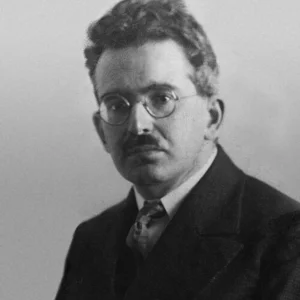

German philosopher, literary critic and translator, a figure of the Frankfurt School. A thinker of language, history and modernity, he is the author of an unfinished, fragmentary body of work that became major after his death.
Walter Benjamin(1892 — 1940)
Walter Benjamin
royaume de Prusse, Reich allemand
6 min read
Frequently asked questions
Famous Quotes
« There is no document of culture which is not at the same time a document of barbarism.»
Key Facts
- Born in 1892 in Berlin into a well-off Jewish family
- Published in 1936 The Work of Art in the Age of Mechanical Reproduction, in which he coined the notion of the aura
- Worked from 1927 onward on the unfinished Arcades Project (Passagenwerk)
- Wrote his Theses on the Concept of History in 1940
- Took his own life in 1940 in Portbou, on the Spanish border, while fleeing the Nazis
Works & Achievements
Essay introducing his translation of Baudelaire, which became a reference text on translation theory.
Collection of short fragments and aphorisms capturing modern urban life in a fragmented literary form.
Study rejected as a university habilitation thesis, later recognized as a major work on allegory and the Baroque.
Famous text analyzing how photography and film transform art by stripping it of its “aura.”
Poetic memories of his childhood in bourgeois Berlin, written in exile as a farewell to a vanished world.
His final theses, written shortly before his death, proposing a revolutionary and messianic vision of history.
Vast unfinished project made of notes and quotations on Parisian modernity, published only after his death.
Anecdotes
Walter Benjamin was a passionate book collector. In a famous essay, *Unpacking My Library*, he describes the intense pleasure of opening crates of books and rediscovering each of his volumes like old friends laden with memories.
He spent years in Paris studying the covered arcades, those nineteenth-century shopping galleries. His vast unfinished project, *The Arcades Project*, remained a collection of thousands of notes and quotations sorted into folders.
In September 1940, fleeing the Nazis, **Benjamin** tried to cross the French-Spanish border on foot through the Pyrenees to reach Portugal. Stranded in **Portbou** and threatened with being sent back to France, he took his own life during the night, at the age of 48.
Benjamin was a friend of the playwright **Bertolt Brecht** and the philosopher **Theodor Adorno**, as well as the thinker **Gershom Scholem**, a scholar of Jewish mysticism. These friendships pulled his thought between Marxism and the Jewish religious tradition.
It is said that during his flight he carried a mysterious black suitcase containing a manuscript he considered more precious than his own life. This suitcase vanished after his death and was never found, giving rise to a genuine legend.
Primary Sources
There is a painting by Klee called Angelus Novus. It shows an angel who seems about to move away from something he is staring at. This is how one might picture the angel of history.
Even in the most perfect reproduction, one thing is missing: the here and now of the work of art, the uniqueness of its existence in the place where it is found.
Not to find one's way around a city does not mean much. But to lose one's way in a city, as one loses one's way in a forest, requires some schooling.
No translation would be possible if, in accordance with its ultimate essence, it sought to resemble the original. For in its afterlife the original is transformed.
Key Places
Benjamin's birthplace, which he evokes with nostalgia in "Berlin Childhood around 1900." He grew up there in the Jewish middle class before going into exile.
The capital of his exile from 1933 onward and the focus of his great project on the 19th-century arcades. He worked there at the Bibliothèque nationale.
The Swiss city where Benjamin earned his doctorate in 1919, having taken refuge there during the war.
The city of the Frankfurt School and the Institute for Social Research, with which Benjamin was associated. It was here that his university habilitation was rejected in 1925.
A small Spanish port at the Pyrenees border where Benjamin, trapped in his flight, died in 1940. A memorial there honors his memory today.
An island in the Balearics where Benjamin stayed several times in the early 1930s to live cheaply and write.
Typical Objects

Benjamin tirelessly jotted down and copied out quotations from authors, dreaming of writing a book made up entirely of quotations. These notebooks were the heart of his working method.

A passionate collector, Benjamin owned thousands of books, including rare works and children's books. His library followed him in crates from one move to the next.

Benjamin bought this drawing by Klee in 1921 and treasured it above all else. He turned it into the image of the “angel of history” in his final theses.

Like every intellectual of his time, Benjamin wrote his newspaper articles and essays by hand and then on the typewriter, earning his living as a critic.

These glass-roofed nineteenth-century shopping galleries, full of boutiques, fascinated Benjamin as relics of early capitalism. He made them the subject of his great unfinished project.

Between 1929 and 1932, Benjamin wrote and hosted many radio programs, especially for young listeners, on Berlin, history, and literature.
School Curriculum
Vocabulary & Tags
Key Vocabulary
Daily Life
Morning
Benjamin often started his mornings late, like the nocturnal intellectual he was. In Paris, he would head to the reading room of the Bibliothèque nationale as soon as it opened, to pore over old books and newspapers.
Afternoon
Afternoons were spent reading, taking notes, and copying quotations into his notebooks. He also wrote articles and reviews for the newspapers and magazines on which his meager income depended.
Evening
In the evening, he would meet his intellectual friends in the cafés to discuss philosophy, politics, and literature. It was the hour for long conversations and games of chess, which he loved dearly.
Food
In exile, Benjamin often lived in precarious conditions and ate modestly, at the café or in small, cheap restaurants. A gourmet at heart, he nonetheless enjoyed good food whenever his finances allowed.
Clothing
He wore the dark suit, tie, and small round glasses typical of the European intellectual of the interwar years. His mustache and pensive air were part of his recognizable silhouette.
Housing
With no stable home, he lived in rented rooms, modest hotels, and with friends, in Berlin, Paris, Ibiza, or Denmark. Exile condemned him to a life of wandering and suitcases.
Historical Timeline
Period Vocabulary
Liens externes & ressources
Références
Œuvres
La tâche du traducteur
1923
Sens unique
1928
Origine du drame baroque allemand
1928
Enfance berlinoise vers 1900
1932-1938
Sur le concept d'histoire
1940
Paris, capitale du XIXe siècle (Le Livre des passages)
1927-1940