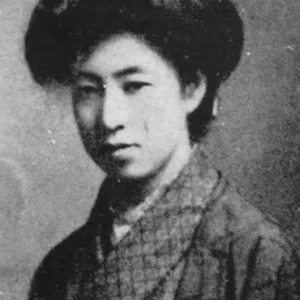

Japanese feminist and writer (1886–1971), founder of the literary journal Seitō ("Bluestocking") in 1911. She was a central figure in Japan's women's rights movement and campaigned throughout her life for equality and pacifism.
Hiratsuka Raichō
Hiratsuka Raichō
9 min read
Frequently asked questions
Famous Quotes
« In the beginning, woman was the sun. An authentic person. Today, woman is the moon.»
Key Facts
- 1911: founds the literary and feminist journal Seitō with fellow women writers
- 1920: co-founds the New Women's Association (Shin Fujin Kyōkai) to secure political rights for women
- 1921: secures the repeal of Article 5 of the Police Law, which had banned women from attending political meetings
- 1955: joins the peace movement and campaigns against nuclear weapons
- 1971: dies in Tokyo at the age of 85, recognized as a pioneer of Japanese feminism
Works & Achievements
Journal founded and edited by Raichō, the first platform for Japanese women writers to express themselves. It addressed taboo subjects (sexuality, abortion, civil rights) and was censored multiple times, becoming the founding symbol of modern Japanese feminism.
This short manifesto, written for the first issue of Seitō, is considered the founding declaration of Japanese feminism. Its opening line remains one of the most quoted in the entire history of women's rights in Asia.
A series of articles and open letters in which Raichō argued that the state should protect and fund motherhood in order for women to be truly free. This debate with Yosano Akiko remains an essential reference in Japanese feminism.
A militant organization co-founded with Ichikawa Fusae, whose efforts led to the partial revision of Article 5 in 1922. This was the first concrete legislative victory of the women's rights movement in Japan.
After the war, Raichō linked feminism and pacifism in a shared commitment against Japanese rearmament and nuclear testing. Her approach lastingly shaped how the women's movement in Japan engaged with the question of peace.
An autobiography published in the year of her death, in which Raichō traces sixty years of feminist and pacifist commitment. An essential work for understanding the history of the women's rights movement in twentieth-century Japan.
Anecdotes
In September 1911
Hiratsuka Raichō opened the first issue of the journal *Seitō* with a resounding declaration:
In the beginning, woman was the sun. She was an authentic human being. Today, woman is the moon — living through others, shining with the light of others." Written by a 25-year-old woman, this sentence sent shockwaves through Japanese society, still deeply conservative, and remains one of the most quoted feminist declarations in Japanese history.
Hiratsuka chose the pen name "Raichō
meaning "thunder bird" — the Japanese term for the ptarmigan, a mountain bird symbolizing freedom. She abandoned her official given name Haru to assert a new identity, independent of the one society had imposed on her. This symbolic gesture reflected her deep conviction that women should define themselves rather than be defined by others.
In 1908, as a student, Hiratsuka was caught up in a public scandal: she and a married writer, Morita Sōhei, had attempted a double suicide at the hot spring resort of Shiobara, without succeeding. The press seized on the affair and turned it into a national sensation. Far from being destroyed by the scandal, Raichō used it as a starting point for her reflection on the condition imposed on Japanese women.
The journal *Seitō* quickly fell under the scrutiny of the authorities: several issues were seized and banned for addressing subjects deemed scandalous, such as abortion, prostitution, and free love. Far from being discouraged, Raichō and her collaborators continued to publish until 1916, making *Seitō* a symbol of female intellectual resistance, with some copies circulating underground.
After World War II, Hiratsuka Raichō became an ardent pacifist activist and opposed, in particular, American nuclear testing in the Pacific. Well into her seventies, she continued to march in peace demonstrations and co-founded the Federation of Japanese Women in 1953, demonstrating a remarkable consistency between the ideals of her youth and the commitments of her old age.
Primary Sources
元始、女性は太陽であった。真正の人であった。今、女性は月である。他によって生き、他の光によって輝く、病人のような蒼白い顔の月である。— “In the beginning, woman was the sun. She was a genuine human being. Now, woman is the moon. Living through others, shining with the light of others, she is the moon with the pallid face of an invalid.”
Raichō traces her journey from the founding of Seitō to her pacifist activism, asserting that the liberation of women is inseparable from an ideal of universal peace and that every woman must rediscover within herself the sun she was in the beginning.
Raichō argues that the State has a duty to protect and fund maternity, since a woman who cannot provide for herself cannot be truly free. This public debate with the poet Yosano Akiko, who championed individual economic independence, remains a landmark reference in Japanese feminism.
Raichō asserts that the Japanese “New Woman” does not imitate the West, but develops an authentic self-awareness grounded in her own experience. She calls on women not to define themselves through the male gaze or by ideals imposed by the State.
Key Places
Hiratsuka Raichō was born in 1886 in the Akasaka district of Tokyo, into a prosperous family of Meiji-era civil servants. The rapidly modernizing capital was the setting for her childhood, her intellectual formation, and the founding of Seitō.
Raichō pursued her higher education here, discovering literature, philosophy, and Western feminist ideas. It was within this pioneering educational institution that she developed her social consciousness and forged the early intellectual connections that would lead to the creation of Seitō.
This mountain hot-spring resort was the scene of Raichō's 1908 suicide attempt alongside the writer Morita Sōhei. The incident, splashed across the national press, left a lasting mark on her public life and deepened her reflection on the constraints imposed on women.
Raichō settled in Kamakura with her partner and later husband, the painter Okumura Hiroshi, and spent most of her adult life there. This coastal town, a retreat for many artists and intellectuals, was the backdrop for her pacifist activism after 1945.
It was in Tokyo that Raichō co-founded this activist organization in 1920, alongside Ichikawa Fusae. Its direct action campaigns resulted in 1922 in the first legislative amendment favorable to the political rights of Japanese women.
Typical Objects

Traditional Japanese writing tools mastered since childhood. A woman seated at her desk, writing freely, was itself a subversive image in Meiji-era Japan, where women were expected to devote their energy to the home rather than to literature.

The issues of the journal she founded and directed from 1911 to 1916 represent her most emblematic work. Several issues, seized by censors, circulated clandestinely, transforming these small printed booklets into genuine acts of political resistance.

Raichō was profoundly shaped by her readings of Schopenhauer, Nietzsche, and the Swedish feminist Ellen Key, whose works she discovered at university. These imported books nourished her conviction that women must develop their own identity, free from social expectations.

Raichō maintained an active correspondence with Seitō contributors and other Japanese intellectuals. Her open letters published in the journal — most notably the landmark debate with Yosano Akiko — became founding documents of Japanese feminism.

Women in the "New Woman" movement sometimes adopted Western dress as a symbol of emancipation, at a time when the traditional kimono could represent the constraints imposed on women. The choice of clothing was itself a political act debated in the pages of Seitō.

The central piece of furniture in her daily life as an intellectual, where she drafted articles, correspondence, and texts for Seitō. Whether in her Tokyo home or later in Kamakura, the personal workspace she preserved was a concrete affirmation of her independence.
School Curriculum
Vocabulary & Tags
Key Vocabulary
Daily Life
Morning
Raichō rose early, following the habits of traditional Japanese life. During the Seitō years (1911-1916), her mornings were often devoted to writing articles or reviewing texts submitted by contributors. She would sometimes begin with a moment of philosophical reading, a legacy of her university education.
Afternoon
Afternoons were dedicated to Seitō circle meetings, visits from writers and intellectuals, or tasks related to publishing the magazine. Raichō also received young women who came to consult her about their writing or their activism, turning her home into an informal feminist literary salon.
Evening
In the evenings, she spent time with her partner Okumura Hiroshi, a painter younger than herself with whom she lived in a free union for many years before officially marrying. Their deliberately unconventional life together was itself a living manifesto: an independent woman freely choosing her own way of life.
Food
Raichō's diet followed the Japanese habits of her time: rice, miso soup, seasonal vegetables, fish, tofu. With the modernization of the Meiji era, certain Western foods (bread, dairy products) were making their appearance in educated middle-class homes, but the cuisine remained fundamentally Japanese.
Clothing
In her youth, Raichō wore the kimono, the universal garment of Japanese women of the era. As her activism grew, she sometimes adopted elements of Western fashion — a symbol of claimed modernity — and her Seitō contemporaries debated the political meaning of these clothing choices in the very pages of the magazine.
Housing
Raichō lived in traditional Japanese houses (wood, tatami, gardens), first in Tokyo then in Kamakura. Her interior reflected the blend of tradition and modernity characteristic of Taishō-era intellectuals: books everywhere, some Western furniture and objects, but a decidedly Japanese architecture and aesthetic.
Historical Timeline
Period Vocabulary
Liens externes & ressources
Références
Œuvres
Seitō (青鞜, « Bluestocking »), revue littéraire
1911-1916
Éditorial d'ouverture de Seitō — « En l'origine, la femme était le soleil »
Septembre 1911
Débat sur la protection de la maternité (Bosei hogo ronsō)
1918-1919
Co-fondation de la Nouvelle Association des Femmes (Shin Fujin Kyōkai)
1920
Engagement pacifiste et co-fondation de la Fédération des femmes du Japon
1953
Genshi, josei wa taiyō de atta (元始、女性は太陽であった) — autobiographie
1971