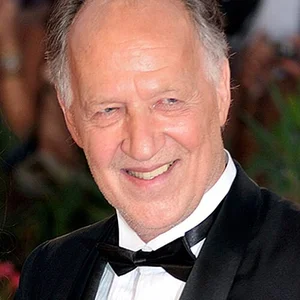

Werner Herzog is a German filmmaker, screenwriter, and actor born in 1942, a leading figure of the New German Cinema. Both his fiction films and his documentaries explore boundless dreams, hostile nature, and the fringes of humanity.
Werner Herzog(1942 — ?)
Werner Herzog
Allemagne
7 min read
Frequently asked questions
Key Facts
- Born on 5 September 1942 in Munich, Germany
- Directs “Aguirre, the Wrath of God” in 1972, starring Klaus Kinski, an emblematic film of the New German Cinema
- Shoots “Fitzcarraldo” (1982), whose production hauls a real steamboat over an Amazonian hill
- Establishes himself as a major documentarian with “Grizzly Man” (2005) and “Cave of Forgotten Dreams” (2010)
- Five tumultuous collaborations with the actor Klaus Kinski, recounted in “My Best Fiend” (1999)
Works & Achievements
A film about a Spanish conquistador descending into madness in the Amazon; it made Herzog known throughout the world and came to symbolize the New German Cinema.
The story of a young man raised in captivity who is brutally thrust into society; the film won the Grand Prix of the Jury at Cannes.
A reimagining of the famous silent vampire film, a tribute to the German Expressionism of the 1920s.
The story of a dreamer who wants to build an opera house in the jungle; the legendary shoot earned Herzog the Best Director prize at Cannes.
A published travel journal recounting his walk on foot from Munich to Paris in the dead of winter.
A documentary about an American who lived among the bears of Alaska, which marked Herzog's success in documentary filmmaking.
A 3D documentary filmed inside the Chauvet Cave, giving the public a glimpse of the oldest known cave paintings.
A documentary in which Herzog looks back on his stormy relationship with the actor Klaus Kinski, his most famous collaborator.
Anecdotes
In 1974, Werner Herzog learns that the great film critic Lotte Eisner is gravely ill in Paris. Convinced that she would not die if he came on foot, he leaves Munich in the dead of winter and walks nearly 800 kilometers all the way to Paris. He recounted this journey in a notebook, and Lotte Eisner went on to live for several more years.
For the shooting of *Fitzcarraldo* (1982) in the Peruvian jungle, Herzog refused to use special effects: he actually had a steamship weighing several hundred tons hauled over a muddy hill using a system of winches. This colossal undertaking, which mirrors the mad dream of the film's hero, nearly cost several people their lives.
In 1980, Herzog had promised the young filmmaker Errol Morris that if he finished his first documentary, he would eat his own shoe. When Morris succeeded, Herzog kept his word: he cooked his shoe in broth and ate it in public during a screening. The scene was filmed in a short film titled *Werner Herzog Eats His Shoe*.
In 2006, during a filmed interview in Los Angeles, Herzog was struck by a bullet fired from a distance by an unknown shooter. He remained unfazed, lifted his shirt to show the wound, and simply declared that “it is not a significant bullet,” before carrying on with the conversation.
Herzog often worked with the actor Klaus Kinski, a man of explosive temperament, on five films including *Aguirre* and *Fitzcarraldo*. Their quarrels were so violent that Herzog later devoted a documentary to them, *My Best Fiend*, recounting their relationship that was both stormy and creative.
Primary Sources
“I told myself: set off now for Paris, on foot, and she will live. (...) I set out on the shortest path to Paris, in the full certainty that she would stay alive if I came on foot.”
“It is not a significant bullet.” (Herzog's reaction after being hit by a projectile during the filming of the interview)
In it, Herzog describes the jungle as a place of “fornication and asphyxiation,” a world without harmony where nature itself seems angry, while confessing his love for it.
“The old cinema is dead. We believe in the new one.” Signed by young filmmakers demanding the freedom to create an auteur cinema in Germany.
Key Places
Werner Herzog's birthplace in 1942 and the cradle of his career as a filmmaker. It is also the starting point of his famous walk to Paris.
Mountain village where Herzog spent his childhood, after his family fled the bombing of Munich. He grew up there amid a harsh and isolated natural setting.
Destination of Herzog's winter walk in 1974, undertaken to visit the film critic Lotte Eisner. Paris is also a major center of auteur cinema.
Filming location for *Aguirre* and *Fitzcarraldo*, where Herzog confronted a hostile natural world. It was there that he had a boat hauled over a hill.
Cave adorned with prehistoric paintings more than 30,000 years old, which Herzog filmed in 3D for *Cave of Forgotten Dreams*.
City where Herzog settled and continues to work as a filmmaker and actor. It was there that he was struck by a bullet during an interview in 2006.
Typical Objects

The filmmaker's central tool, the camera lets Herzog shoot both fiction films and documentaries in extreme locations. He reportedly learned to film with a camera borrowed from his film school.

A text describing the story, dialogue, and scenes of a film before shooting begins. Herzog often wrote his own screenplays very quickly, sometimes in just a few days.

A river steamboat that the hero of *Fitzcarraldo* dreams of hauling over a mountain. Herzog actually hoisted one over a hill during filming.

A device that projects the film onto a large screen in front of the audience, in cinemas or at festivals. This is where Herzog's works meet their viewers.

A small notebook in which Herzog jotted down his thoughts, such as during his walk from Munich to Paris. These journals went on to become published books.

A shoe that Herzog boiled and then ate in public after losing a bet, as a sign of a promise kept and as encouragement to young filmmakers.
School Curriculum
Vocabulary & Tags
Key Vocabulary
Daily Life
Morning
Herzog is known for rising early and working with great discipline. His mornings are often devoted to writing screenplays, which he drafts very quickly, or to the meticulous preparation of his shoots.
Afternoon
In the afternoon, during filming, he directs his crews in the field, sometimes in extreme conditions such as the jungle or high mountains. When not shooting, he reads a great deal and prepares his film projects.
Evening
In the evening, Herzog reviews footage that has been shot, talks with his collaborators, or attends screenings at festivals. He also enjoys telling stories and reflecting on the meaning of his films.
Food
Herzog leads a sober life and is wary of excess. He claims to attach little importance to refined food, eating simply, which contrasts with the episode in which he had to eat his own shoe to honor a bet.
Clothing
He dresses in a plain and practical way, favoring rugged clothing suited to outdoor shoots, far from the ostentatious elegance of show business.
Housing
After a childhood in an isolated Bavarian village, Herzog lived in Munich and then settled in Los Angeles. He has always preferred a life marked by travel and shoots in remote places rather than great comfort.
Historical Timeline
Period Vocabulary
Liens externes & ressources
Références
Œuvres
Sur le chemin des glaces
1978