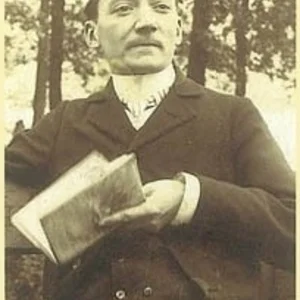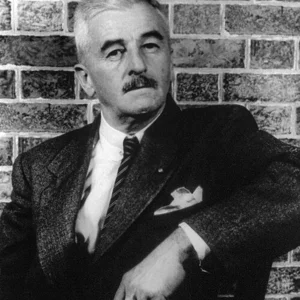

American writer, a major figure of the literature of the American South. A master of stream of consciousness, in a dense body of work he depicted the decline of Southern families after the Civil War. Nobel Prize in Literature 1949.
William Faulkner(1897 — 1962)
William Faulkner
États-Unis
7 min read
Frequently asked questions
Famous Quotes
« The past is never dead. It's not even past.»
« Between grief and nothing, I will take grief.»
Key Facts
- Born in 1897 in New Albany, Mississippi, he set most of his work in the imaginary county of Yoknapatawpha
- Published *The Sound and the Fury* in 1929, a landmark novel of stream of consciousness
- Brought out *As I Lay Dying* (1930), *Light in August* (1932) and *Absalom, Absalom!* (1936)
- Received the Nobel Prize in Literature in 1949 (awarded in 1950)
- Died in 1962 in Byhalia, Mississippi
Works & Achievements
A masterpiece of stream-of-consciousness writing, recounting the decline of the Compson family through four points of view, including that of a mentally disabled man.
A polyphonic novel in which fifteen narrators recount the funeral journey of a poor family to bury their mother.
A dark and violent novel that earned Faulkner his first real commercial success and caused a scandal.
A sweeping epic about race, identity, and religion in the South, centered on the character of Joe Christmas.
Often considered his most ambitious novel: the rise and fall of Thomas Sutpen, haunted by slavery and the Civil War.
The first installment of the Snopes trilogy, following the rise of a family of cunning, unscrupulous peasants.
An allegorical novel about the First World War that won him the Pulitzer Prize and the National Book Award.
His final novel, picaresque and lighter in tone, awarded a second Pulitzer Prize posthumously.
Anecdotes
The novelist's surname was originally spelled "Falkner." The "u" is said to have appeared by mistake when a typesetter altered the spelling on the cover of his first book, in 1919. Faulkner kept this version, declaring that it suited him just fine.
During the First World War, Faulkner, deemed too short for the American army, enlisted in the Royal Air Force in Canada. The war ended before he ever flew in combat, but he returned to Oxford in uniform, sometimes feigning a war wound and a limping gait he had never actually suffered.
Appointed postmaster of the University of Mississippi, Faulkner proved a disastrous employee: he read, threw away mail that bored him, and closed the window whenever he pleased. On resigning, he reportedly declared that he refused from then on to be "at the beck and call of any man with two cents and a stamp."
For his novel "A Fable," Faulkner pinned up and painted the detailed plot outline, day by day, directly onto the walls of his study at Rowan Oak. These inscriptions in pencil and red paint are still visible there today.
Faulkner called his imaginary county of Yoknapatawpha "my own little postage stamp of native soil." He invented this region of Mississippi, drew its map, and had the same families live on from one novel to the next, building a coherent fictional world inspired by his native Oxford.
Primary Sources
I decline to accept the end of man. […] I believe that man will not merely endure: he will prevail. He is immortal, not because he alone among creatures has an inexhaustible voice, but because he has a soul, a spirit capable of compassion and sacrifice and endurance.
The past is never dead. It's not even past.
The writer's only responsibility is to his art. He will be completely ruthless if he is a good one. […] If a writer has to rob his mother, he will not hesitate: the “Ode on a Grecian Urn” is worth any number of old ladies.
A shadow on the curtain, like two crossed legs. […] Time is dead as long as it is being clicked off by little wheels; only when the clock stops does time come to life.
Key Places
William Faulkner's birthplace, in northern Mississippi, on September 25, 1897.
A Greek Revival-style home that Faulkner bought in 1930, where he lived and wrote most of his work. Today it is a museum.
Faulkner was briefly a student here, then the campus postmaster, a position he resigned from in dramatic fashion.
Faulkner worked here as a screenwriter in the 1930s and 1940s, notably for director Howard Hawks, in order to support himself.
Faulkner received the Nobel Prize in Literature here and delivered his famous speech on the endurance of mankind, on December 10, 1950.
Faulkner died of a heart attack in a clinic in this small Mississippi town, on July 6, 1962.
Typical Objects

Faulkner composed his novels on the typewriter in his study at Rowan Oak, tirelessly reworking his long sentences. It was the central tool of his literary workshop.

An inveterate smoker, Faulkner is almost always photographed with a pipe in his mouth. It accompanied his working hours and became a feature of his public image.

Bourbon, the Southern corn whiskey, accompanied the writer throughout his life, for his alcoholism is well documented. He made it as much a writing companion as a scourge.

A horse enthusiast, Faulkner rode across the grounds of Rowan Oak and took part in fox hunts. A fall from a horse even contributed to his death in 1962.

Faulkner painted and wrote on the walls of his study the day-by-day progression of the plot of his novel “A Fable.” These wall notes are preserved exactly as they were at Rowan Oak.

Away from the farm, Faulkner cultivated the air of a Southern gentleman in a tweed jacket, sometimes with a neat moustache and a pipe. An elegance that contrasted with his rural life.
School Curriculum
Vocabulary & Tags
Key Vocabulary
Tags
Daily Life
Morning
Faulkner often reserved his mornings for writing, shut away in his study at Rowan Oak with his typewriter and his pipe. He composed long, dense sentences that he reworked relentlessly.
Afternoon
In the afternoon, he became a farmer and country gentleman again: he oversaw his land, went horseback riding, and took part in the rural life of Oxford. His contact with the Mississippi soil fed directly into his work.
Evening
Evenings were spent with family or friends, often over a glass of bourbon. Faulkner might also read or carry on his writing late into the night.
Food
He ate the cuisine of the Deep South: corn, sweet potatoes, pork, garden vegetables, and slow-cooked dishes. Bourbon, the regional corn whiskey, held a notable place in his daily life.
Clothing
On the farm, Faulkner wore riding attire, boots, and jodhpurs. In society, he favored the elegance of the Southern gentleman: a tweed jacket, a neatly trimmed mustache, and a pipe.
Housing
He lived at Rowan Oak, a Greek Revival home surrounded by cedars in Oxford. This old house, bought in disrepair and then restored, embodied the fallen aristocracy of the Old South that he depicted.
Historical Timeline
Period Vocabulary
Liens externes & ressources
Références
Œuvres
Le Bruit et la Fureur (The Sound and the Fury)
1929
Tandis que j'agonise (As I Lay Dying)
1930
Sanctuaire (Sanctuary)
1931
Lumière d'août (Light in August)
1932
Absalon, Absalon ! (Absalom, Absalom!)
1936
Le Hameau (The Hamlet)
1940
Parabole (A Fable)
1954