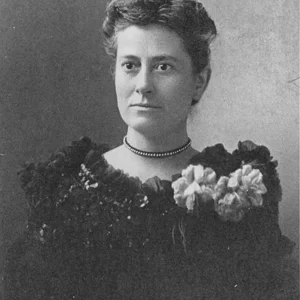

Scottish-American astronomer, she joined the Harvard Observatory as a "Harvard Computer." She developed a system for classifying stellar spectra and discovered the Horsehead Nebula in 1888.
Williamina Fleming(1857 — 1911)
Williamina Fleming
États-Unis, Royaume-Uni de Grande-Bretagne et d'Irlande
7 min read
Frequently asked questions
Key Facts
- Born in 1857 in Dundee, Scotland; emigrated to the United States in 1878
- Hired in 1881 by Edward Pickering at the Harvard College Observatory as a computer
- Developed the stellar spectral classification known as the "Fleming system
- (1890)
- Discovered the Horsehead Nebula (Barnard 33) in 1888
- Catalogued more than 10,000 stars in the Draper Catalogue of Stellar Spectra (1890)
Works & Achievements
A landmark of nineteenth-century astronomy, this catalogue records the spectra of 10,351 stars classified according to the alphabetical system devised by Fleming. It laid the groundwork for the Harvard classification scheme, later refined by Annie Jump Cannon and still in use today.
While examining photographic plates of the Orion region, Fleming identified a dark nebula shaped like a horse's head. This discovery is one of the most celebrated in the history of astronomy, and the image has become one of the most iconic in world scientific culture.
A major publication in which Fleming catalogues and describes 222 variable stars identified through the systematic analysis of Harvard's photographic plates. This work illustrates the rigor and scope of her contribution to observational astronomy.
An original system for classifying stars according to their spectral characteristics, using letters of the alphabet. Developed by Fleming from the Draper Catalogue plates, it was the direct forerunner of the OBAFGKM classification still used by astronomers today.
Over the course of her career, Fleming identified 59 gaseous nebulae and 10 novae through the meticulous examination of thousands of photographic plates. These discoveries contributed significantly to mapping the universe at the end of the nineteenth century.
Anecdotes
Williamina Fleming arrived at Harvard in 1879 as a maid in the household of the Observatory director, Edward Pickering. Impressed by her intelligence and rigor, he invited her to join his team of “computers” — women tasked with analyzing astronomical data. This unconventional recruitment marked the beginning of a remarkable scientific career.
In 1888, while examining photographic plates of the Orion region, Fleming spotted a dark anomaly shaped like a horse's head. This is how she discovered the famous Horsehead Nebula (Barnard 33), one of the most iconic images in astronomy. Her patience and trained eye were decisive.
Fleming developed a spectral classification system for stars used in the Draper Catalogue. She classified more than 10,000 stars by meticulously analyzing their spectra on glass photographic plates, laying the groundwork for the modern stellar classification system still refined today.
In 1899, Fleming was appointed Curator of Astronomical Photographs at Harvard — a first for a woman at that institution. She was responsible for all of the observatory's photographic plates and supervised the work of the other “computers,” an official recognition of her essential role.
In her 1900 diary, Fleming bitterly describes the situation of women scientists of her era: although her work was recognized by her peers, her earnings remained far below those of her male colleagues, even the most junior ones. This account stands as a valuable document on the condition of science's female pioneers.
Primary Sources
It seems to me that there is a great disparity between the salaries of men and women at the observatory, even for equivalent work. I receive only twenty-five cents an hour, whereas a man in my position would receive more.
This catalogue records the spectra of 10,351 stars classified according to the alphabetical system devised by Fleming, representing the first comprehensive stellar spectral classification published at large scale.
Fleming presents her discoveries of 222 variable stars identified through the systematic analysis of Harvard Observatory photographic plates, the result of several years of meticulous examination.
The dark nebula shaped like a horse's head, spotted by Fleming on photographic plates of the Orion region, is formally reported and described for the first time in this notice.
Key Places
Birthplace of Williamina Fleming, born on May 15, 1857, where she received her early education before working as a teacher. The city was then a major industrial center, which stands in striking contrast to the pioneering scientific career she would go on to pursue.
The heart of Fleming's entire scientific career, where she worked for more than thirty years — first as a "computer," then as Curator of Astronomical Photographs. It was here that she discovered the Horsehead Nebula and classified tens of thousands of stars.
The city where Fleming lived and died in 1911, at the heart of one of America's great intellectual hubs on the East Coast. Boston was home to numerous scientific and cultural institutions that fostered the rise of women in science like Fleming.
Typical Objects

A glass support coated with a silver bromide photosensitive emulsion, used to capture stellar spectra. Fleming spent her days examining these plates under a magnifying glass to identify and classify stars.

An optical instrument for examining astronomical photographic plates in detail. The everyday tool of Harvard's “computers,” it allowed them to distinguish the fine spectral lines characteristic of each star.

An instrument that broke starlight down into a spectrum of colors, revealing the chemical composition and temperature of stars. Fleming analyzed thousands of spectra obtained with this instrument to build her stellar classification system.

A thick notebook in which Fleming methodically recorded her observations and star classifications. These registers formed the raw material of the Draper Catalogue, a landmark of nineteenth-century astronomy.

A translucent surface lit from below, allowing photographic plates to be examined by transmitted light. The central piece of equipment in the “computers'” workroom, it made the finest details of stellar photographs visible.

An essential light source for evening work on photographic plates in the “computers'” room. Its soft, steady light allowed the most subtle details of recorded spectra to be distinguished.
School Curriculum
Vocabulary & Tags
Key Vocabulary
Tags
Daily Life
Morning
Fleming rose early and had a modest breakfast before walking to the Harvard Observatory. She began her day by checking the new photographic plates delivered by the observing astronomers, carefully labeling them before distributing them to the other “computers.”
Afternoon
The afternoon was devoted to the meticulous examination of photographic plates under a magnifying glass, noting the spectral characteristics of each star in her classification registers. She also supervised the work of the other women on the team and answered scientific questions from her male colleagues.
Evening
In the evening, Fleming wrote up her summary notes and journal, recording the day's discoveries and any classification problems she had encountered. She also prepared reports for Pickering and corresponded by post with astronomers around the world.
Food
Fleming's diet was typical of the American middle class in the late nineteenth century: bread, cold meats, seasonal vegetables, and tea — meals often eaten quickly so as to devote as much time as possible to scientific work.
Clothing
Fleming wore the sober, practical clothing typical of professional women of the Victorian era: long dark skirts, white blouses with high collars, and hair pinned up in a bun. Her dress reflected the social respectability expected of her and the practical need to sit and work for long hours at a stretch.
Housing
Fleming lived in a middle-class house in Cambridge, Massachusetts, in a neighborhood close to the university. Her home was furnished in the Victorian manner — heavy curtains, dark wood furniture, and a well-stocked bookcase — attesting to her standing as a respected professional.
Historical Timeline
Period Vocabulary
Visual Style
Style réaliste de l'ère victorienne tardive, dans les tons sépia et ambrés d'un observatoire astronomique du XIXe siècle, avec une attention aux détails des instruments scientifiques et des tenues d'époque sobres et fonctionnelles.
Sound Ambience
Ambiance feutrée et studieuse de la salle de travail des « computers » de l'Observatoire de Harvard à la fin du XIXe siècle, dominée par les sons discrets du travail scientifique minutieux sur les plaques photographiques.
Liens externes & ressources
Références
Œuvres
Draper Catalogue of Stellar Spectra
1890
Découverte de la nébuleuse de la Tête de Cheval (Barnard 33)
1888
A Photographic Study of Variable Stars
1907
Système de classification spectrale de Fleming
1890
Catalogue de 59 nébuleuses gazeuses et 10 novae
1890-1911