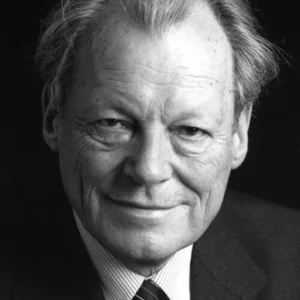

German statesman, Chancellor of the Federal Republic of Germany (FRG) from 1969 to 1974. A leading figure of social democracy, he is famous for his policy of rapprochement with the Eastern Bloc (Ostpolitik) and received the Nobel Peace Prize in 1971.
Willy Brandt(1913 — 1992)
Willy Brandt
Norvège, Espagne, Suède, Allemagne, Empire allemand
6 min read
Frequently asked questions
Key Facts
- Governing Mayor of West Berlin from 1957 to 1966, during the construction of the Berlin Wall (1961)
- Chancellor of the Federal Republic of Germany from 1969 to 1974
- Launched Ostpolitik, a policy of normalizing relations with the USSR and the countries of the Eastern Bloc
- Received the Nobel Peace Prize in 1971 for his efforts to promote détente
- Warsaw Genuflection (1970): he knelt before the ghetto memorial, a symbol of German repentance
- Resigned in 1974 in the wake of the Guillaume espionage affair
Works & Achievements
Brandt's major foreign policy aimed at normalizing relations with the USSR, Poland, and East Germany. It marked a turning point in the détente of the Cold War.
Agreement with the Soviet Union renouncing the use of force and recognizing the borders that emerged from the war. A cornerstone of Ostpolitik.
Agreement with Poland recognizing the Oder-Neisse line as a border. It sealed the German-Polish reconciliation.
Agreement of mutual recognition between West Germany and East Germany. It allowed both German states to join the UN in 1973.
Report by the international commission he chaired on the inequalities between the rich countries of the North and the poor countries of the South. It proposed an overhaul of global economic relations.
Autobiography in which Brandt looks back on his journey, from exile to the chancellery. A leading account of twentieth-century Germany.
Anecdotes
On December 7, 1970, while visiting Warsaw, Willy Brandt spontaneously knelt before the monument to the victims of the Jewish ghetto. This gesture, entirely unplanned and remembered in history as the *Kniefall von Warschau* (the Warsaw Genuflection), symbolizes Germany's plea for forgiveness for Nazi crimes. Asked about it later, Brandt explained that, faced with the abyss of German history, words had failed him.
Willy Brandt was not his real name: he was born Herbert Frahm. He adopted this pseudonym in the 1930s to escape the Gestapo while he was campaigning against Nazism and living in exile in Norway and then Sweden. He never went back to his birth name, even after the war.
In 1971, Willy Brandt received the Nobel Peace Prize for his *Ostpolitik*, his policy of opening up toward the countries of the Eastern Bloc. He was the first German chancellor to receive this honor since Gustav Stresemann in 1926.
His career as chancellor came to an abrupt end in 1974 because of an espionage affair: one of his closest aides, Günter Guillaume, was in fact a secret agent of the Stasi, the East German intelligence service. Brandt took political responsibility for the scandal and resigned.
During the war, while a refugee in Norway, Brandt was for a time captured by the German soldiers occupying the country. But because he was wearing a Norwegian uniform and no one recognized him, he was able to pass himself off as an ordinary Norwegian prisoner of war and thus escaped certain execution.
Primary Sources
War is no longer the ultima ratio, but the ultima irratio. [...] A sound German peace policy must also be a policy of good neighborliness.
We want to dare more democracy (“Wir wollen mehr Demokratie wagen”).
Under the weight of Germany's recent history, I did what people do when words fail.
The contracting parties undertake to settle their disputes exclusively by peaceful means and to refrain from any threat or use of force.
Key Places
Hanseatic city in northern Germany where Herbert Frahm was born in 1913. It is there that he grew up in a working-class, socialist milieu.
City where Brandt served as Governing Mayor from 1957 to 1966, on the front line of the Cold War. He witnessed the building of the Wall there in 1961.
Capital of Poland where Brandt knelt before the ghetto memorial in 1970. This gesture became a worldwide symbol of repentance.
Capital of West Germany where Brandt carried out his duties as Chancellor from 1969 to 1974. The seat of the West German government was located there.
Norwegian capital where Brandt received the Nobel Peace Prize in 1971. Norway had also been his land of exile during the Nazi era.
Small town on the banks of the Rhine where Willy Brandt spent his final years and died in 1992.
Typical Objects

Gold medal awarded to Brandt in 1971 for his Ostpolitik. It symbolizes the international recognition of his policy of reconciliation and détente.

Diplomatic documents signed with Moscow, Warsaw, and East Germany in the early 1970s. They enshrined the normalization of relations between West Germany and the Eastern Bloc.

A tool of the political orator that Brandt was, renowned for his eloquence. He used it for his speeches in the Bundestag and at SPD rallies.

Brandt was a heavy smoker, often photographed with a cigarette in hand. Tobacco was part of his public image as a thoughtful and sometimes melancholic man.

A depiction of the two Germanys (West Germany and East Germany) and the Berlin Wall. This object embodies the context of division that Brandt sought to overcome through dialogue.
School Curriculum
Vocabulary & Tags
Key Vocabulary
Daily Life
Morning
An overworked Chancellor, Brandt began his days in Bonn by reading the newspapers and diplomatic telegrams. His mornings were paced by cabinet meetings and sessions with his advisers, including the loyal Egon Bahr, architect of the Ostpolitik.
Afternoon
His afternoons were spent in debates at the Bundestag, in receptions for foreign heads of state, and in diplomatic negotiations. A gifted orator, he defended there his vision of a Germany reconciled with its neighbours.
Evening
In the evening, Brandt enjoyed hosting intellectuals and writers, such as his friend the novelist Günter Grass. An avid reader and lover of conversation, he often extended his evenings over a glass of wine and a cigarette.
Food
Brandt enjoyed the northern German cuisine of his childhood as well as simple dishes. A bon vivant, he loved wine and was known for a certain taste for the pleasures of the table, though without ostentatious excess.
Clothing
He wore the dark, understated suits of the statesman of the second half of the 20th century, with a tie and white shirt. His elegant figure and composed bearing contributed to his public charisma.
Housing
As Chancellor, he lived and worked at the chancellery in Bonn, then the capital of West Germany. He ended his life in a house in Unkel, a peaceful little town on the banks of the Rhine.
Historical Timeline
Period Vocabulary
Liens externes & ressources
Références
Œuvres
Ostpolitik (politique d'ouverture à l'Est)
1969-1974
Traité de Moscou
1970
Traité de Varsovie
1970
Traité fondamental (Grundlagenvertrag)
1972
Rapport Brandt (Nord-Sud : un programme de survie)
1980
Mémoires (Erinnerungen)
1989