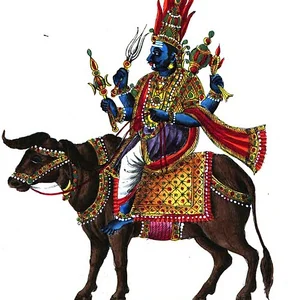

Yama is the god of death and justice in Hindu and Buddhist traditions. He rules over the realm of the dead and weighs souls to determine their rebirth according to the deeds performed during their lifetime.
Yama
Yama
8 min read
Frequently asked questions
Key Facts
- Mentioned in the Rigveda (c. 1500–1200 BCE) as the first human being to die and the guide of the dead
- In Tibetan Buddhism, he is depicted holding the Wheel of Dharma (Bhavachakra), symbolizing the cycle of rebirths
- He is assisted by two four-eyed dogs that guard the path to the realm of the dead
- His scribe Chitragupta keeps a record of every soul's deeds to inform Yama's judgment
- Integrated into the Buddhist pantheon as a guardian of dharma, particularly in Southeast Asia and China (Yanluo Wang)
Works & Achievements
The earliest appearance of Yama in world literature, describing him as the first mortal to have discovered the path to the afterlife. These hymns establish Yama's foundational role in Vedic thought.
A major philosophical text in the form of a dialogue between Yama and the young Nachiketa, in which the god reveals the secrets of the soul's immortality. This text is one of the cornerstones of Vedanta philosophy.
A legal and moral text attributed to Yama himself, codifying karmic rules and the criteria of divine judgment. It belongs to the Dharmashastra, a body of texts governing Hindu social and spiritual life.
A detailed account of the soul's journey, Yama's tribunal, and the various hells (naraka) assigned to sinners. This text is still recited today during Hindu funeral rites.
A Buddhist iconographic representation in which Yama holds the wheel of the six realms of rebirth, symbolizing impermanence and the cycle of samsara. This symbol is found in every Tibetan Buddhist monastery.
A foundational narrative episode in which Yama disguises himself as a yaksha to test the wisdom of his son Yudhishthira. This passage contains some of the most widely quoted philosophical maxims in Sanskrit literature.
Anecdotes
Yama is the first human being to have died according to the Rigveda, which earned him the title of king of the dead. As the first mortal to have crossed the threshold of death, he knows the path to the afterlife better than anyone, and so he is entrusted with welcoming and guiding souls there.
In the Mahabharata epic, the hero Yudhishthira encounters Yama disguised as a yaksha (nature spirit) beside a lake. Yama poses philosophical questions about life and death to his son, and Yudhishthira answers with such wisdom that he is the only one to pass the ordeal without perishing.
Yama possesses two fearsome four-eyed, broad-nostriled dogs named Shyama and Sabala, who guard the paths leading to the realm of the dead. These dogs roam among the living to identify those whose death is imminent — an image that has endured through the centuries in Vedic texts.
In Tibetan Buddhism, Yama (known as Yanluo Wang in China) is depicted holding the Bhavachakra, the wheel of existence, in his claws. This wheel illustrates the six realms of rebirth and the cycle of samsara, making Yama not only a judge but also the guardian of the cycle of reincarnations.
According to the Katha Upanishad (c. 600 BCE), the young Brahmin Nachiketa waited three days before Yama's palace without food or water. Upon his return, Yama, impressed by this perseverance, granted him three wishes — including the revelation of the secret of life after death, a foundational teaching of Hindu philosophy.
Primary Sources
"Yama, the first to have found the path for us, this pasture that cannot be taken away, where our ancient fathers went — all who are born make their way there by their own road."
"May Yama grant you rest in this world, may he settle you among the virtuous ancestors. May you dwell in the light of the forefathers after leaving this mortal body."
"Nachiketa said: O Death, there is this doubt concerning the man who has died — some say he still exists, others say he does not. I wish to know this truth; teach me. This is the third boon I ask of you."
"Yudhishthira answered the yaksha: The most astonishing thing in this world is that every day men see creatures departing to the abode of Yama, and yet those who remain still long to live forever."
"After death, the soul is led by Yama's messengers (Yamadutas) along the southern road to Yamaloka, where Chitragupta opens the book of deeds and reads aloud the merits and sins of each soul before the judge's throne."
Key Places
A mythical kingdom located in the southern regions according to Hindu cosmology, where Yama dispenses divine justice to the souls of the deceased. It is described in the Garuda Purana as a vast city with a great tribunal.
A mythical river that souls must cross to reach Yamaloka, the Hindu equivalent of the Greek Styx. Hindu funerary rites include offerings to help the soul of the deceased cross this treacherous river.
A sacred city on the banks of the Ganges, considered the most auspicious place to die, as dying there grants liberation (moksha) directly from Shiva, bypassing Yama's judgment. Cremations continue around the clock on the Manikarnika ghats.
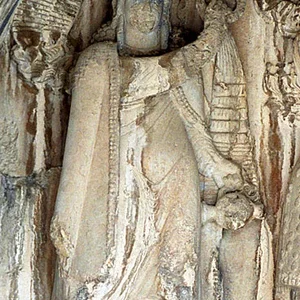
A great Hindu temple dedicated to Shiva on the banks of the Bagmati River, with sacred cremation grounds where Hindus wish to be cremated. Statues of Yama adorn the temple entrances, where he stands as guardian and protector of the passage into the afterlife.
The site of the great battle in the Mahabharata, where Yudhishthira encountered Yama in disguise. This sacred site is also associated with funerary rituals: Hindus come here to perform shraddha rites to liberate their ancestors.
Typical Objects

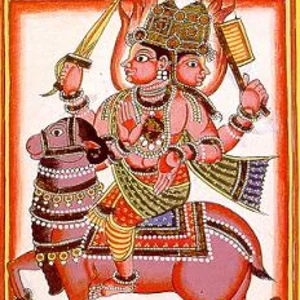
Yama's mace or scepter symbolizes his absolute authority over the living and the dead. It is the instrument of his relentless justice, which he wields to subdue defiant souls.

Yama uses this lasso to capture the souls of the dying and lead them to his kingdom. It is depicted in one of the god's hands as a symbol of the inevitability of death.

His clerk Chitragupta keeps a great ledger in which all the deeds of every living being are recorded. At the time of judgment, this book is opened and good or bad deeds are tallied to determine one's rebirth.

In Buddhist iconography, Yama holds the wheel of existence (Bhavachakra) in his claws or arms. This wheel illustrates the six realms of rebirth and serves as a reminder that even gods are subject to the cycle of time.

Yama's mount is a great black buffalo, an animal associated with death and mourning in Indian culture. This choice of mount reinforces the austere and formidable image of the lord of the dead.

Yama is sometimes depicted with a skull or an ornate vessel, symbols of the purifying waters of the passage between life and death. These objects recall the Vedic funerary rituals meant to ease the soul's journey.
School Curriculum
Vocabulary & Tags
Key Vocabulary
Daily Life
Morning
Each dawn, Yama takes his place on his obsidian throne in Yamaloka to preside over the judgment of souls that arrived during the night. His scribe Chitragupta opens the cosmic records and reads aloud the account of each soul's deeds — merits, sins, gifts, acts of violence — omitting nothing.
Afternoon
During the central hours of the cosmic day, Yama dispatches his messengers (Yamaduttas) across the three worlds to watch over beings whose time is drawing near. He deliberates with his advisors on complex cases, especially those involving souls contested between Vishnu's celestial messengers and his own agents.
Evening
In the evening, Yama receives the offerings and prayers of the living on behalf of their ancestors: rice, sacred water, sesame seeds. He determines the transitional dwelling of each soul in one of the many intermediate realms before its next rebirth. His consort Dhumorna assists him in these decisions of fate.
Food
As a god, Yama is sustained by the ritual offerings (pitru-tarpana) that the living present during funeral ceremonies: water mixed with black sesame seeds, cooked rice, milk, and honey. These offerings, conveyed through the shraddha rites, maintain the cosmic order between the world of the living and the world of the dead.
Clothing
Yama is clad in deep red robes and armor symbolizing blood, passion, and unyielding justice, embroidered with golden threads forming patterns of lotuses and serpents. He wears a crown adorned with skulls and flowers, and his arms are heavy with copper and iron bracelets.
Housing
Yama resides in Yamaloka, a vast underground palace with walls of black stone carved with mantras, lit by thousands of oil lamps. According to the Garuda Purana, this palace measures a thousand yojanas (roughly 13,000 km) on each side and is surrounded by lush but inaccessible gardens where virtuous souls await rebirth.
Historical Timeline
Period Vocabulary
Visual Style
Esthétique de tribunal divin sombre et majestueux, inspirée des fresques de temples hindous et des miniatures Rajput : peau sombre, robes pourpres et or, lumière de lampes à huile sur la pierre sculptée.
Sound Ambience
Une atmosphère solennelle et sacrée mêlant les sons des rituels funéraires védiques — tambours, cloches de temple, crépitement des bûchers crématoires — et la résonance grave d'une salle de jugement divine.
Liens externes & ressources
Références
Œuvres
Hymnes à Yama — Rigveda (Mandala X, hymnes 13-14)
vers 1500-1200 av. J.-C.
Kathopanishad
vers 600 av. J.-C.
Yama-smriti (Traité de loi de Yama)
vers 200-600 apr. J.-C.
Garuda Purana — section Pretakhanda
vers 800-1000 apr. J.-C.
Bhavachakra (Roue de la vie bouddhiste)
vers 200 av. J.-C. – 100 apr. J.-C.
Mahabharata — épisode du yaksha (Vana Parva)
vers 400 av. J.-C. – 400 apr. J.-C.