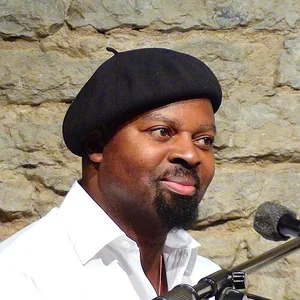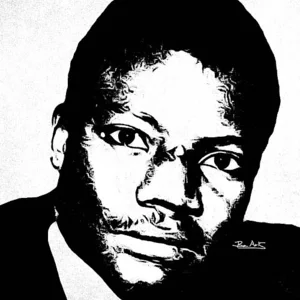

Yambo Ouologuem (1940-2017) was a Malian writer, the first African author to win the Prix Renaudot in 1968 for his novel “Bound to Violence.” A major and controversial figure of francophone African literature, he later withdrew from public life.
Yambo Ouologuem(1940 — 2017)
Yambo Ouologuem
Mali
5 min read
Frequently asked questions
Key Facts
- Born in 1940 in Bandiagara, in French Sudan (present-day Mali)
- Published “Bound to Violence” in 1968, a historical epic of the fictional African Empire of Nakem
- Won the Prix Renaudot in 1968, the first African author to receive it
- Accused of plagiarism from 1971 onward, he gradually withdrew from the literary scene
- Having returned to live in Sévaré, Mali, he died in 2017
Works & Achievements
A sweeping novel that recounts the violent history of an imaginary African empire, Nakem; winner of the Prix Renaudot and a major work of French-language African literature.
A collection of essays and satirical letters in which the author ironically examines the relationships between Africa, France, and the West.
A novel published under the pseudonym Utto Rodolph that reflects the writer's freedom of tone and boldness.
Anecdotes
In 1968, at just 28 years old, Yambo Ouologuem became the first African writer to receive the prestigious Renaudot Prize for his novel *Bound to Violence*. The news caused a sensation: a young Malian had won one of France's major literary awards.
In *Bound to Violence*, Ouologuem dared to break a taboo of his time: instead of idealizing precolonial Africa as the Négritude movement did, he showed that violence and slavery also existed at the hands of African dynasties. This raw perspective shocked as much as it fascinated.
Starting in 1971, the novel was accused of plagiarism: English critics pointed out passages very close to works by Graham Greene and André Schwarz-Bart. The controversy deeply wounded the writer, who felt unfairly treated by the Parisian literary world.
Disappointed and hurt, Ouologuem eventually turned his back on fame. He returned to Mali in the 1970s, settled in Sévaré, devoted himself to Islam, and for decades refused to receive the journalists and researchers who came looking for him.
Before his great novel, Ouologuem was a brilliant student: sent to study in France around 1960, he attended prestigious Parisian high schools and earned degrees in literature, philosophy, and English, evidence of an immense culture that would nourish his writing.
Primary Sources
Our eyes drink in the brightness of the sun and, overcome, marvel that they are weeping. Maschallah! oua bismillah!…
A tale of the bloody saga of Black Africa traces the centuries of violence of an imaginary African empire, the Nakem, from 1202 up to colonization.
A collection of satirical letters in which Ouologuem challenges France and the West about the way they view Africa and Africans.
Key Places
Town in Dogon country where Ouologuem was born in 1940, at the heart of a region famous for its cliffs and rich culture.
Where he pursued his higher education and published his works; it was here that he received the Renaudot Prize in 1968.
Town where Ouologuem withdrew after his return to Mali; he lived there as a recluse until his death in 2017.
Major river port on the Niger, close to Sévaré, the regional hub of the area where the writer spent his final decades.
Typical Objects

The working tool of the 1960s writer, on which manuscripts and letters were typed before the computer age.

The typewritten pages of the novel that earned Ouologuem the Prix Renaudot and international fame.
French literary award presented in 1968; a symbol of recognition and a turning point in the writer's life.

The everyday writing instrument of the student and the author, for notes, drafts and correspondence.

The holy book of Islam, central to the second part of Ouologuem's life after his return to Mali and his conversion to a pious way of living.

A bound edition of the novel distributed by a Parisian publishing house, a vehicle for the work's worldwide spread.
School Curriculum
Vocabulary & Tags
Key Vocabulary
Daily Life
Morning
As a student in Paris in the 1960s, Ouologuem began his days with classes and reading in the library. Possessed of an immense thirst for knowledge, he studied literature, philosophy and English.
Afternoon
His afternoons were devoted to writing and to frequenting the intellectual and literary circles of Paris. There he rubbed shoulders with publishers, students and writers from across the French-speaking world.
Evening
In the evening he wrote and revised his manuscripts, sometimes late into the night. It was amid this ferment that he completed “Bound to Violence.”
Food
In Paris he shared the everyday fare of the students of the time: simple meals in the university cafeteria and coffee. Back in Mali, he returned to a Sahelian cuisine based on millet, rice and local sauces.
Clothing
In 1960s France, he wore the suit and tie of students and intellectuals. After his return to Mali, he adopted the loose, traditional garments of the Sahel, in keeping with his pious and withdrawn life.
Housing
At first he lived in modest student and writer's lodgings in Paris. His life ended in a house in Sévaré, in Mali, where he lived as a recluse, surrounded by his books and turned toward religion.
Historical Timeline
Period Vocabulary
Liens externes & ressources
Références
Œuvres
Le Devoir de violence
1968
Lettre à la France nègre
1969
Les Mille et Une Bibles du sexe
1969