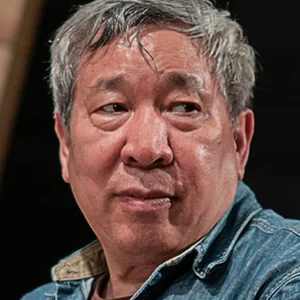

Yan Lianke is a contemporary Chinese novelist born in 1958 in Henan province. A leading figure of social satire, he is known for his critical works—often censored in China—that blend raw realism with grotesque absurdity.
Yan Lianke(1958 — ?)
Yan Lianke
République populaire de Chine
6 min read
Frequently asked questions
Key Facts
- Born in 1958 into a peasant family in Henan, China
- Enlisted in the People's Liberation Army in 1978, where he began writing
- Published 'Dream of Ding Village' (2006), a novel about the contaminated-blood scandal, banned in China
- Received the Franz Kafka Prize in 2014, the first Chinese figure to be honored
- Several of his works ('Serve the People!', 'Lenin's Kisses') are censored in China
Works & Achievements
A short tale about an old man and a blind dog struggling to survive in a village stricken by drought. It earns Yan Lianke the Lu Xun Literary Prize.
A scathing satire in which a village of disabled people plans to buy Lenin's embalmed body to attract tourists. A key work of his “mythorealism.”
A novella that subverts a Maoist slogan through a story of forbidden love in an army barracks. Immediately censored in China.
A novel about the contaminated-blood scandal in Henan, narrated by a dead child. Banned from sale in China despite its real-life basis.
An account of intellectuals confined to a re-education camp during the Great Leap Forward famine. Unpublishable in mainland China.
A grotesque fresco about the dizzying enrichment of a village turned megacity, a critical mirror of Chinese capitalism.
A novel set over a single night in which an entire village falls into sleepwalking and acts out its hidden urges. An allegory of Chinese society.
Anecdotes
Born in a poor village in Henan in 1958, Yan Lianke experienced the great famine that followed the Great Leap Forward as a child. He recounts that he began writing partly to escape the poverty of the countryside: at the time, becoming a writer or a soldier was one of the few ways to leave the land.
In 1978, he enlisted in the People's Liberation Army. It was within the army's cultural services that he became a professional writer and published his first stories, a common path for talented young rural men of his generation.
To write “Dream of Ding Village,” which deals with Henan's contaminated-blood scandal, Yan Lianke discreetly travelled several times to villages devastated by AIDS, accompanied by an anthropologist. Despite these precautions and a real-world subject, the novel was banned from sale in China.
His satirical novella “Serve the People!” (2005), which subverts a famous Mao slogan, was struck by a censorship order forbidding even any mention of it in the press. The leak of this directive paradoxically made the text even more famous abroad.
In 2014, Yan Lianke became the first Chinese writer to receive the prestigious Franz Kafka Prize, awarded in Prague. A repeated finalist for the Man Booker International, he nonetheless remains one of the most censored authors in his country.
Primary Sources
The novel describes a village in Henan decimated by “the fever,” the name given to AIDS contracted by peasants who had sold their blood to unscrupulous collectors. The narration is carried by the voice of a dead child, watching the slow agony of his community.
The novella stages a forbidden relationship between a young orderly and the wife of a division commander, in a barracks dominated by the Maoist slogan “Serve the People.” The subversion of this sacred formula led to the text being banned in China.
In it, Yan Lianke evokes the organized amnesia and the darkness in which, he believes, Chinese writers live, forced to seek light at the very heart of the shadows of their recent history.
In this theoretical essay, Yan Lianke defends an aesthetic he calls “mythorealism” (shenshizhuyi): going beyond apparent realism to reach, through the absurd and the grotesque, a deeper truth of Chinese reality.
Key Places
A poor rural region in central China where Yan Lianke was born in 1958. The Henan countryside provides the raw material for nearly all of his work.
The epicenter of the contaminated-blood scandal, where impoverished peasants contracted HIV by selling their blood. Yan Lianke traveled there to document “Dream of Ding Village.”
The capital where Yan Lianke settled and taught literature after leaving the army. The center of China's political and literary power.
The city where Yan Lianke taught as a visiting professor. Its relative editorial freedom made it a place to publish works banned in mainland China.
The Czech capital where Yan Lianke received the Franz Kafka Prize in 2014, named after the writer of the absurd and of oppression to whom he is often compared.
Typical Objects

A notebook covered in Chinese characters in which the writer drafts his work by hand. It is the primary tool of a novelist who reworks his texts at length.

Military attire worn by Yan Lianke during his years of service, where he became a professional writer. For many young rural men, the army was a path to social advancement.

An iconic writing instrument of the twentieth-century Chinese intellectual. It symbolizes the author's patient work on language.

A book banned from sale in China that circulates as photocopies, in Taiwanese or Hong Kong editions, or on the Internet. Several of Yan Lianke's works existed for his Chinese readers only in this way.

An international literary distinction awarded in Prague, which Yan Lianke received in 2014. It honors a body of work widely recognized abroad despite censorship at home.

A modern writing tool used by contemporary novelists to draft and correct their manuscripts. The Internet also allows censored texts to circulate.
School Curriculum
Vocabulary & Tags
Key Vocabulary
Daily Life
Morning
Like many writers, Yan Lianke devotes his mornings to writing, the time when the mind is most available. He works long hours on his manuscripts, endlessly reworking his language and his imagery.
Afternoon
His afternoons may be taken up with reading, archival research, or teaching literature at the university. Over the course of his career, he has also engaged with foreign readers and scholars during trips and conferences.
Evening
Evenings are well suited to reading the great novelists, both Chinese and foreign, who feed his thinking. It is also a time for conversation with family or with fellow authors.
Food
His diet is that of contemporary China, marked by memories of hunger from his rural childhood: rice, noodles, vegetables, and dishes from Henan. The famine he lived through as a young man remains a central theme of his work.
Clothing
In daily life, he wears modern, understated urban clothing. During his years in the military, the uniform of the People's Liberation Army signaled his allegiance.
Housing
After growing up in a modest peasant house in Henan, he lives in Beijing, in the living environment of a big-city intellectual. The contrast between the poor countryside and the metropolis nourishes his critical eye.
Historical Timeline
Period Vocabulary
Liens externes & ressources
Références
Œuvres
Les Jours, les Mois, les Années (年月日)
1997
Bons baisers de Lénine (受活)
2004
Servir le peuple ! (为人民服务)
2005
Le Rêve du village des Ding (丁庄梦)
2006
Les Quatre Livres (四书)
2010
Les Chroniques de Zhalie (炸裂志)
2013
La Mort du soleil (日熄)
2015