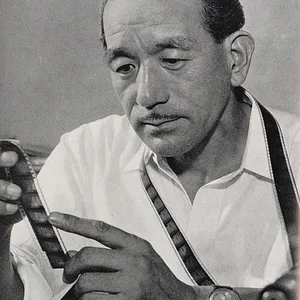

Yasujirō Ozu (1903-1963) was a Japanese filmmaker, one of the greatest masters of world cinema. His intimate films delicately portray the Japanese family and the passage of time, in a spare, contemplative style.
Yasujirō Ozu(1903 — 1963)
Yasujirō Ozu
Japon
6 min read
Frequently asked questions
Key Facts
- Born in 1903 in Tokyo, he joined the Shōchiku studios in 1923 and directed his first film in 1927.
- Developed a singular formal style: a camera placed at tatami height, static shots, frontal framing, and 'pillow shots' (transitional shots).
- Directed his masterpiece in 1953, *Tokyo Story* (Tokyo monogatari), about grandparents neglected by their children.
- Made other major films such as *Late Spring* (1949) and *An Autumn Afternoon* (1962), centered on family and marriage.
- Died in 1963, on his 60th birthday; his work was rediscovered in the West during the 1970s.
Works & Achievements
A silent comedy about two young brothers who discover that their father must humble himself before his boss. One of the high points of Japanese silent cinema.
Ozu's first sound film, about a provincial mother who visits her son in Tokyo and takes the measure of her disappointed hopes.
The first major film of his postwar period, about a young woman who hesitates to leave her father in order to marry. The beginning of his collaboration with Setsuko Hara.
A delicate portrait of an extended family around the marriage of a young woman who chooses her own destiny.
His masterpiece: an elderly couple visit their children in Tokyo, who are too busy to look after them. Regularly ranked among the greatest films in history.
A color comedy about two children who go on a silence strike to get a television set, a gentle satire of consumer society.
Ozu's final film: an aging father marries off his daughter and finds himself facing loneliness. A melancholy farewell to his lifelong themes.
Anecdotes
Yasujirō Ozu died on December 12, 1963, the exact day of his sixtieth birthday: he had been born on December 12, 1903. His mother, with whom he had lived almost his entire life without ever marrying, had passed away a few months earlier, in 1962.
Ozu invented a way of filming so personal that it is called the “tatami shot”: he placed his camera very low, about one meter off the ground, at the eye level of a person sitting on the floor in the Japanese manner. The viewer thus feels invited into the room, seated with the family.
To write his screenplays, Ozu would shut himself away for weeks in a mountain chalet at Tateshina with his faithful collaborator Kōgo Noda. It is said that they measured the progress of their work by the number of bottles of sake they emptied: a finished screenplay sometimes amounted to more than a hundred bottles.
On Ozu's grave, at the Zen temple of Engaku-ji near Kamakura, there is neither a name nor any dates: a single Japanese character is engraved there, 無 (“mu”), which means “emptiness” or “nothingness,” a central concept of Zen Buddhism.
To describe his art, Ozu would say with humor: “I am a tofu seller, all I know how to make is tofu.” He meant that he refused to chase after trends and preferred to spend his whole life perfecting the same kind of intimate films about the Japanese family.
Primary Sources
I am a tofu merchant, so I only make tofu.
— Life is disappointing, isn't it? — Yes… it is disappointing.
無 (mu) — “emptiness,” “nothingness.”
In it, Ozu recorded day by day his writing work, his meals, his walks and the seasons, bearing witness to his methodical and solitary life.
Key Places
Working-class district of Tokyo where Ozu was born in 1903. The modern city and its families of salaried employees would lie at the heart of his cinema.
Town where Ozu spent his childhood and adolescence, sent by his father far from Tokyo. It was there, while skipping classes, that he discovered his passion for cinema.
Major film company that Ozu joined in 1923 as an assistant and where he spent his entire career. He directed nearly all of his films there.
Mountain resort where Ozu owned a cottage and would retreat with screenwriter Kōgo Noda to write his films.
Great Zen temple near Kamakura where Ozu is buried. His grave bears only a single character: 無 (“nothingness”).
Typical Objects

Ozu set his camera very low, motionless on a special tripod, to film his characters seated on the tatami. This fixed camera is the hallmark of his art.

A woven rice-straw mat that covers the floor of traditional Japanese houses. It is the unit of space for the room and the reference height for Ozu's famous “tatami shot.”

A small brightly colored kettle or teapot that Ozu often placed in the set of his interiors. These motionless objects, filmed alone, punctuated his films like moments of breathing.

Sake, a rice wine, accompanies countless scenes of meals and reunions in Ozu's films — he was himself a great lover of the drink.

A traditional Japanese garment worn by many of Ozu's female characters, notably the actress Setsuko Hara, in contrast with the Western suits of the office workers.

Trains and railway tracks recur constantly in Ozu's work, filmed alone as “pillow shots.” They symbolize travel, separation, and the passing of time, as in Tokyo Story.
School Curriculum
Vocabulary & Tags
Key Vocabulary
Daily Life
Morning
A methodical and solitary man, Ozu would rise without hurry in the house he shared with his mother in Kamakura. When he was not filming, his mornings were devoted to reading, correspondence, and preparing his films.
Afternoon
On set, Ozu was a demanding perfectionist who controlled every detail of the decor and had his actors rehearse tirelessly. Away from filming, he often joined screenwriter Kōgo Noda for long writing sessions.
Evening
Evenings were happily spent among film-world friends, over good meals washed down with sake, of which he was a great enthusiast. Ozu enjoyed quiet conversation and the company of his loyal collaborators.
Food
Like most Japanese people of his time, Ozu ate rice, fish, soups, and pickled vegetables, served on small low tables. Sake, the rice wine, held an important place in his social life and his films.
Clothing
In daily life Ozu wore comfortable Western clothing, a suit or work attire on set, like many Japanese city men. The kimono remained reserved for special occasions or private life, as it was for his characters.
Housing
Ozu lived in a traditional Japanese house with rooms covered in tatami mats, sliding partitions, and low furniture — exactly the kind of interior he filmed. He also owned a mountain cottage at Tateshina for writing.
Historical Timeline
Period Vocabulary
Liens externes & ressources
Références
Œuvres
Été précoce (Bakushū)
1951
Bonjour (Ohayō)
1959