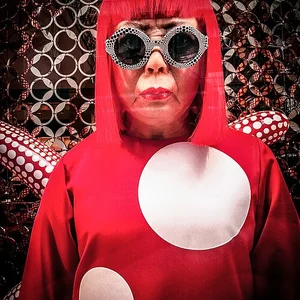

Yayoi Kusama is a Japanese visual artist born in 1929 in Matsumoto. A pioneer of psychedelic art and pop art, she is known for her obsessive polka-dot patterns and immersive mirror installations. Since 1977, she has voluntarily lived in a psychiatric hospital in Tokyo while continuing to create.
Yayoi Kusama(1929 — ?)
Yayoi Kusama
Japon
9 min read
Frequently asked questions
Famous Quotes
« Art is a way to survive.»
« My life is a dot lost among thousands of other dots.»
Key Facts
- Born on March 22, 1929, in Matsumoto, Nagano Prefecture, Japan
- Moved to New York in 1958 and became part of the avant-garde scene (Andy Warhol, Donald Judd)
- Organized happenings and protest performances against the Vietnam War in the 1960s
- Returned to Japan in 1973 and voluntarily moved into a psychiatric facility in 1977
- Became one of the highest-selling living artists in the world in the 21st century, largely through her Infinity Mirror Rooms
Works & Achievements
A series of monumental canvases entirely covered by hand with an obsessive network of small arcs forming net-like patterns. These foundational works establish the principle of infinite repetition that defines her entire artistic output.
An armchair covered with hundreds of phallic forms made from white cotton-stuffed fabric. This provocative accumulation sculpture is one of the first to give physical form to the repetitive compulsion at the heart of her practice.
The first 'Infinity Mirror Room': an entire space lined with mirrors, its floor covered with red polka-dotted phalluses. Visitors find themselves surrounded by their own reflection multiplied endlessly — an experience that is both unsettling and mesmerizing.
An installation at the Venice Biennale consisting of 1,500 stainless steel spheres arranged across a garden. Kusama illegally sold them for $2 each, protesting the commodification of art — she was eventually removed by the organizers.
An immersive room enclosed by mirrors on all four walls and on the floor (a shallow pool of water), dotted with hundreds of small suspended lights. The experience creates a sensation of floating in an infinite universe of light.
A series of large, colorful paintings featuring plant-like and organic forms rendered in multicolored dots against a black background. Exhibited at Gagosian Gallery, it marked the pinnacle of her triumphant return to the international art scene.
Giant tulip sculptures in black and white polka dots installed outside the Matsumoto City Museum of Art. This monumental work in her hometown symbolizes Kusama's reconciliation with a Japan that had long overlooked her.
Anecdotes
From childhood, Yayoi Kusama suffered from hallucinations: she saw flowers speaking to her and patterns multiplying endlessly around her. To try to control these terrifying visions, she began obsessively reproducing them on paper — and that is how her famous polka dot motifs were born.
In 1958, Kusama wrote a letter to Georgia O'Keeffe, an American artist she admired, asking for advice on how to break through in New York. O'Keeffe wrote back and encouraged her. Kusama crossed the ocean with a few paintings sewn into her clothing, carrying almost no money.
In the 1960s, Kusama organized provocative 'happenings' in New York, including on the steps of the U.S. Capitol, where she painted polka dots on nude protesters as a statement against the Vietnam War. These actions brought her both fame and run-ins with the police.
In 1977, when she could have pursued a comfortable international career, Kusama voluntarily chose to enter a psychiatric hospital in Tokyo. She still lives there today, crossing the street every morning to reach her studio and create without pause. She has said that art is her only therapy.
In 2014, one of her 'Infinity Nets' canvases sold at auction for over 7 million dollars, making her the world's most expensive living artist. Yet she continues to paint by hand, covering vast canvases with her endlessly repeated dots — like a never-ending visual meditation.
Primary Sources
I, Kusama, am the modern Alice in Wonderland. The polka dot has the form of the sun, which is a symbol of the energy of the whole world and our living life, and also the form of the moon, which is calm. Round, soft, colorful, senseless and unknowing. Polka dots become movement.
I am a young Japanese artist who has just come to the United States. I am a poor artist and I work very hard painting... Would you be so kind as to give me some advice on how to promote my work in this new country?
Our earth is like one polka dot among a million stars in the cosmos. Polka dots are a way to infinity. When we obliterate nature and our bodies with polka dots, we become part of the unity of our environment.
Art-making is my reason for existence and my way of expressing my feelings. I paint myself into existence. Without art, I might not be here at all.
Key Places
Kusama's hometown, surrounded by mountains, where she grew up in a conservative family. It was here that her first hallucinations appeared and her artistic vocation was born, despite her mother's opposition.
Kusama lived here from 1958 to 1973 and reached the peak of her creative output, rubbing shoulders with Andy Warhol, Donald Judd, and Claes Oldenburg. It was in New York that she invented her happenings, accumulation sculptures, and first Infinity Rooms.
Located across from the psychiatric hospital where she resides, this studio is the heart of her current production. She goes there every day to paint, surrounded by her team, producing series of large-format works.
Kusama participated several times, most notably in 1966 when she illegally sold 1,500 gold balls in the gardens, and in 1993 when she officially represented Japan, earning international recognition.
Opened in 2017 in the Shinjuku district, this museum is entirely dedicated to her work. It hosts permanent and temporary exhibitions of her paintings, sculptures, and immersive installations.
Typical Objects

Kusama works with very fine brushes to trace her tireless networks of dots and nets. These simple tools are the origin of monumental canvases that can require months of repetitive work.

Her 'Infinity Nets' are painted on canvases sometimes several meters wide, entirely covered by hand with a single repeated motif. The size of the canvas amplifies the hypnotic effect of obsessive repetition.

A central element of her 'Infinity Mirror Rooms', mirrors allow lights, dots, and silhouettes to be multiplied infinitely. Kusama uses them to give form to her hallucinations and dissolve the boundaries between body and space.

For her participatory installations, Kusama provides the public with round adhesive stickers to place on walls, objects, and sometimes other visitors. This collective gesture transforms the entire space into a living work of art.

An immediately recognizable visual signature, the red wig worn by Kusama during her performances and public appearances has become an icon. It is an integral part of her artistic identity, constructed since the 1960s.

Since childhood, Kusama has filled sketchbooks with compulsive drawings to exorcise her hallucinations. These intimate archives bear witness to the therapeutic origins of her art and serve as a valuable documentary source for understanding her practice.
School Curriculum
Vocabulary & Tags
Key Vocabulary
Daily Life
Morning
Since voluntarily moving into the Seiwa psychiatric hospital in 1977, Kusama rises early each morning in her spare room. She has a light breakfast, then crosses the street to her private studio in Shinjuku — an unchanging routine that structures her day and gives her a sense of security.
Afternoon
The afternoon is devoted to intensive work: Kusama paints sitting or standing before her large canvases, fine brushes in hand, endlessly reproducing her signature polka-dot and net patterns. She is surrounded by assistants who prepare canvases and handle logistics, but the painting itself is always done by her own hand.
Evening
In the evening, Kusama returns to the hospital, where she has dinner and rests. She sometimes jots down ideas and writes poetic texts in her notebooks. She has also published novels and poetry collections — proof that her creative activity never truly stops, even outside the studio.
Food
Kusama follows a simple, moderate diet in keeping with her life at the hospital. She enjoys traditional Japanese cuisine — rice, vegetables, fish — and avoids heavy meals that might disrupt her concentration. Regular mealtimes are part of the reassuring framework she has built for herself.
Clothing
Kusama is famous for her extravagant outfits covered entirely in polka dots, which she designs herself in order to blend into her own artwork. Her bright red wig is her most recognizable signature. Outside of public appearances, she wears comfortable clothes in the same vivid color palette.
Housing
Since 1977, Kusama has voluntarily lived in a psychiatric hospital in Tokyo — by choice, not by compulsion. Her room is simple, almost monastic. This institutional setting provides the stability and security she needs in order to create. She describes this environment as the very condition of her survival and artistic productivity.
Historical Timeline
Period Vocabulary
Visual Style
Univers visuel psychédélique et hypnotique dominé par les pois obsessionnels en couleurs saturées, les reflets infinis dans les miroirs et la répétition comme principe esthétique fondateur.
Sound Ambience
Ambiance sonore entre le silence méditatif de l'atelier tokyoïte de Kusama — le geste répétitif du pinceau sur la toile — et le bourdonnement lumineux de ses salles aux miroirs infinis.
Liens externes & ressources
Références
Œuvres
Infinity Nets
À partir de 1958
Infinity Mirror Room — Phalli's Field
1965
Narcissus Garden
1966
Infinity Mirror Room — Fireflies on the Water
2002