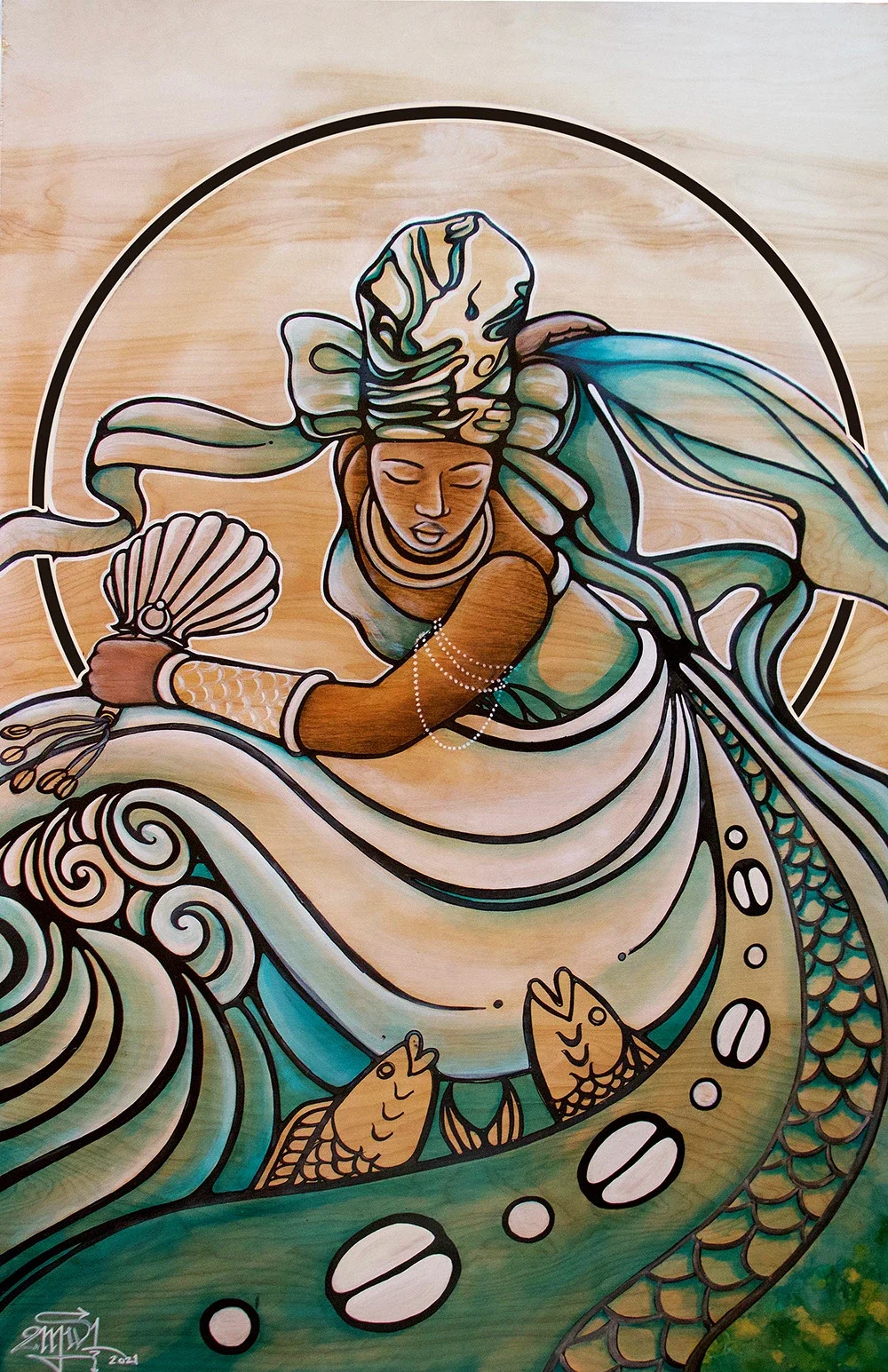
Yemanjá is a female water deity from the Yoruba religion of West Africa, venerated as the mother of the gods (orishas) and protector of the sea. Carried to the Americas by the Atlantic slave trade, she became a major figure in Brazilian Candomblé and Cuban Santería.
Yemanjá
Yemanjá (Iemanjá, Yemoja)
6 min read
Frequently asked questions
Key Facts
- A deity (orisha) of the Yoruba pantheon, originating from the region of the Ogun River in present-day Nigeria
- Regarded as the mother of the orishas and goddess of the waters, oceans, and motherhood
- Her worship was carried to the Americas with the Atlantic slave trade (16th-19th centuries), giving rise to Candomblé in Brazil and Santería in Cuba
- Her feast is celebrated on February 2nd in Salvador de Bahia (Brazil), where offerings are cast into the sea
- Often syncretized with the Virgin Mary (Our Lady of Seafarers or of the Immaculate Conception) in popular Catholicism
Works & Achievements
Founding narrative that makes Yemanjá the progenitor of many deities and the origin of the rivers and waters, a pillar of Yoruba cosmology.
Afro-Brazilian ritual system in which Yemanjá holds a central place, passed down in the terreiros (temples) of Salvador.
Afro-Cuban tradition in which the goddess, under the name Yemayá, rules over the sea and motherhood, associated with Our Lady of Regla.
Major popular celebration in Salvador de Bahia, which has become an emblem of Afro-Brazilian culture and intangible heritage.
Body of Yoruba oral poems celebrating the qualities and great deeds of Yemanjá, passed down from generation to generation.
Association of Yemanjá with Catholic Marian figures (Our Lady of Regla, Our Lady of the Navigators), a religious survival strategy that became a lasting tradition.
Anecdotes
Every year, on February 2nd, hundreds of thousands of worshippers dressed in white gather on Rio Vermelho beach in Salvador de Bahia to honor Yemanjá. They place flowers, mirrors, combs, and perfumes in small boats and entrust them to the sea: if the offerings do not wash back ashore, it is a sign that the goddess has accepted them.
When enslaved Africans were deported to Brazil and Cuba, they were forbidden from practicing their religion. To keep worshipping Yemanjá, they secretly linked her to Catholic figures such as the Virgin Mary: behind a statue of the Virgin, many were in fact praying to the orisha of the waters. This disguise, known as syncretism, saved the Yoruba tradition from oblivion.
In Yoruba mythology, Yemanjá is regarded as the mother of many other orishas. According to some versions of the myth, when her waters broke, they gave birth to the rivers and streams, and from her body several great deities were born.
In Cuba, in Santería, Yemanjá (called Yemayá) is associated with the color blue and the number seven, which symbolizes the seven seas. Her ritual necklaces alternate blue and white beads, and her devotees offer her watermelon, molasses, and ducks.
The name Yemanjá is thought to come from the Yoruba expression “Yeye omo eja,” often translated as “mother whose children are fish,” emphasizing her role as a boundless mother and her nature bound to the waters.
Primary Sources
“Mother whose children are as numerous as the fish of the sea” — a traditional invocation addressed to the goddess of the waters.
Yemanjá is honored as the mother of the orishas, a deity of the waters whose cult unites Yoruba Africa and the Afro-Brazilian communities of Bahia.
Yemayá, mistress of the waters and universal mother, is one of the most beloved deities of Cuban Santería, associated with the sea and with motherhood.
Key Places
Sacred city of the Yoruba people, regarded as the mythical cradle of the world and of the orishas. The original center of worship of the Yoruba deities.
Site of the great annual festival of Yemanjá on February 2, where the faithful cast offerings into the sea. A major center of Candomblé.
A major heartland of Santería, where Yemanjá is venerated under the name Yemayá as mistress of the waters. A center of Afro-Cuban culture.
A watercourse in Yorubaland associated with Yemanjá in certain traditions, where she is honored as a river deity before becoming the goddess of the sea.
Site of the great offerings of December 31, where millions of people greet Yemanjá for the new year. A symbol of Brazilian popular devotion.
Typical Objects

Ritual necklace worn by the devotees of Yemanjá, whose colors symbolize the sea and its foam. It marks one's belonging to and protection by the orisha.

A round fan adorned with mother-of-pearl and marine motifs, a royal attribute of Yemanjá. It evokes the shimmering surface of the waters and her majesty as queen of the sea.

A frequent offering to Yemanjá, the mirror refers to her femininity, her gentle vanity and the reflective surface of the water. It is placed in the offering boats.

A small boat laden with flowers, perfumes and jewelry, set adrift on the sea in honor of Yemanjá. If it does not return to shore, the offering is believed to have been accepted.

Roses and white flowers cast into the sea during the festivals of Yemanjá. They symbolize purity, motherhood and the respect owed to the goddess.

Toiletry items offered to Yemanjá, highlighting her beauty and her coquetry. They are placed in the ritual boats along with the other gifts.
School Curriculum
Vocabulary & Tags
Key Vocabulary
Daily Life
Morning
In the traditions that honor her, the day begins with a salute to the waters: fresh water, white flowers, and a blue candle are placed near a household altar. Initiated devotees offer her their first prayers before any other activity.
Afternoon
The afternoon is well suited to ritual care: cleaning the altars, preparing offerings, and singing in her honor. In the terreiros, devotees rehearse the drum rhythms and dances that call forth the orisha's presence.
Evening
In the evening, the candomblé and santería ceremonies reach their height: drumming, dancing, and trances allow Yemanjá to “descend” and manifest herself through her initiated devotees. The chants carry on late into the night.
Food
Food offerings to Yemanjá include sweet and ocean foods: watermelon, molasses, white rice, fish, and duck. Dishes prepared without violence and associated with the colors white or blue are dedicated to her.
Clothing
Yemanjá is depicted dressed in blue and white, adorned with beads, a mother-of-pearl fan, and sometimes a crown. Her devotees wear white and her ritual necklaces during festivals.
Housing
Her domain is the sea and the deep waters, but she also “dwells” in the altars (pejis) of the terreiros and in household shrines, where sacred stones, seashells, and water embody her presence.
Historical Timeline
Period Vocabulary
Liens externes & ressources
Références
Œuvres
Mythe de la mère des orishas
tradition orale yoruba
Culte du candomblé de Bahia
à partir du 18e-19e siècle
Culte de la santería cubaine (Yemayá)
à partir du 19e siècle
Fête de Yemanjá du 2 février
depuis le début du 20e siècle
Orikì et chants de louange
tradition orale
Syncrétisme avec la Vierge Marie
période coloniale