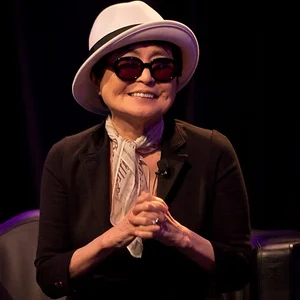

Yoko Ono is a Japanese artist born in 1933 in Tokyo, a major figure in conceptual art and the Fluxus movement. A peace activist, she is also known for her artistic and political commitment alongside John Lennon. Her work explores audience participation, peace, and memory.
Yoko Ono(1933 — ?)
Yoko Ono
Japon, États-Unis
7 min read
Frequently asked questions
Famous Quotes
« Imagine all the peace in the world. A dream you dream alone is only a dream. A dream you dream together is reality.»
« Art is my life and my life is art.»
Key Facts
- 1933: born in Tokyo into an aristocratic Japanese family
- 1960: co-founder of the Fluxus movement in New York, which revolutionized the concept of the artwork
- 1966: creation of the participatory work 'Instruction Paintings', inviting the public to co-create
- 1969: 'Bed-In for Peace' campaigns with John Lennon against the Vietnam War
- 1971: exhibition 'This is not here' at the Everson Museum, dedicated to conceptual art
Works & Achievements
A performance in which the audience is invited to cut away the artist's clothing: a founding work of participatory art that questions violence, gender, and the relationship to the body.
A book of poetic and artistic instructions, and a manifesto of conceptual art that dissolves the boundary between artist and audience.
An installation consisting of a white ladder allowing viewers to read the word 'YES' on the ceiling through a magnifying glass; a positive, participatory work that marked the first meeting with John Lennon.
A protest performance against the Vietnam War staged with John Lennon: the couple spent a week in bed in a hotel room open to media from around the world.
A permanent installation in Iceland that projects a column of light into the sky each year around John Lennon's birthday, serving as a global symbol of the call for peace.
A series of trees on which the public ties written wishes on paper: a participatory and universal work inspired by Japanese Shinto traditions.
A double album recorded with John Lennon, released three weeks before his assassination; Yoko Ono's tracks alternate with Lennon's, reflecting the depth of their artistic dialogue.
Anecdotes
In 1964, Yoko Ono presented a performance in Tokyo titled 'Cut Piece': seated on stage, she invited the audience to cut her clothing with scissors. This radical work questioned violence, vulnerability, and the power dynamics between artist and spectator.
After meeting John Lennon in 1966 at the Indica Gallery in London, Yoko Ono invited him to climb a ladder and look through a magnifying glass at a word written on the ceiling. The word was 'YES'. Lennon later said that this positive sign had captivated him as much as the artist herself.
In 1969, John Lennon and Yoko Ono staged two 'Bed-Ins for Peace' — one in Amsterdam, the other in Montreal — staying in bed in their hotel room for a week to protest the Vietnam War. It was during the second that the song 'Give Peace a Chance' was recorded.
Since 1981, Yoko Ono has funded the upkeep of the 'Strawberry Fields' memorial in Central Park in New York, near the spot where John Lennon was murdered. She also created the 'Imagine Peace Tower' in Iceland in 2006, a column of light lit each year on Lennon's birthday.
Her work 'Grapefruit' (1964) is a book of artistic instructions — for example, 'Watch the sky until it becomes holey' — that anticipates conceptual art and invites everyone to become an artist. John Lennon read it regularly and drew inspiration from it for some of his compositions.
Primary Sources
Drill a hole in the sky. Drill a hole in the earth. Drop a stone in each. Wait.
We're staying in bed for a week to tell the world that we want peace, not war. Hair peace. Bed peace.
I always had the feeling that I was trying to build a better world by showing people a different kind of communication — one based on vulnerability and openness rather than power.
John's spirit is here with us. We have to remember that peace is not just the absence of war — it is a positive force, something we create together every day.
Key Places
Yoko Ono's birthplace, where as a child she witnessed the destruction of war, shaping her lifelong sensitivity to peace and memory.
The heart of the American avant-garde in the 1950s and 1960s, where Yoko Ono staged her first performances and encountered John Cage, the Fluxus movement, and the international art scene.
The Upper West Side residential building where Yoko Ono and John Lennon lived; the site of Lennon's assassination in 1980 and a global symbol of the struggle for peace.
A memorial funded by Yoko Ono in tribute to John Lennon, set within Central Park and featuring a mosaic bearing the word 'Imagine'.
Home of the Imagine Peace Tower, a permanent light installation inaugurated in 2006 by Yoko Ono to honor Lennon's memory and call for world peace.
Typical Objects

The central instrument of the performance 'Cut Piece' (1964), scissors symbolize for Ono the artist's vulnerability and the audience's responsibility in the act of creation.

A collection of poetic instructions published in 1964, considered a manifesto of conceptual art and a work of art in itself, accessible to everyone.

The centerpiece of her installation 'Ceiling Painting / YES Painting' (1966), the ladder invites viewers to climb up and read a word on the ceiling, turning the observer into a participant.

An iconic accessory of Yoko Ono, associated with her public image and her pacifist performances of the 1960s–1970s.

In the work 'Add Colour Painting' (1966), Ono invites each visitor to add a color to a white canvas, making the collective puzzle a metaphor for the shared construction of peace.

Used in several Fluxus performances, the candle represents for Ono fragility, memory, and the light carried by each individual against the darkness of war.
School Curriculum
Vocabulary & Tags
Key Vocabulary
Tags
Daily Life
Morning
In the 1960s–1970s in New York, Yoko Ono starts her day early in her SoHo loft or at the Dakota Building. She meditates, practices exercises inspired by Japanese artistic disciplines, and writes in her notebooks — poetic instructions or ideas for performances.
Afternoon
Her afternoons are spent creating in her studio — drafting instructions, preparing exhibitions, rehearsing performances — or meeting with other artists from the international avant-garde. From 1969 to 1980, she often works in the recording studio with John Lennon.
Evening
Her evenings are devoted to gallery openings, concerts, or activist gatherings. Yoko Ono is a fixture of the New York cultural scene and regularly welcomes artists, journalists, and peace activists to her home.
Food
Yoko Ono has always placed great importance on healthy eating and is known for her macrobiotic diet, influenced by traditional Japanese practices. She favors natural foods, grains, and vegetables, and avoids processed food.
Clothing
Her personal style is both avant-garde and understated: simple black outfits, long white dresses for performances, and her signature round thin-framed glasses. She favors a minimalist elegance that shuns ostentation.
Housing
From 1973 onward, she lives in Apartment 72 of the Dakota Building, one of New York's most prestigious addresses. This spacious apartment serves as family home, studio, and artistic gathering place, with spare décor, works of art, and spaces dedicated to creation.
Historical Timeline
Period Vocabulary
Visual Style
L'esthétique de Yoko Ono est celle du dépouillement radical : blanc immaculé, minimalisme conceptuel hérité du Fluxus et de la calligraphie japonaise, avec une tension entre vide et sens.
Sound Ambience
L'univers sonore de Yoko Ono mêle le silence tendu des performances d'art conceptuel, les sons expérimentaux des lofts new-yorkais des années 1960 et les voix collectives des mouvements pacifistes.