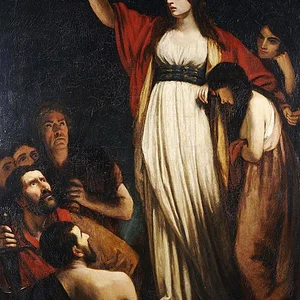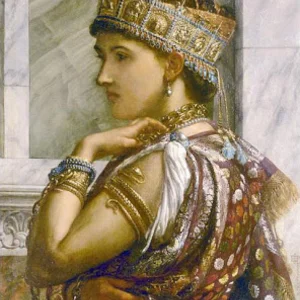

Queen of the Palmyrene Empire in the 3rd century, Zenobia ruled as regent in her son's name and expanded her empire to Egypt and Asia Minor, openly defying Rome. Defeated by Emperor Aurelian in 272, she remains the enduring symbol of an indomitable Eastern queen.
Zenobia(240 — 275)
Zenobia
Empire palmyrénien, Rome antique
7 min read
Frequently asked questions
Key Facts
- Around 267: death of her husband Odaenathus, king of Palmyra — Zenobia assumes the regency in the name of her son Vaballathus
- 270–271: conquest of Egypt, Syria, Asia Minor, and part of Anatolia
- 271: proclamation of an independent Palmyrene Empire in defiance of Rome
- 272: defeat by Emperor Aurelian at the Battle of Immae; Palmyra is recaptured and destroyed
- 272–275: Zenobia is brought to Rome for Aurelian's triumph, then exiled to Tivoli, where she lives out the rest of her life
Works & Achievements
Zenobia conquered and annexed the regions of the Levant, Egypt, and Asia Minor, transforming Palmyra into a major power in the Roman East. This expansion made Palmyra a direct rival of the Western Roman Empire.
Following the death of her husband Odaenathus, Zenobia ruled Palmyra with remarkable political and military acumen, establishing a strong and independent dynastic line amid the turbulent instability of the 3rd century.
Zenobia annexed Roman Egypt, thereby seizing control of the Nile's vital agricultural wealth and resources, significantly boosting Palmyra's economic power.
Zenobia led a series of victorious military operations across Asia Minor, consolidating an empire stretching from the Nile to Thrace and challenging Rome for dominance over the East.
Zenobia established Palmyra's monetary independence by issuing coinage in her son's name, symbolizing the political and economic autonomy of her state.
Zenobia championed the arts, literature, and philosophy, drawing scholars and intellectuals to her court and cementing Palmyra's reputation as a major cultural center of the ancient world.
Zenobia mounted a military resistance against the Roman emperor Aurelian during his final campaign to reclaim the East, defending Palmyra until her capture and deportation.
Anecdotes
Zenobia, Queen of Palmyra, was renowned for her exceptional intellect: she spoke at least five languages (Aramaic, Greek, Latin, Egyptian, and Persian) and had mastered mathematics and philosophy. At a time when few women had access to education, she stood out for her remarkable learning and counted the greatest scholars of her age among her advisors.
After the death of her husband Odaenathus in 267, Zenobia took control of Palmyra and became regent for her young son. She dramatically expanded the Palmyrene Empire by conquering Egypt, Syria, and Asia Minor, forging a vast state that rivaled Rome itself, between 270 and 272.
Zenobia refused to bow to the Roman Emperor Aurelian and declared Palmyra's independence. However, in 272, Aurelian defeated her armies at the Battle of Emesa and captured Palmyra, putting an end to the dream of an ambitious queen who had dared to challenge the power of Rome.
After her capture by Aurelian, Zenobia was paraded through the streets of Rome bound in golden chains during the emperor's triumph — an honor reserved for the most formidable of enemies. According to historical accounts, she displayed remarkable dignity in the face of her fate, refusing to be broken in spirit.
Primary Sources
Aurelian marched against Zenobia, queen of the Palmyrenes, who had usurped Roman authority in the East and seized Egypt. This woman of great sagacity governed her kingdom with remarkable courage and exceptional political intelligence.
Zenobia, wife of King Odaenathus, upon the death of her husband seized power and governed Palmyra with prudence. She extended her influence over the Roman provinces of the East and challenged the authority of Rome.
Queen Zenobia was remarkable for her wisdom, her courage in war, and her eloquence. She ruled Palmyra and conquered Egypt, establishing an empire that rivalled that of Rome.
Coins struck in the name of Zenobia and her son Vaballathus bear the titles of Augusta and Caesar, thereby asserting the sovereign authority of the Palmyrene kingdom over the conquered territories.
Key Places
Capital of Zenobia's kingdom in Syria. It was from this prosperous city that Zenobia ruled and built her commercial and political empire in the 3rd century.
A major city of Roman Syria that Zenobia conquered and controlled. She established her authority over this important metropolis of the eastern Roman Empire.
Region conquered by Zenobia around 270, following her control of Palmyra. She extended her influence into Egypt to dominate the Mediterranean trade routes.
A Syrian city near Palmyra where Zenobia consolidated her military and political control over the region.
Center of Roman power, where Zenobia was brought as a captive after her defeat by Emperor Aurelian in 272. She spent her final years there.
Liens externes & ressources
Références
Œuvres
Expansion de l'Empire de Palmyre
267-272
Règne en tant que régente et reine
267-272
Conquête de l'Égypte
270-271
Émission de monnaies au nom de son fils Vaballath
270-272
Politique culturelle et intellectuelle
267-272
Défense contre l'armée romaine d'Aurélien
272