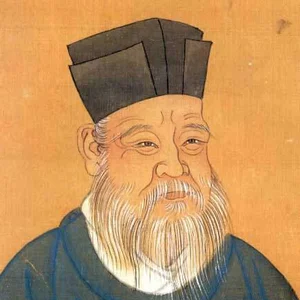

Zhu Xi (1130–1200) was the greatest Confucian philosopher of medieval China and the founder of Neo-Confucianism. A scholar of the Song dynasty, he synthesized the thought of Confucius and Mencius with metaphysical elements. His work became the official reference for imperial examinations for seven centuries.
Zhu Xi(1130 — 1200)
Zhu Xi
dynastie Song
9 min read
Frequently asked questions
Famous Quotes
« Learn as though you could never know enough, and as though you feared losing what you already know.»
« When knowledge is pushed to its utmost, the will becomes sincere.»
Key Facts
- 1130: born in Youxi (Fujian), into a family of scholars
- 1148: passed the jinshi examination (equivalent to an imperial doctorate) at age 18
- 1175: participated in the famous Goose Lake Conference, a landmark philosophical debate
- 1179: restored and directed the White Deer Grotto Academy, a model of scholarly education
- 1200: died in Jianyang; his Neo-Confucian system became official doctrine as early as 1241
Works & Achievements
Zhu Xi's masterwork, these commentaries on the Analects of Confucius, the Mencius, the Great Learning, and the Doctrine of the Mean became the required reference text for Chinese imperial examinations from 1313 to 1905.
Compiled with Lü Zuqian, this anthology presents the foundational texts of Neo-Confucianism by the Song Masters. It served as an introductory manual to Neo-Confucian thought for centuries.
Zhu Xi's commentary on the Yijing (Book of Changes), in which he develops his metaphysics of li (principle) and qi (vital energy), the twin pillars of his Neo-Confucian cosmology.
A short text laying out the educational and moral principles of the academy restored by Zhu Xi. This document profoundly influenced the organization of academies (shuyuan) across China, Japan, and Korea.
A vast collection of Zhu Xi's letters, memorials, poems, and essays, bearing witness to the breadth of his intellectual, political, and literary activity over more than five decades.
A rewriting of Sima Guang's great historical work, restructured according to Zhu Xi's Confucian moral principles in order to render ethical judgments on rulers and events throughout Chinese history.
Anecdotes
Zhu Xi was a child prodigy: at the age of five, he asked his father what lay beyond the sky — a question that already revealed his hunger to understand the fundamental principles of the universe. His father, impressed, replied that there was nothing, an answer that did not satisfy the young boy, who was already convinced that some ultimate reality must exist.
Zhu Xi spent nearly nine years writing and revising his commentaries on the Four Confucian Books. He was still correcting his texts on the eve of his death in 1200, dissatisfied with his phrasing on a point of metaphysics. This obsessive intellectual rigor earned him a reputation for extreme exactingness among his disciples.
In 1196, Zhu Xi's teachings were officially condemned by the emperor under the label of 'false learning' (weixue), and he was banned from teaching and from sitting the imperial examinations. Yet barely two decades after his death, his works became the official foundation of those very examinations that had been closed to him.
Zhu Xi engaged in a celebrated philosophical dispute with his contemporary Lu Jiuyuan, who championed a more intuitive and inward approach to moral knowledge. Their great debate of 1175 at the White Deer Grotto Academy drew dozens of scholars and remains one of the most iconic moments in Chinese intellectual history.
Zhu Xi physically restored the White Deer Grotto Academy (Bailudong Shuyuan) in 1179, transforming abandoned ruins into a thriving center of learning. There he drafted pedagogical regulations that influenced scholarly education in China, Japan, and Korea for centuries.
Primary Sources
Nature is the principle. As soon as one speaks of nature, one must know what principle is, and as soon as one speaks of principle, one must know what nature is. The two are one and the same.
Learning without reflection is futile; reflection without learning is perilous. This is why the study of the classics and the cultivation of the self cannot be separated.
Between father and son, there is affection; between ruler and minister, there is righteousness; between husband and wife, there is distinction; between elder and younger, there is order; between friends, there is trust. These five relationships are what the ancient kings taught.
The Supreme Ultimate (taiji) is the principle of all things under heaven. There is nothing that does not possess the Supreme Ultimate, and each individual thing itself possesses a complete Supreme Ultimate.
It is not that I disregard affairs of state, but I firmly believe that if men of virtue do not first cultivate their own moral character, they will never be able to govern with justice.
Key Places
Zhu Xi lived and taught for many years at the foot of this mountain range in Fujian, which he cherished for its beauty and serenity, ideal for meditation and study. There he founded the Wuyi Jingshe Academy.
Restored by Zhu Xi in 1179 at the foot of Mount Lu, this academy became the model for scholarly education in China. The educational regulations he drafted there influenced learning across East Asia for centuries.
Zhu Xi's first administrative post (1153–1157), where he put his ideals of virtuous governance into practice by reforming local taxation and encouraging education among the population.
Capital of the Southern Song empire, where Zhu Xi was briefly summoned to the imperial court in 1194. It was there that he attempted to directly influence imperial policy before being dismissed in disgrace.
Zhu Xi's birthplace in 1130, born into a family of scholarly officials. This region of Fujian was an active intellectual hub during the Southern Song period.
Typical Objects

The central tool of the Chinese scholar, the silk-and-bamboo brush was used by Zhu Xi to write his commentaries, letters, and poems. For him, calligraphy was a moral discipline as much as an aesthetic one.

Zhu Xi selected and annotated the Analects of Confucius, the Mencius, the Great Learning, and the Doctrine of the Mean, forming a canonical corpus that became the official curriculum for the imperial examinations for seven centuries.

Zhu Xi placed great importance on funeral rites and ancestor veneration; he wrote texts prescribing how to honor one's ancestors, an object of filial piety at the heart of Confucian ethics.

Zhu Xi was interested in the natural sciences, astronomy, and geography; he used measuring instruments to observe celestial phenomena, seeking to connect empirical knowledge with metaphysical principles.

Classical texts were copied onto silk or paper scrolls that Zhu Xi would annotate and circulate among his disciples. These scrolls formed the basis of teaching in the academies.

A badge of official rank, the tablet was held during imperial audiences. Zhu Xi held several administrative posts and appeared at court bearing this attribute of the scholar-official.
School Curriculum
Vocabulary & Tags
Key Vocabulary
Daily Life
Morning
Zhu Xi rose before dawn to perform purification rites and bow before the ancestral altar, in keeping with Confucian ritual prescriptions. He then devoted the early hours of the day to silent reading of the classics, which he considered the most favorable time for concentration and deep understanding of the texts.
Afternoon
Afternoons were dedicated to oral instruction of his disciples, gathered in the academy's main hall. Zhu Xi would comment on the classical texts, answer questions, and engage in philosophical debates on the nature of principle (li) and vital energy (qi). He also dictated his written commentaries and reviewed his students' work.
Evening
Evenings were devoted to personal writing: Zhu Xi composed letters to his scholarly correspondents spread throughout the empire, refined his commentaries, or wrote poetry. He also organized collective study sessions by oil lamp, during which disciples recited memorized passages from the classics.
Food
Zhu Xi followed a simple and frugal diet, in keeping with the Confucian ideal of moderation. His meals centered on rice, seasonal vegetables, tofu, millet soups, and green tea from Fujian. He ate fish and occasionally meat at ritual banquets or seasonal festivals.
Clothing
Zhu Xi wore the dress of the scholar-official: a long robe (changshan) in silk or cotton depending on the season, in muted colors — dark charcoal, deep indigo, or brown — belted with a wide sash. He wore the regulation black gauze cap of Song dynasty officials on formal occasions, and a simple dark cloth cap during his daily teaching sessions.
Housing
Zhu Xi lived in the academies he directed, most notably at Wuyi and at the White Deer Grotto. These timber-framed buildings with gray ceramic tile roofs included a large teaching hall, individual study cells for disciples, a library of scrolls, and a ritual altar. The mountain setting, deliberately removed from urban life, was conducive to intellectual and moral retreat.
Historical Timeline
Period Vocabulary
Visual Style
Le style visuel de Zhu Xi s'inspire de la peinture lettrée des Song du Sud : paysages en encre de Chine, robes en soie sombre, décor d'académie montagnarde dans une atmosphère de sérénité studieuse.
Sound Ambience
L'atmosphère sonore de l'académie de Zhu Xi mêle le grattement des pinceaux sur le papier de riz, la récitation rythmée des classiques par les étudiants et les sons apaisants de la nature montagnarde du Fujian.