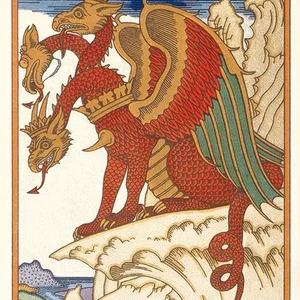

Zmey Gorynych is a multi-headed dragon from East Slavic folklore, an iconic figure of the Russian bylinas. A fire-breather, he embodies evil and abducts princesses, until he is slain by heroes such as Dobrynya Nikitich.
Zmey Gorynych
Zmey Gorynych
6 min read
Frequently asked questions
Key Facts
- A many-headed dragon (usually three heads) of East Slavic folklore, able to breathe fire
- Appears in the bylinas, Russian epic songs handed down orally since the era of Kievan Rus' (9th–13th century)
- His patronymic “Gorynych” evokes the mountains (gora) or the act of burning (goret), depending on the interpretation
- Iconic adversary of the bogatyr (valiant knight-hero) Dobrynya Nikitich, who battles him to free captives
- Symbolizes the forces of evil and chaos opposed to the protective heroes of Russian folk tradition
Works & Achievements
The central account of Dobrynya Nikitich's battle against the dragon and his rescue of Princess Zabava. It is the founding text for the figure of the Zmey.
A tale in which the serpent abducts princesses from three kingdoms, providing the stakes for the hero's quest.
A body of epic songs from Kievan Rus' in which the serpent embodies the pagan enemy confronted by the bogatyrs.
A painting that fixed the popular image of the many-headed dragon in the modern Russian imagination.
Folk-style engravings depicting the Zmey Gorynych, widely circulated in children's books.
A feature film by the Melnitsa studio that modernizes the myth and turns the dragon into a comic character, a sign of the legend's enduring vitality.
Anecdotes
The name "Gorynytch" intrigues scholars: it may come either from "gora
(mountain)
since the monster nests in the Sorochinsky Mountains
or from the verb
goret'
(to burn)
echoing its fiery breath. Both etymologies coexist in the tradition
much like this creature that is at once earthly and igneous.
In the bylina "Dobrynya and the Serpent
the hero Dobrynya Nikitich battles Zmey Gorynych for three days without being able to defeat him, until a voice from the heavens orders him to hold on a little longer. He finally finishes the monster off by crushing it with the "cap of the Greek land" filled with sand.
The dragon's number of heads is never fixed: depending on the sung versions, it has three, six, nine, or twelve. Each severed head can grow back, which makes the fight nearly endless and forces the hero to strike them down in a single blow.
When Dobrynya finally slays the serpent, the monster's blood refuses to be absorbed by the earth and threatens to drown the hero. On divine command, Dobrynya strikes the ground with his spear for three days so that it opens up and swallows the bloody flood.
Zmey Gorynych guards the Kalinov Bridge, which spans the fiery Smorodina River, the mythical boundary between the world of the living and the world of the dead. To cross this bridge is to confront its guardian: no hero passes without a fight.
Primary Sources
“The young Dobrynya Nikitich struck the accursed Serpent and cut off all its furious heads.”
The collection brings together the epic songs featuring the bogatyrs of Prince Vladimir's court, including Dobrynya, vanquisher of the serpent of the mountains.
The Zmey Gorynych abducts young maidens there and guards his lair filled with gold, until a hero comes to free the captives.
The peasant singers of the Russian Far North orally transmit the battle of Dobrynya against the many-headed serpent.
Key Places
Mythical mountains where the serpent makes its lair and keeps its captives. Their name is sometimes linked to the “Saracens,” evoking a hostile, far-off East.
A bridge spanning the fiery river Smorodina, the border between the world of the living and that of the dead. The serpent is its guardian and fights its battles there.
A mythical river of fire and brimstone marking the boundary of the afterlife in East Slavic folklore. The dragon prowls along its banks.
The river where young Dobrynya bathes despite his mother's warnings, and where the serpent surges up to attack him. The site of the first encounter between the hero and the monster.
Capital of the Rus' where Prince Vladimir resides and from which the bogatyrs set out. It is here that the princess abducted by the serpent must be brought back.
Typical Objects

A legendary headpiece that Dobrynya fills with sand and hurls at the serpent to strike it down. A decisive item in the fight, it symbolizes strength coming from the Byzantine Christian world.

The serpent spits flames from its many maws, setting villages and harvests ablaze. This natural weapon embodies the creature's destructive, hellish menace.

A braided silk lash that the bogatyr uses to flog the dragon's heads and break its wings. An unexpected weapon, it shows that cunning counts as much as strength.

In its cave the serpent amasses stolen gold and abducted captives, especially princesses. This guarded plunder makes it a figure of greed and predation.

The dragon's offspring, little serpents that swarm around it and that the heroes must crush to prevent the monstrous race from carrying on. They extend the threat beyond the main battle.

The hero's blade, tasked with slicing off the serpent's heads in a single stroke before they can grow back. It embodies virtue and justice set against chaos.
School Curriculum
Vocabulary & Tags
Key Vocabulary
Tags
Lieu
Daily Life
Morning
At daybreak, the serpent watches over its lair carved into the Sorochinsky Mountains, counting its hoarded gold and guarding the captives it has abducted. Its many heads scan the horizon in search of prey or reckless heroes.
Afternoon
In the afternoon, it takes flight over the plains of Rus', spotting villages and travelers. It is the hour of raids: it swoops down on the countryside to carry off young maidens and cattle.
Evening
When evening comes, it prowls near the Kalinov Bridge and the Smorodina River, of which it is the relentless guardian. No one crosses the border of the dead without enduring its fiery breath.
Food
The serpent feasts on human flesh and stolen livestock, devouring both herds and the captives that no one comes to rescue. In some versions, it demands regular tributes from the terrified population.
Clothing
A monstrous creature, it wears no clothing: its body is covered in scales as hard as steel, topped with several heads and membranous wings. Its claws and fire-breathing maws serve as both armor and weapons.
Housing
It dwells in a deep cavern at the heart of the mountains, cluttered with the plunder of its raids and populated by its young serpents. This jealously guarded lair becomes the ultimate goal of the bogatyrs' quest.
Historical Timeline
Period Vocabulary
Liens externes & ressources
Références
Œuvres
Byline « Dobrynia et le Serpent » (Dobrynia i Zmeï)
tradition orale médiévale, fixée par écrit au XVIIIe-XIXe siècle
Conte « Les trois royaumes » (Tri tsarstva)
recueilli par Afanassiev, 1855-1863
Cycle des bylines de la cour de Vladimir
Xe-XIIe siècles (tradition orale)
« Combat de Dobrynia Nikititch avec le serpent à sept têtes », tableau de Viktor Vasnetsov
1918
Illustrations d'Ivan Bilibine pour les contes russes
début du XXe siècle
Film d'animation « Dobrynia Nikititch et le Serpent Gorynytch »
2006