Imaginary interview with Ada Yonath
by Charactorium · Ada Yonath (1939 — ?) · Sciences · 5 min read
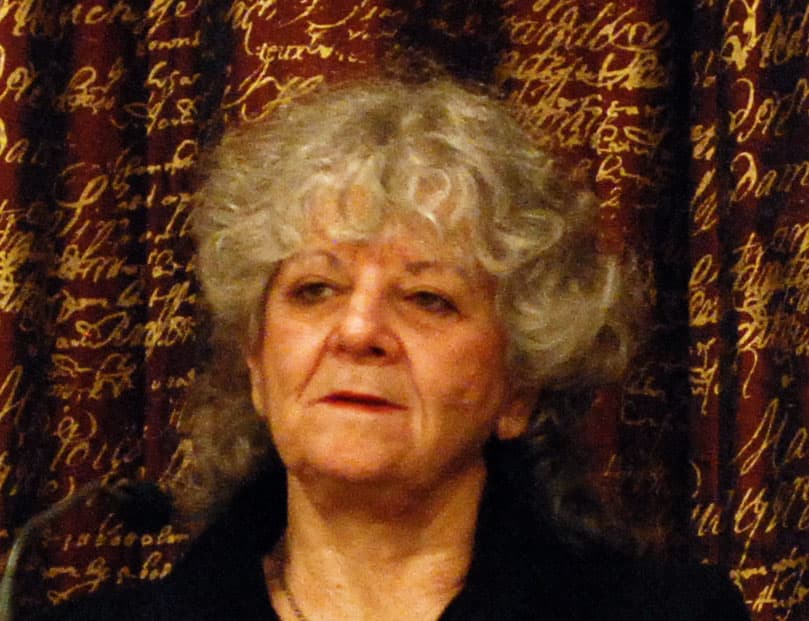
Rehovot, the Weizmann Institute campus, a spring morning. In an office cluttered with molecular models and diffraction pattern photographs, a seventy-year-old woman welcomes us with steaming tea. Light falls on a framed picture: the very first ribosome crystal. She smiles — that's where it all began.
—Do you remember the home of your childhood in Jerusalem?
A tiny apartment in Jerusalem, where three families shared the space and money was always scarce. The books, however, were stored on the highest shelves, out of reach of a curious little girl. So I did what children who want to understand do: I stacked furniture and climbed. One day, I fell and broke my arm. My mother was furious, of course. But neither the cast, nor the poverty, nor the cramped space extinguished that urge to touch what seemed too high. I think I've spent my entire life climbing toward shelves that others deemed unreachable. The ribosome was just another shelf, a bit higher than the rest.
I've spent my life climbing toward shelves that others deemed unreachable.
—How did you come up with the idea in 1980 to crystallize a molecule that everyone thought impossible to freeze?
The ribosome is an enormous, mobile machine with no internal symmetry, made of thousands of atoms that never stay put. Crystallizing it seemed, to most of my colleagues, pure madness. But I asked a biologist's question rather than a chemist's: which organisms produce the most robust ribosomes? The answer: extremophiles — those bacteria that thrive in hot springs or very salty seas. In 1980, I chose Bacillus stearothermophilus, a thermophilic bacterium whose ribosomes withstand heat without falling apart. They were the first to give me three-dimensional crystals diffracting beyond 3.5 ångströms. You had to look for stability where nature had already invented it.
You had to look for stability where nature had already invented it.
—For nearly twenty-five years, your peers mocked your project. How did you endure those taunts?
I was called the village fool, my work was called science fiction, and one of my favorite nicknames — because you have to laugh — was Don Quixote of crystallography. At conferences, some would smile politely as they listened to my results, like listening to someone recount a dream. It lasted almost a quarter of a century. But I never felt I was tilting at windmills: my crystals existed, they diffracted, the patterns were there on the films. You don't argue with a diffraction pattern. Mockery based on disbelief rather than data slides off. I kept my eyes on the microscope, not on the laughers.
You don't argue with a diffraction pattern.
—They say polar bears inspired a decisive technique. What happened?
My crystals suffered a terrible problem: under the X-ray beam, they disintegrated almost immediately, ravaged by radiation. I was desperately looking for a way to protect them. Then I read an article about how polar bears survive hibernation, how cold slows and preserves life. The idea struck me: what if I froze my crystals? We started plunging them into liquid nitrogen, down to -196 °C, before exposing them to the beam. The cold froze the damage. That's what we now call cryocrystallography, the standard for all structural biology. An intuition from the ice sheet saved years of lab work.
An intuition from the ice sheet saved years of lab work.
—What did those crystals actually represent in your daily lab work?
A good ribosome crystal was worth more than gold. Sometimes it took years of trial and error to get a single one of quality — the right concentration, the right temperature, the right patience. In the morning, at 7:30 AM, I would examine under a polarizing microscope those that had matured overnight, judging with a trained eye which ones deserved to be mounted on the diffractometer. A mediocre crystal wastes an entire synchrotron session; a perfect crystal can alone yield a whole structure. It's a craft as much as a science: you care for these tiny objects like fragile beings, knowing that the small 30S or large 50S subunit will only reveal its secrets if you have first cherished it to obsession.
A good ribosome crystal was worth more than gold.
—Understanding the ribosome also meant understanding antibiotics. How did these two paths cross?
Many essential antibiotics work by binding to the bacterial ribosome to block protein synthesis. But as long as we couldn't see where or how, we were working in the dark. In 2001, with the structure of the large subunit of Deinococcus radiodurans, we finally mapped the precise sites where these molecules attach. From then on, everything became visible at atomic scale — including how some bacteria slightly deform their ribosome to prevent the drug from binding. That's the heart of antibiotic resistance. Seeing that evasion at the atomic level opens the door to new molecules designed to bypass the defense. The most fundamental research suddenly found itself at the patient's bedside.
Seeing the bacterium's evasion at the atomic level opens the door to new drugs.
—When you discovered that RNA, not proteins, catalyzes synthesis at the heart of the ribosome, how did you feel?
An almost dizzying emotion. It had long been assumed that proteins did all the chemical work in the cell. But our electron density maps showed that the center where amino acid bonds form is lined with ribosomal RNA, not protein. RNA was the worker, the rRNA the true catalyst. This resonated with the discovery of ribozymes by Cech and Altman in the early 1980s: RNA could act, transform, build. The ribosome turned out to be a relic of an ancient world, perhaps the oldest, where RNA reigned before proteins. Holding that structure in your hands was like contemplating a relic of the origin of life.
The ribosome turned out to be a relic of a world where RNA reigned before proteins.
—Your research took you far from Rehovot, to the great European synchrotrons. How did those campaigns unfold?
To extract sharp images from such small crystals, you needed X-rays of an intensity that only a synchrotron can produce. I first set up a satellite lab in Hamburg, at the DORIS synchrotron at DESY, then we worked on beamlines at the ESRF in Grenoble, one of the most powerful sources in the world. Those campaigns were exhausting: several weeks straight, day and night, in the control room, a diet of sandwiches and lukewarm coffee, because the machine doesn't stop for meals. We watched each diffraction pattern like a fisherman watches his line. The high-resolution data published in 2000 came from those endless vigils far from home.
We watched each diffraction pattern like a fisherman watches his line.
—On the morning of the 2009 Nobel, what exactly happened?
It was 5:30 AM in Israel and I was fast asleep when the phone rang. The voice from Stockholm announced the Nobel Prize in Chemistry, shared with Ramakrishnan and Steitz, for the structure and function of the ribosome. I was the first woman to receive this prize since Dorothy Hodgkin, forty-five years earlier. You imagine tears, screams. In truth, I mainly thought that the real reward, the one that matters, I had already received the day I understood how this machine makes life. The Nobel, as heavy as it is, is only the cherry on the cake. The discovery was the whole cake.
The discovery was the cake; the Nobel is only the cherry.
—What would you say to a young girl today who hesitates to embark on a project deemed impossible?
I would tell her about the little girl in Jerusalem who climbed furniture to reach books too high, and who broke her arm without ever stopping climbing. A project called impossible is often just a project that no one has yet loved enough to give twenty-five years. I was called Don Quixote, they laughed at my crystals, and the same laughers fell silent before the images. I would tell her: don't seek approval first, seek data. Find the robust bacterium, invent your own cryocrystallography, choose a problem worthy of a lifetime. And above all, always keep a notebook at hand — because the best ideas, like the one from the polar bears, come when you least expect them.
An impossible project is just a project that no one has yet loved enough to give twenty-five years.
This imaginary interview was generated by artificial intelligence from sources documented in Ada Yonath's profile. It dramatises what the figure might have said based on what we know about them, but does not constitute attested historical testimony. For primary sources and factual documentation, refer to the full profile.