Imaginary interview with Aimé Césaire
by Charactorium · Aimé Césaire (1913 — 2008) · Literature · Politics · 6 min read

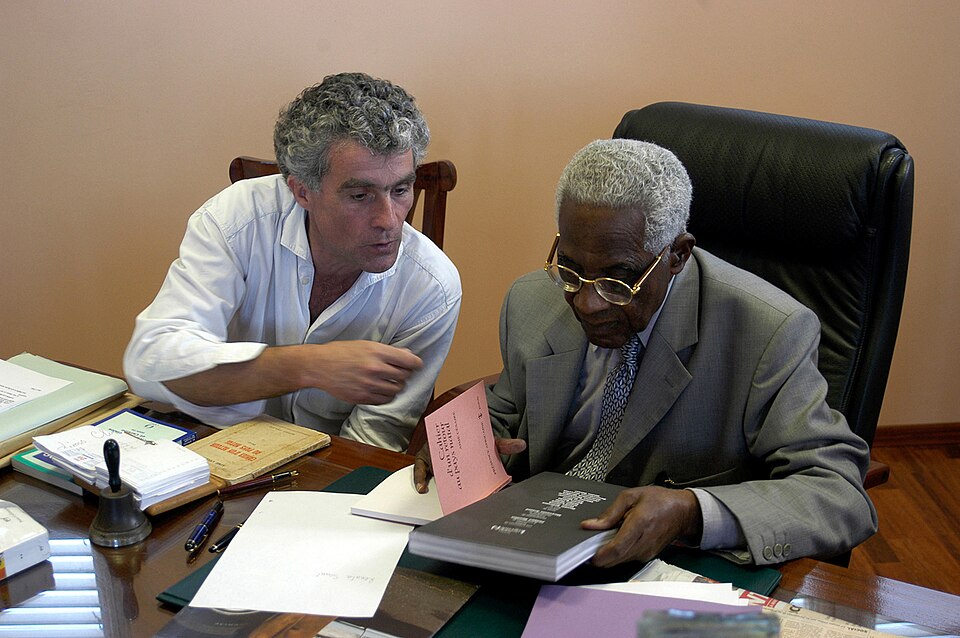
Fort-de-France, late morning. Heat rises from the bay while, in a book-cluttered office where a fan stirs the Caribbean air, a man sorts a bundle of municipal correspondence. Aimé Césaire, the poet turned mayor, agrees to trace the thread — from the school notebook to the podium of the Assembly, from Negritude to the stage where his black kings dance.
—How was this long poem, the Cahier d'un retour au pays natal, born in you?
It was born in Paris, in 1939, in the cold of a student's room, and it was precisely the distance that made it burst forth. Far from Martinique, I finally saw my island, its misery, its hills, its Blacks standing on the decks of banana boats. I wanted a poem that does not console, that screams. You know, I write there that I would be a man-cry, to shout on the barricades the essence of the human condition. It was not drawing-room literature; it was a bringing into the world. I returned to the country through words before returning by boat, and that return taught me that my land was not a shame to hide but a dignity to proclaim. The poem preceded me on the dock.
I returned to the country through words before returning by boat.
—That word, Negritude, which you coined — what did it exactly cover for you?
It was first a challenge thrown in the face of those who turned the word nègre into an insult. With Senghor and Damas, in the columns of L'Étudiant noir, we decided to pick up that insult and make it a flag. Negritude was not a reverse racialism; it was the simple and proud recognition of being Black, of our history, of our African culture denied by three centuries of slavery. Senghor put his warmth, his ontology into it; I put my revolt. We forged this between the walls of the metropolis, strangers among strangers, and the word caught fire like a spark in dry straw. Generations of writers seized it far beyond what we imagined.
We picked up the insult to make it a flag.
—Do you remember the day you became mayor of Fort-de-France?
1945. The poet found himself with a sash and a city in ruins on his hands. I was barely forty years old, and they handed me the keys to a city where people still lived in tin shacks, without water, without sewers. Poetry can tell misery; the mayor's office must fight it, stone by stone. I kept this office fifty-six years, until 2001, and every morning correspondence piled up, petitions, files, sewer plans. They thought I was lost in the clouds; I was bent over neighborhood plans. That was my double life: at night the writing desk, by day the roads. I never believed a man should choose between dream and pavement. Fort-de-France was my longest poem, written in concrete.
Fort-de-France was my longest poem, written in concrete.
—You are sometimes blamed for the 1946 departmentalization. What do you reply?
Understand the moment. In 1946, emerging from slavery and the Code Noir, my compatriots demanded equal rights — the same wages, the same laws, the same schools as the citizen of Lyon or Brest. I carried this departmentalization law because it tore Martinique from colonial status and brought it into common law. It was not to deny Negritude; it was to demand that a Black people be treated as equals. Later I was told I had sewn our chains into a republican suit. Perhaps. But assimilation of rights never meant for me assimilation of souls. I wanted bread and dignity together. Later, seeing promises betrayed, I sought another path — but I never regretted having wanted, that day, concrete equality for my people.
Assimilation of rights never meant assimilation of souls.
—The Discours sur le colonialisme still strikes with its violence. In what state of mind did you write it?
In cold anger, the kind that does not tremble. In 1950, Europe draped itself in civilization and gave lessons to the whole world. I wanted to turn the mirror back. I say this, and I maintain it: They talk to me of civilization, I talk of proletarianization and mystification. Before being made to the peoples, they were made famine, their economy was bled. My idea was simple and terrible: colonialism brutalizes the colonizer himself, and the barbarism that Europe unleashed at home, it had first rehearsed in the colonies. This little book became a weapon in the hands of independence activists in Africa and Asia. I did not write a treatise; I loaded a gun with words.
I did not write a treatise; I loaded a gun with words.
—Why do you link colonialism so firmly to European barbarism itself?
Because you cannot humiliate millions of men with impunity without dehumanizing yourself. I saw the rhetoric of assimilation born, that soft word that wanted to melt the colonized into the master's culture by erasing his own. And behind that polite vocabulary, there was the whip, the corvée, the contempt. My Discours sur le colonialisme does not only accuse the distant executioner; it shows how the habit of treating man as a thing returns, one day, to strike Europe at its heart. Colonization decivilizes the colonizer, brutalizes him, awakens his lowest instincts. That is why I never separate the fate of the Black in the cane fields from that of the European worker: it is the same mystification that crushes them, to different degrees.
You cannot humiliate millions of men without dehumanizing yourself.
—In 1956, you broke with the French Communist Party. What caused the link to give way?
Eurocentrism, and silence. I had been elected in 1945 under the communist label, and for a long time I believed that party would carry the cause of colonized peoples as well as that of workers. But I saw its blindness, its contempt for our particularities, its muteness before the crimes of Stalinism. So I wrote my Letter to Maurice Thorez. I say clearly: I am not and have never been communist, and I renounce none of my principles to enter the French Communist Party. No one would dictate to me, from a Parisian office, how to think the struggle of a Caribbean people. A Black man, even a Marxist, is not a docile instrument. That letter was a tear, but also a liberation.
No one would dictate to me, from a Parisian office, the struggle of a Caribbean people.
—After that break, you founded your own party. What path were you seeking?
A path that would be ours. In 1958, I founded the Parti progressiste martiniquais because we had to think Martinique from Martinique, not from Moscow or Paris. Neither pure assimilation that erased us, nor brutal rupture that would have left us destitute: I sought autonomy, real responsibility for Martinicans over their affairs, within the framework of the Republic. They mocked my caution, called it lukewarm. But I was responsible for a real people, not an abstraction. The mayor I was knew what a hospital, a school, a dock costs. Politics, for me, was never a geometry of pure ideas: it is the art of raising men upright without hurling them into the void.
Thinking Martinique from Martinique, not from Moscow or Paris.
—With La Tragédie du Roi Christophe, you left poetry for the stage. Why theater?
Because a people needs to see itself living before it, in flesh and voice. In La Tragédie du Roi Christophe, in 1963, I brought to the stage the history of Haiti, that first Black republic which, barely freed from slavery, had to invent itself alone. Christophe wants to build a nation, raise his people, and his very dream becomes tyranny — that is the drama of all liberation. The poem speaks to the solitary individual; theater speaks to the gathered crowd. I wanted my Caribbeans to hear, in a hall, the paradoxes of conquered freedom: how to build a free Black state without reproducing the chains you have just broken? This king who builds his citadel on the backs of his people is the warning I held out to all the mornings after revolution.
How to build a free Black state without reproducing the chains you have just broken?
—In Une tempête, you give voice to Caliban. What did you want him to say that Shakespeare kept silent?
His revolt, quite simply. In Shakespeare, Caliban is the monster, the grumbling slave of Prospero. In 1969, in Une tempête, I gave him back his language and his anger: he is no longer the savage, he is the colonized demanding his stolen island. I reread this three-centuries-old play in the light of Toussaint Louverture, whose epic I had studied — that slave who, first, turned against the metropolis the very principles of the French Revolution. Caliban and Toussaint are brothers: they take the master's own language of freedom to summon him. That is what haunted me all my life, from the Cahier to the stage: to make emerge, from the depths of humiliation, a speech that rises and no longer asks permission to speak.
Caliban is no longer the savage: he is the colonized demanding his stolen island.
This imaginary interview was generated by artificial intelligence from sources documented in Aimé Césaire's profile. It dramatises what the figure might have said based on what we know about them, but does not constitute attested historical testimony. For primary sources and factual documentation, refer to the full profile.