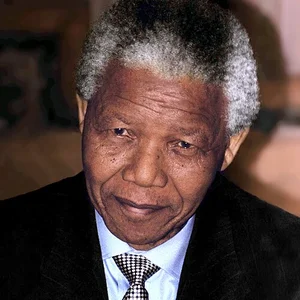

South African political leader (1918–2013), founding figure of the struggle against apartheid and first Black president of South Africa. Imprisoned for 27 years for his revolutionary activities, he became a symbol of reconciliation and democratic transition in his country.
Nelson Mandela(1918 — 2013)
Nelson Mandela
Afrique du Sud
9 min read
Frequently asked questions
Famous Quotes
« I am not truly free if I am taking away someone else's freedom»
« Education is the most powerful weapon which you can use to change the world»
« I am the master of my fate»
Key Facts
- 1944: Joined the ANC (African National Congress)
- 1962–1990: Imprisoned on Robben Island for 27 years and 5 months
- 1990: Released from prison and began negotiations to end apartheid
- 1994: Elected as South Africa's first Black president
- 1995: Truth and Reconciliation Commission established to address the wounds of the apartheid regime
Works & Achievements
Mandela's autobiography tracing his childhood, his struggle against apartheid, and his 27 years of imprisonment. Translated into dozens of languages, this book became one of the major political testimonies of the 20th century.
Mandela co-founded the armed wing of the ANC after the banning of peaceful demonstrations, a decisive turning point in the anti-apartheid struggle. The organisation carried out sabotage operations against the regime's infrastructure, initially without targeting civilian casualties.
Mandela was the first Black president of South Africa, elected in the country's first multiracial elections. His term was marked by the drafting of a new constitution, the creation of the Truth and Reconciliation Commission, and a policy of national reconciliation.
This document drawn up at the Congress of the People in Kliptown laid the foundations for a democratic, non-racial and non-sexist South Africa. It inspired the post-apartheid constitution of 1996.
After his presidency, Mandela established this foundation dedicated to promoting democracy, education, and the fight against HIV/AIDS in Africa. It carries forward his legacy and his commitment to social justice around the world.
This speech delivered before the court, in which Mandela declared he was prepared to die for his ideals, is considered one of the most powerful political texts of the 20th century. It was broadcast around the world and strengthened the international movement against apartheid.
Anecdotes
At the time of his arrest in 1962, Nelson Mandela was traveling disguised as a chauffeur under the name 'David Motsamayi'. The CIA allegedly passed information to the South African police that led to his capture, though this was never officially proven. He was sentenced to five years in prison before being retried in the Rivonia Trial.
During his 27 years of detention on Robben Island, Mandela tended a small garden in the prison courtyard. He wrote that this garden taught him patience: 'A garden was one of the few places in prison where one could exercise a measure of control over one's environment.' The tomatoes and vegetables he grew also allowed him to share food with his fellow prisoners.
On February 11, 1990, the day of his release, Mandela walked out of Victor Verster Prison holding his wife Winnie's hand, his left fist raised. Millions of people around the world watched the scene live on television. He was 71 years old and had not seen Johannesburg in nearly three decades.
In 1995, Mandela, now president, attended the Rugby World Cup final wearing the Springboks jersey — the South African national team long regarded as a symbol of the white minority. By handing the trophy to captain François Pienaar, an Afrikaner, in front of 63,000 spectators, he transformed a sporting gesture into a political act of national reconciliation.
In 1985, Nelson Mandela refused a conditional release offer proposed by President Botha, who required in exchange that he publicly renounce the armed struggle. His daughter Zindzi read his response before a massive crowd in Soweto: 'Your freedom and mine cannot be separated.' This refusal considerably strengthened his moral authority throughout the world.
Primary Sources
I have walked that long road to freedom. I have tried not to falter; I have made missteps along the way. But I have discovered the secret that after climbing a great hill, one only finds that there are many more hills to climb.
I have fought against white domination, and I have fought against black domination. I have cherished the ideal of a democratic and free society in which all persons live together in harmony and with equal opportunities. It is an ideal which I hope to live for and to see realised. But if needs be, it is an ideal for which I am prepared to die.
Our march to freedom is irreversible. We must not allow ourselves to be intimidated by the challenges that remain. I have cherished the dream of a free, democratic and non-racial South Africa. I still cherish that dream.
We have entered into a covenant with all the peoples of South Africa in the common interest of ensuring that our country takes its rightful place among the nations of the world. Never, never and never again shall this beautiful land experience the oppression of one by another.
There is something deeply satisfying about being able to hold firm and knowing that one is fighting for a just principle, that one is not compromising one's conscience.
Key Places
Prison island in Table Bay where Mandela was incarcerated for 18 of the 27 years of his detention. It became a museum and UNESCO World Heritage Site in 1999, and stands as a symbol of both the brutality of apartheid and the resistance of its victims.
Black township of Johannesburg where Mandela and his family lived and where he developed his political consciousness. Soweto was also the scene of the 1976 uprising, a major turning point in the struggle against apartheid.
Mandela's birth village where he spent his childhood and where he was buried on December 15, 2013, according to Xhosa traditions. This place represents his cultural roots and his attachment to the African land.
Seat of the South African government where Mandela was sworn in as South Africa's first Black president on May 10, 1994. This historic ceremony was attended by dozens of heads of state from around the world.
The last prison where Mandela was held, in the Cape region; it was through its gates that he walked free on February 11, 1990, before the cameras of the entire world. A statue today commemorates this historic moment.
The city where Mandela settled as a law student and co-founded with Oliver Tambo the first Black law firm in South Africa in 1952. This city was the centre of his political activism throughout the 1950s.
Typical Objects

Mandela carried this traditional Xhosa stick during official ceremonies, asserting his belonging to the Thembu royalty and African culture. This gesture symbolized the link between his political struggle and the cultural roots of the Black South African people.

Black prisoners on Robben Island were made to wear an orange uniform imposed by the prison administration, a symbol of their humiliation. This jumpsuit became a worldwide symbol of the injustice of apartheid and of Mandela's resistance.

From his release onward, Mandela adopted colorful shirts with African patterns, refusing the tie and the traditional Western suit worn by heads of state. These shirts became his trademark and a symbol of his African cultural pride.

The jersey worn by Mandela during the final of the 1995 Rugby World Cup became one of the most iconic objects in modern political history. By putting it on, he transformed a symbol of white domination into an emblem of the Rainbow Nation.

The prisoners of Robben Island secretly organized intellectual activities; Mandela annotated literary and philosophical texts passed around clandestinely. These contraband books represented the resistance of the mind against imprisonment.

On Robben Island, Mandela secretly wrote the first drafts of his autobiography in notebooks hidden in the garden. These manuscripts, partially discovered and confiscated by the guards in 1977, were nonetheless preserved and published decades later.
School Curriculum
Vocabulary & Tags
Key Vocabulary
Tags
Daily Life
Morning
At Robben Island, Mandela woke up at 5:30 a.m. to the sound of a bugle, attended roll call in the courtyard, and then worked in the limestone quarry under the blinding sun. Despite the harshness of the forced labor, he organized political and intellectual discussions every morning with his fellow prisoners, turning the prison into the 'University of Robben Island'.
Afternoon
Afternoons in prison were devoted to physical labor, correspondence strictly censored by the guards (one letter every six months), and the secret study of law and politics. After his release and during his presidency, his afternoons were filled with diplomatic meetings, political negotiations, and meetings with foreign delegations.
Evening
In prison, evenings in the 2 m² cell allowed Mandela to read, write clandestinely, and reflect. After his release, he enjoyed receiving his family, listening to traditional Xhosa music and Western opera, two musical genres he was particularly fond of.
Food
In prison, Mandela and the Black prisoners received smaller rations than those given to Coloured or White prisoners: maize porridge, boiled vegetables, and very rarely meat. After his release, he enjoyed traditional Xhosa cuisine (umngqusho, a maize and bean stew) as well as South African fruits.
Clothing
During his imprisonment, Mandela wore the standard orange overalls issued to Black prisoners, lighter and less warm than those given to White prisoners. After his release, he deliberately adopted colorful African-patterned batik shirts, openly rejecting Western suits and ties to assert his cultural identity.
Housing
Mandela spent 18 years in a 2.4 m × 2.1 m cell at Robben Island, with no toilet or running water, sleeping on a mat on the bare floor. He was later transferred to better conditions at Pollsmoor Prison and then Victor Verster, where he was given a private house within the prison grounds during secret negotiations with the government.
Historical Timeline
Period Vocabulary
Visual Style
Esthétique documentaire en noir et blanc pour les années de lutte, évoluant vers des teintes chaleureuses africaines pour symboliser la libération et la réconciliation.
Sound Ambience
Ambiance sonore mêlant chants de liberté des townships sud-africains, sons marins de Robben Island et tension sourde de la vie sous l'apartheid.
Liens externes & ressources
Références
Œuvres
Un long chemin vers la liberté (Long Walk to Freedom)
1994
Fondation de Umkhonto we Sizwe (MK)
1961
Présidence de l'Afrique du Sud
1994-1999
Charte de la liberté (contribution à la rédaction)
1955
Fondation Nelson Mandela
1999
Discours du procès de Rivonia
1964