Imaginary dialogue between Al-Ma'mun (calife abbasside) and Al-Khwârizmî
by Charactorium · Al-Khwârizmî (780 — 850) · Sciences · 5 min read
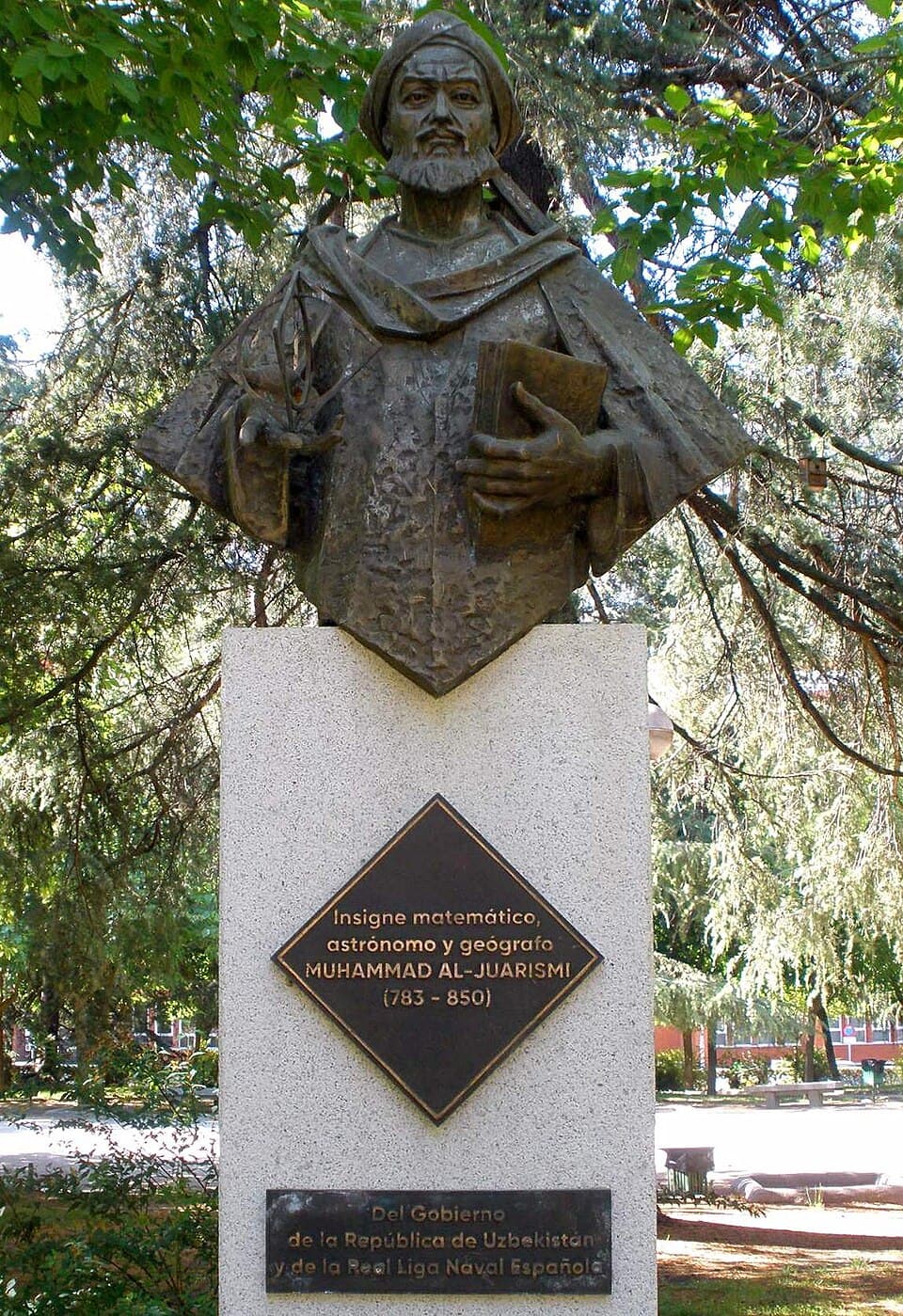
It is in the shaded courtyard of the House of Wisdom, in Baghdad, around 830, that Caliph Al-Ma'mun comes to sit beside his mathematician. The brass astrolabe still rests on the low table, next to the sheets of an unfinished world map that the scholar is tracing for his sovereign. They have known each other for years—the caliph founded this house, the scholar filled it with numbers from India. Today, setting aside protocol, Al-Ma'mun wants to hear the man behind the treatises.
—My friend, when I entrusted you with writing your treatise on calculation, you spoke of restoration. What did you mean by that?
You recall, O Commander, that I sought a method to solve any problem of inheritance division or land surveying brought before your judges. In my Kitab al-Jabr wa-al-Muqabala, I named al-jabr—restoration—the act of restoring balance to an equation by moving a subtracted term to the other side. And al-muqabala, confrontation, reduces like terms face to face. With these two operations, I reduce every first- or second-degree equation to six canonical forms that anyone can solve, even without knowing Greek geometry. It is not a book of scholars for scholars: it is a tool for your officials, your merchants, your surveyors.
It is not a book of scholars for scholars: it is a tool for your officials, your merchants.
—I am told you advocate for these Indian numerals, those written with an empty circle. Is that not strange for my scribes?
A strangeness worth an empire, prince. In my treatise on Indian calculation, I presented this system of nine signs plus a tenth, that small circle marking absence, which the Indians call the void. On my tablet, I place numbers according to their rank—units, tens, hundreds—and each digit is valued by its place. Where the abacus requires tokens and mental calculation an elephant's memory, my method lets a child add a thousand and multiply ten thousand on a simple dust board. Your tax collectors will save entire days. Believe me: this empty circle will weigh heavier in history than many conquests.
This empty circle will weigh heavier in history than many conquests.
—You sign your works 'the one from Khwarezm,' after your distant land. Why cling to that origin here, in my capital?
Because a man is also the place that shaped him, my caliph. Khwarezm, that region of Central Asia where water and desert contend, taught me the patience of calculation and a taste for roads. My name says where I come from, and it follows me in every treatise I deposit in your library. I wanted my calculation methods to be so simple that they could be followed step by step, like a traveler following milestones on a track: an orderly procedure, requiring no special genius, only rigor. Should my name one day serve to designate these orderly steps of calculation, I would not mind—but that, only the centuries will tell.
A man is also the place that shaped him.
—Remember the day I founded this house. Describe your days here—what do you do from dawn to dusk?
I rise before day for the fajr prayer, O Ma'mun, then a little bread and some dates, and I hurry to the house you built. In the morning, I work on my calculations in silence, before the disciples flock in. In the afternoon, I teach: I discuss geometry with the sons of Ibn Mūsā, I verify a table with an astronomer, I compare a Greek text that a translator has just rendered into Arabic. Here, the knowledge of India, Persia, Byzantium cross paths—nowhere else in the world can a man draw from so many sources. After maghrib, I go home, share the meal, and if the sky is clear, I observe the stars. This house, prince, is the finest gift a sovereign has ever given to knowledge.
Nowhere else in the world can a man draw from so many sources.
—This world map you are drawing for me, and these star tables—what do they bring to a caliph who rules such vast lands?
They give you the eye of God over your empire, Commander of the Faithful—or at least what a man can approach. In my Description of the Earth, I recorded for each city, each sea, each mountain its longitude and latitude, correcting the ancient measurements of the Greeks where my calculations disproved them. With this astrolabe, I measure the height of the stars, and my sine tables allow predicting their course to set prayer times and direction toward the Kaaba. Geography and astronomy are not separate sciences: they are two faces of the same number. When you read this map, you will see the extent of what you govern—and the immensity of what remains to be known.
Geography and astronomy are not separate sciences: they are two faces of the same number.
—The ancients already solved measurement problems. How is your method truly different from theirs?
The Babylonians and Greeks solved cases, my prince—this one, then that one, each by a particular trick. I seek the general rule. I classified all equations into six species, and for each I state a procedure that one applies blindly, surely, without having to reinvent the solution. And so that no suspicious mind doubts, I prove each rule with a geometric figure: I complete a square, literally, on paper. That is my novelty: not a solution, but an autonomous science of solving, which stands without the aid of figures for those who know how to follow its steps. Algebra no longer imitates geometry—it now walks on its own legs.
Not a solution, but an autonomous science of solving.
—Do you fear that these Indian numerals will be lost, like so much knowledge before them, once our generations are gone?
Written and useful knowledge does not get lost, Ma'mun—it travels. Already my treatises reach Andalusia along the routes of merchants and pilgrims, and from there, who knows, they may cross the Pyrenees into the lands of the Franks, where they still count with those heavy Roman numerals. The day a merchant from Cordoba or Toledo sees that he calculates three times faster with ten signs than with Latin sticks, he will never go back. Convenience is the surest missionary. What your house gathers today, other peoples will collect tomorrow, without even knowing whom they owe it to. And that matters little to me: what matters is that the number survives.
Convenience is the surest missionary.
—Between us, my friend—algebra, the stars, geography: how does one man embrace so many fields at once?
Because they are one, prince, for those who know how to see. Behind the geometer's equation, the position of the star, and the coordinate of the city, there is always the same foundation: a ratio of quantities, a measurement, a calculation to conduct with order. I do not jump from algebra to astronomy as one changes mounts; I follow a single path that traverses these different gardens. And besides, you who are well placed to know, it is your house that makes it possible: here, I do not have to chase books or pay translators out of my own purse. You gave me time—the only good a scholar cannot buy. The rest is only patience and a dipped pen.
You gave me time—the only good a scholar cannot buy.
—If your treatises survive you, as I hope, what would you want them to teach those who never knew you?
That one can make simple what seemed reserved for the initiated, O Commander. I invented nothing that the gods had hidden: I gathered what India, Persia, and Greece had sown, I put it in order, and I wrote the method in clear words so that the merchant, the surveyor, and the judge could grasp it. Let my future readers remember this: a well-ordered procedure, stated step by step, is worth more than a hundred flashes of genius that cannot be passed on. Give a man a rule he can follow, and you have made him capable forever. If I am remembered, let it be for that—not for my person, but for the orderly march of calculation I leave behind.
A well-ordered procedure is worth more than a hundred flashes of genius that cannot be passed on.
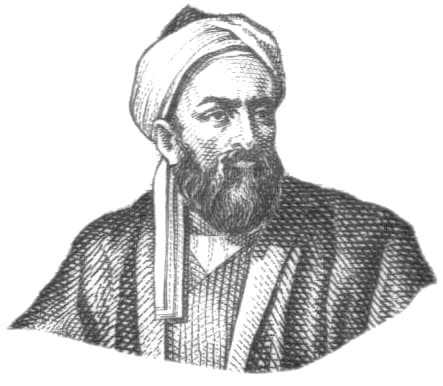
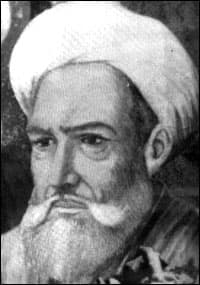
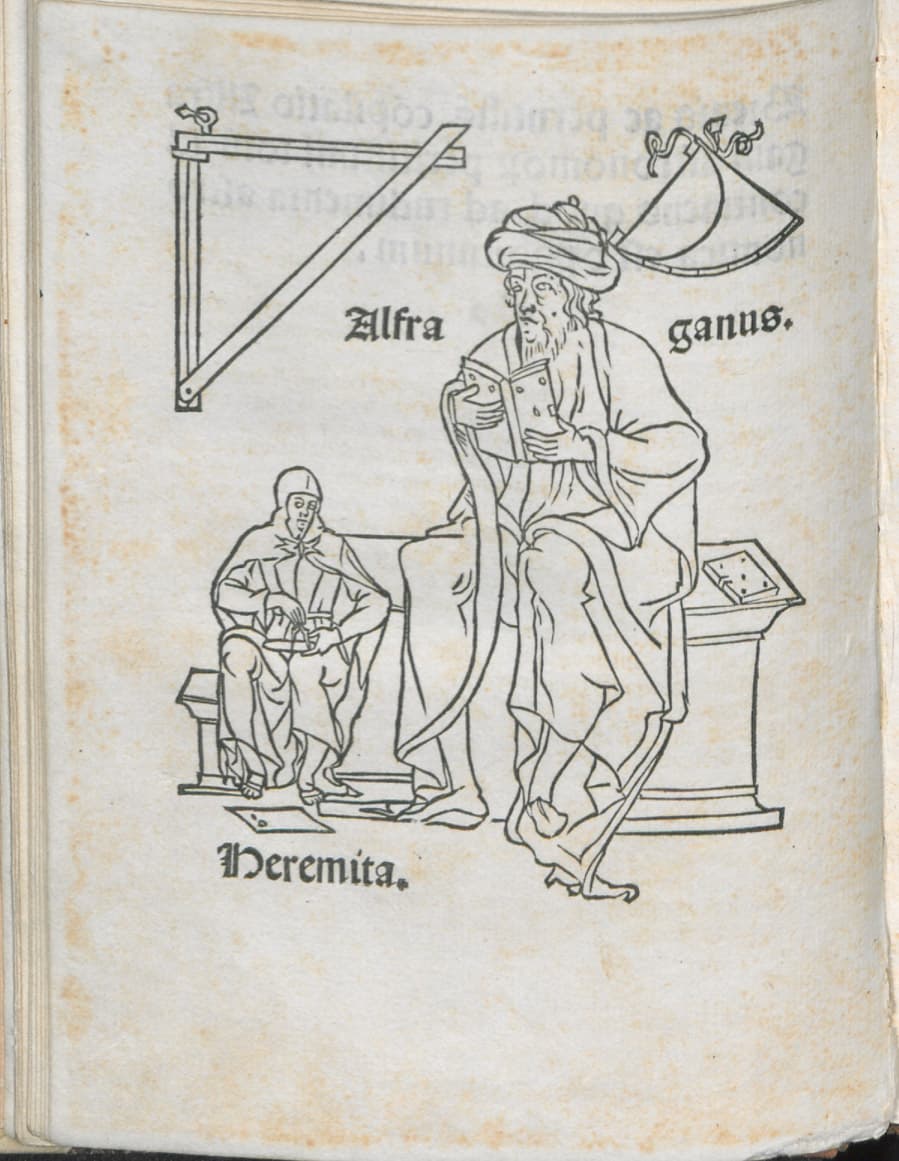
This imaginary interview was generated by artificial intelligence from sources documented in Al-Khwârizmî's profile. It dramatises what the figure might have said based on what we know about them, but does not constitute attested historical testimony. For primary sources and factual documentation, refer to the full profile.