Imaginary dialogue between Jean-Paul Sartre and Albert Camus
by Charactorium · Albert Camus (1913 — 1960) · Literature · Philosophy · 6 min read
It is in a smoky café in Saint-Germain-des-Prés, an autumn evening in 1951, that Jean-Paul Sartre meets Albert Camus over two half-empty glasses. The Rebel has just been published, and the rift between the two men, whom the post-war years had made inseparable, is already apparent. The yellow lamplight falls on the notebook Camus places next to his pack of cigarettes. Sartre, sharp-eyed, has not come to flatter — he has come to understand, and perhaps to spar.
—Albert, before we quarrel over revolt, go back to the source. In 1942, you published The Stranger and The Myth of Sisyphus the same year. What exactly do you call the absurd?
You who love sharp definitions, Jean-Paul, will be disappointed. The absurd is not in man, nor in the world, but in their confrontation. I have a visceral need for meaning, and the universe answers me with silence. From this divorce is born the absurd. Meursault, in The Stranger, does not lie, and that is why society condemns him: he refuses to play the comedy of conventional feelings. But be careful, the observation of the absurd is not an end. It is a starting point. They think I am despairing; I am the most stubborn man you know. Sisyphus pushes his rock, sees it roll back down, and begins again. In this lucid repetition, there is a joy that defies the gods.
The absurd is not in man nor in the world, but in their confrontation.
—You write that we must imagine Sisyphus happy. Happy? Admit that this last sentence is somewhat provocative for anyone who takes the human condition seriously.
Provocative, perhaps, but it is the sentence that sums up my whole heart, and I did not write it in vain. You see, Sisyphus's misfortune does not lie in his burden, but in the hope one would lend him. Remove the hope of finishing, and his rock becomes his affair, his own thing. His consciousness of his fate is precisely his victory. The contempt of the gods, the love of the earth, the refusal to resign: that is what I put into that happiness. It is not the blissful smile of the believer. It is the dark and upright joy of one who looks his destiny in the face without lowering his eyes. You see, I console no one — I give back the weight of the rock to the one who carries it.
Sisyphus's misfortune does not lie in his burden, but in the hope one would lend him.
—They think you are entirely in ideas. But you, who spoke so little of your childhood, tell me: this father you never knew, killed at the Marne in 1914, what weight does he have in you?
You touch where I never go, Jean-Paul, and that is why I answer you. My father died in the war when I was one year old. I never knew him: he is for me only a name on a monument and a story my mother, almost mute, did not know how to tell. We were poor, in Mondovi then Algiers, so poor that the word itself was useless to us. This absence made me more than all the books. I carry within me a man I must invent, for lack of memory. One day, I will write this — the story of a son who goes in search of a father younger than himself. The first man, in short, the one who inherits nothing and must found everything alone.
I carry within me a man I must invent, for lack of memory.
—During the Occupation, you held the pen at Combat when others kept silent. And then came The Plague in 1947. That epidemic in Oran is the Occupation, isn't it?
You read correctly, as often. The Plague has several meanings, but yes, I wanted the European resistance to Nazism to recognize itself in it. The scourge that falls on the city is the occupying armies, the stupidity that contaminates, the cowardice that sets in. At Combat, we wrote at night, under false names, with fear in our bellies — I learned there that courage is less a virtue than a habit one acquires. Doctor Rieux does not believe he will defeat the plague; he fights it because it would be indecent not to. That is my morality, without grand words: refuse to compromise with what kills men, even when you know you will not cure everything.
Courage is less a virtue than a habit one acquires.
—You, the son of the poor of Algiers, how did you experience this transition from solitary writer to committed journalist, in the midst of clandestinity?
I never believed in the writer taking refuge in his ivory tower, you know that better than anyone, Jean-Paul — we agreed on that, at least. Poverty had taught me very early that ideas are only valuable if they stand up in the street. At Combat, I did not sign for glory; I signed because a free newspaper, under the Occupation, was worth a weapon. But I already mistrusted commitment that believes everything is permitted. Serving truth and serving freedom are sometimes the same thing, and sometimes not. I wanted a journalism that informs before judging, that does not insult the adversary before understanding him. I was reproached for this restraint. I consider it a form of honesty, not lukewarmness.
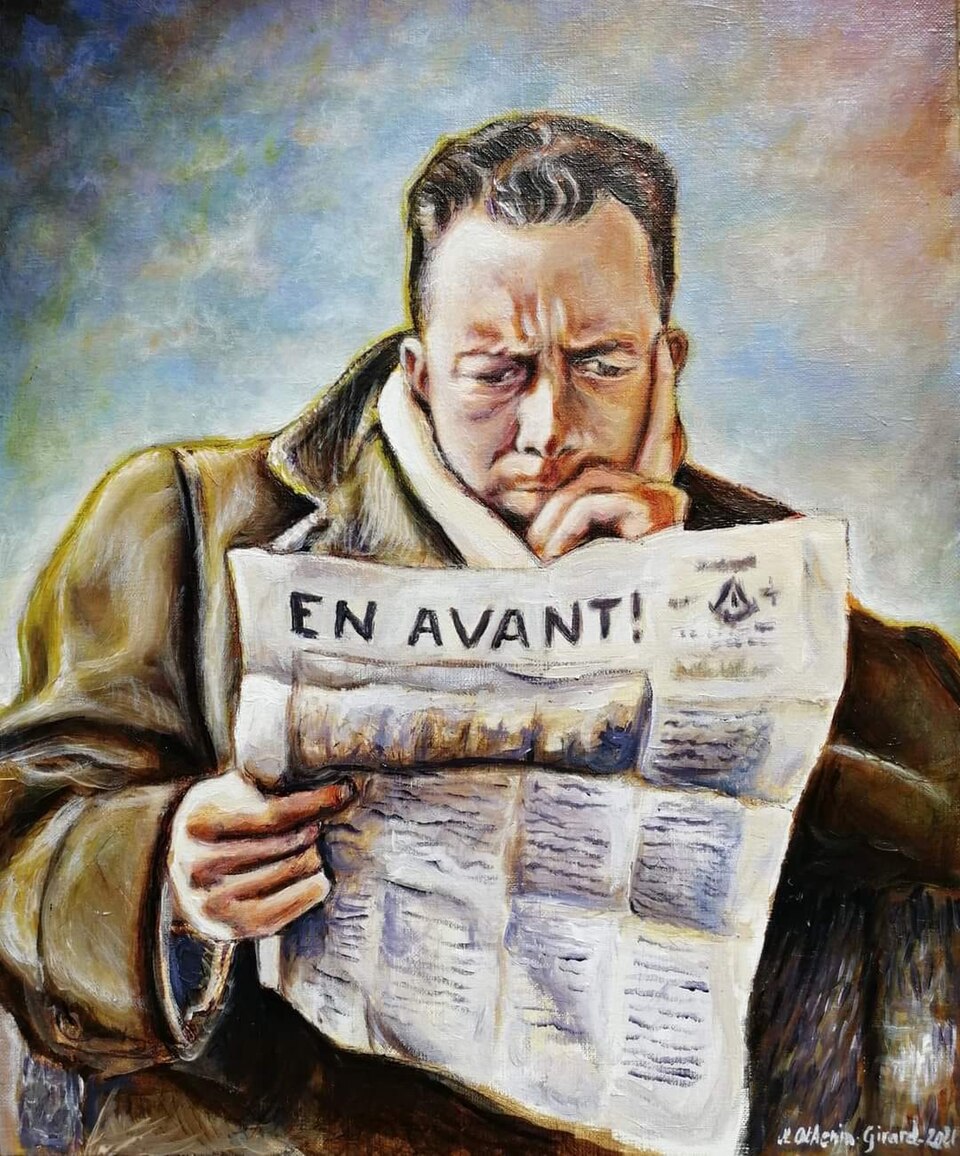
A free newspaper, under the Occupation, was worth a weapon.
—Let us come to what separates us, since you expect it. In The Rebel, you refuse that the end justifies the means. You know that this sets us apart. Why this limit at all costs?
Because I have seen where revolt that frees itself from all measure leads: to camps, to the gallows, to murder erected into logic. Authentic revolt says no to the oppressor, but it also says no to murder — otherwise it betrays what gave it birth. I know, Jean-Paul, that you find me timid, that for you History absolves necessary violence. But I cannot sign that contract. The rebel man sets a limit he refuses to cross, even in the name of the radiant future. The revolutionary who kills his brother while promising the happiness of future generations, I do not follow him. I prefer to be wrong with the living than right with the executioners. Our disagreement, I fear, will not be settled tonight.
I prefer to be wrong with the living than right with the executioners.
—Commitment, precisely: the word comes up constantly between us. You reproach me for my silences on certain crimes, I reproach you for your refusal to choose a side. Where do you draw the line?
I draw the line where one begins to lie to men for their own good. Commit myself, yes, I have always done so, but never to the point of closing my eyes to what my own camp commits. You tell me that one cannot judge a cause before the tribunal of bourgeois morality. And I answer you that a cause that demands silence about its own crimes has already lost its innocence. I do not want to be the useful idiot of a History that crushes those it claims to liberate. They will call me a tender soul, a moralist. So be it. But I will never write that a deported man deserved it in the name of the meaning of History. Between justice and my mother, I have said, I would choose my mother — and that is not a weakness, it is my compass.
A cause that demands silence about its own crimes has already lost its innocence.
—You speak of your mother, and therefore of Algeria. You who were born there, who love Tipasa and the light of Algiers, how do you bear this country torn between its peoples?
That is the wound from which I heal the least. Tipasa, its Roman ruins among the wormwood, the sea bursting in the sun — that is where I learned the happiness of the senses before learning books. This land, I love it with a carnal love that Paris will never understand. But I see two peoples who love each other poorly and tear each other apart, and I am of both. My family is poor, French, attached to this soil; and I know the injustice done to the Arabs, I wrote it when no one wanted to read it. They want me to decide, to choose a side with a flag. I cannot applaud bombs that might kill my mother in a tram in Algiers. I seek a justice that does not require us to kill each other. They call me naive. I prefer that to being complicit.
This land, I love it with a carnal love that Paris will never understand.
—Colonialism, you speak of it with a caution that annoys many of us. Are you not afraid that this in-between position will leave you alone, without any side?
Alone, I will be, and I know it already. But solitude is better than comfortable lies. The colonial system is unjust, I denounced it from my reports on the misery of Kabylia, when that was not done. Only I refuse to replace one injustice with another, and to believe that blood washes away blood. They press me to choose between the settlers and terrorism: that is asking me to choose between two misfortunes. I hold out for an Algeria where communities would live together, and they laugh in my face. Perhaps History will prove me wrong. But the writer is not there to serve those who make History; he is there for those who suffer it. If defending those lives condemns me to silence from both sides, I will bear that silence.
The writer is not there to serve those who make History; he is there for those who suffer it.
—One last question, Albert. After so much absurdity, plague, and revolt, what still keeps you standing, you, the man of the South lost in our Parisian winters?
What keeps me standing, Jean-Paul, is precisely what your reasoning does not grasp: a morning of sun on the sea, the laughter of a friend, the taste of a fruit. I built an entire philosophy on the absurd, and yet I remain a man who loves this fleeting life immoderately. In the midst of winter, I discovered within me an invincible summer — that is my only certainty. I do not believe one can save man, but I believe one can save in him his dignity, and that is already immense. Our quarrels will pass, regimes will pass. There will remain, I hope, a few pages that will have helped a stranger to stand through a difficult night. That is all I ask of my craft. The rest, you see, is too intimate to debate in a café.
In the midst of winter, I discovered within me an invincible summer.
This imaginary interview was generated by artificial intelligence from sources documented in Albert Camus's profile. It dramatises what the figure might have said based on what we know about them, but does not constitute attested historical testimony. For primary sources and factual documentation, refer to the full profile.